
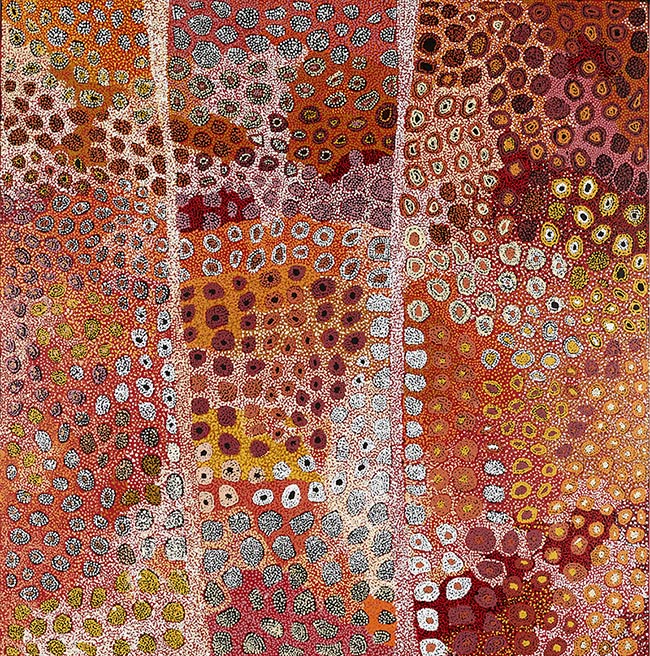
For the Aborigines, the word “art” does not exist: it is inseparable from the land, language, traditions, myths and rites. Through more than a hundred works from the collection of Alison and Peter W. Klein, built up during their regular trips to Australia, to local galleries and art centers, the exhibition “Aboriginal Art, Dreamtime” invites you to discover and contemplate these representations which preserve and tell the story of Aboriginal dreams, mythological episodes linked to the territory, rooted in a 65,000-year-old culture. We decipher these mystical maps through symbols – paths, water points, wind corridors, itineraries of ancestral beings – which narrate founding myths, such as that of the Seven Sisters, pursued across the sky and the desert, and becoming a constellation. This contemporary Aboriginal painting on canvas emerged in 1971, when a young Australian schoolteacher, Geoffrey Bardon, appointed to the Papunya school, observed children tracing patterns on the sand, evoking those in Australian caves dating back more than 30,000 years. He then encourages the community to paint these ritual motifs, and provides them with canvases and acrylic paint. Painting becomes for indigenous peoples not only an identity card of the territory, but also, in turn, a political weapon to claim their rights. Divided into three sections, the beautiful tour of the Lodève Museum, which presents some of the greatest Aboriginal artists, provides the keys to understanding this art which is above all a story. On each cartel, a map locates the place of creation, reminding us that styles vary profoundly from one region to another, from the cross-hatching of Arnhem Land to the vibrant dots of the central desert. An exhibition all the more poignant as it resonates with the museum’s permanent collection, also anchored in the territory, reminding us that all art is born from the soil from which it was born.

Similar Posts
the world seen from Taiwan
Taipei (Taiwan). Bringing together around sixty artists from around twenty countries, the 13th Taipei Biennale was designed by three young…

Le Corbusier and the order of things
Berna, The first exhibition that the Zentrum Paul Klee de Bern opens in the year of its twentieth anniversary is…

Opening Madrid Gallery Weekend 2026: painting and vindication
This morning, after its presentation at the Reina Sofía Museum, the seventeenth edition of Apertura Madrid Gallery Weekend began,…

Dis Berlin, an enigma in vivid colors
Madrid, Just over a year after presenting his recent works in “Labyrinth of Solitudes” at the Sala Parés in Barcelona,…

Imogen Cunningham, the time to see a flower
Malaga, Born in Portland in 1883, Imogen Cunningham was, even in life, considered a pioneering figure in photography for her…

Another trip by Alberto Carrera Blecua
Huesca, Soon he will forty years of the presentation, both in the exhibition hall of the Diputación de Huesca and…