Madrid,
I can take from other artists whatever I want and whatever I need; I have no problem admitting that the Queen of Trick is as important as a neon tube. I steal everything I can from the history of art.
Forty-one years after Juan Muñoz’s first solo exhibition, which took place in 1984 at the Fernando Vijande Gallery, the Prado Museum opens its doors to him who was one of the greatest innovators of figurative sculpture in Spain, the architect of a highly original creative universe who, from a young age, made this house almost his second studio, a laboratory where he could find multiple sources of inspiration, especially in the rooms corresponding to Velázquez and Goya.
Alfonso Palacio, the deputy director of Conservation and Research at the Prado, recalled today that the Renaissance, Mannerism and Baroque are usually highlighted as the periods that most interested Muñoz, but that he really drank from the entire history of art, as he himself made clear in statements such as those that begin this article. The Madrid creator was opposed to all forms of puritanism and exclusivity in the artistic field.
Vicente Todolí curated this exhibition, precisely titled “Juan Muñoz. Art Stories”, which can be seen both in rooms C and D of temporary exhibitions and in various spaces of the Prado’s permanent collection, in order to test Muñoz on two levels: in the most intimate one in which his pieces are the only protagonists and in the expanded field in which he established relations with Borromini, Bernini and the aforementioned Velázquez and Goya.
His figures, never life-size and always self-absorbed, generate their own spaces and also mysteries that are quite unfathomable. Sometimes, they are similar to ventriloquism dolls and the spectator will have to give them a voice.
Todolí has stressed today the importance of Santiago Amón as Muñoz’s private art history teacher, by family decision, and the strong vocation of this author, who put aside his early architecture studies to train in the plastic arts in the United Kingdom and the United States. Upon his return to Spain he began to work as a curator, along with Carmen Jiménez and Cristina Iglesias, but early on, in the early eighties, he already established himself as an artist and was equally soon starring in exhibitions in international museums.
Also important was his residence for a year in Italy, in 1993: he studied the sculpture of Bernini and the architecture of Borromini, whom he came to compare with Jannis Kounellis, for his treatment of light. But he also drew on literature – especially existentialist literature -, cinema and theater and when he did not receive permission to use certain texts (Harold Pinter refused to lend his), he resorted to collages of quotes without authorship.
Given that his pieces appropriate spaces and respond to them, in both a physical and metaphorical sense, the interactions of Muñoz’s work with those of the Prado will offer unprecedented fruits in the rest of his exhibitions, while – this time, as always – the viewer is questioned and becomes a witness, participant and, sometimes, an observed figure.
If he was interested in illusionism in painting, which he wanted to preserve in his sculptures; In the Renaissance he looked at the artists’ concern for the relationships between work and spectator and, in Mannerism and the Baroque, in distorted forms, theatricality and the tension between the object and the viewer. He expressed his belief that the same thing is expected from contemporary authors as from the Baroque ones: the creation of fictional places (scenarios) that make the world bigger than it is.
Thus, the optical floors of its installations evoke those of Borromini, but also the minimalist structures of Carl Andre, and pieces such as The Prompter and The nature of visual illusion They necessarily refer to those baroque spaces in which we will be both witnesses and actors. Its balconies, along this path, in addition to leading us to Goya or Manet, are the perfect resource to look at while being looked at, while the conversation pieces which he carried out in the nineties, by rejecting the viewer’s entry into the ties between the figures, forced him to become aware of his presence in the same space.

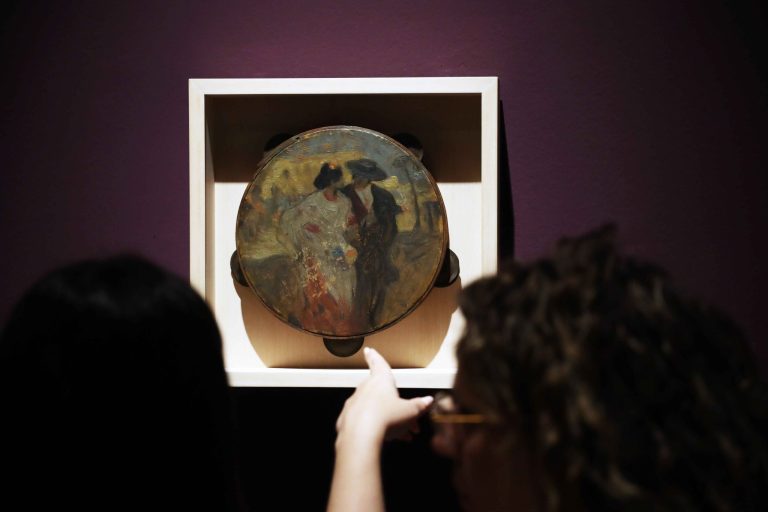
The exhibition opens with drums that suggest the sounds that are imagined because they cannot be heard, and with a ventriloquist who observes, while being observed by us, a composition formed by an everyday environment divided in two, with impossible views.
In the aforementioned The prompter We will contemplate the prompter, not the actor, in a certain Beckettian absurdity; In the artist’s words, It is a bit like the theater of Giulio Romano or Giordano Bruno, like a stage without a performance, without a play, just a man trying to remember.
It is especially enigmatic Staring at the sea I: two figures standing on tiptoe to reflect in a mirror, but with their faces covered. They seem to want to discover their identity, but at the same time they hide it. And near them, two groups of rag dolls look at us – and are seen by us – from their respective balconies, in one of their creations most closely linked to baroque architecture.
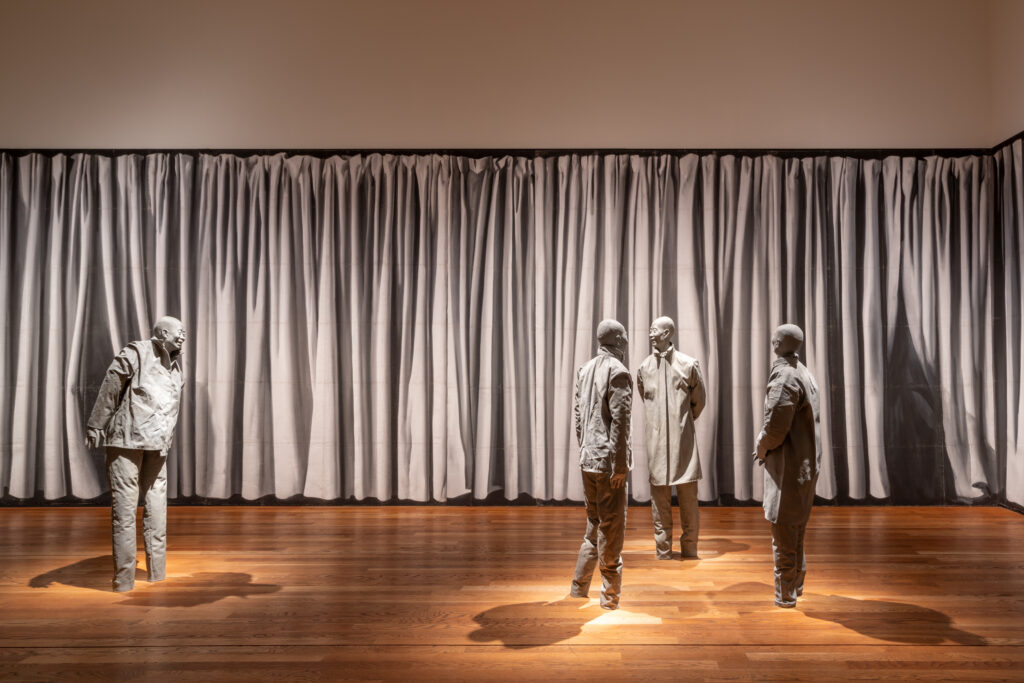
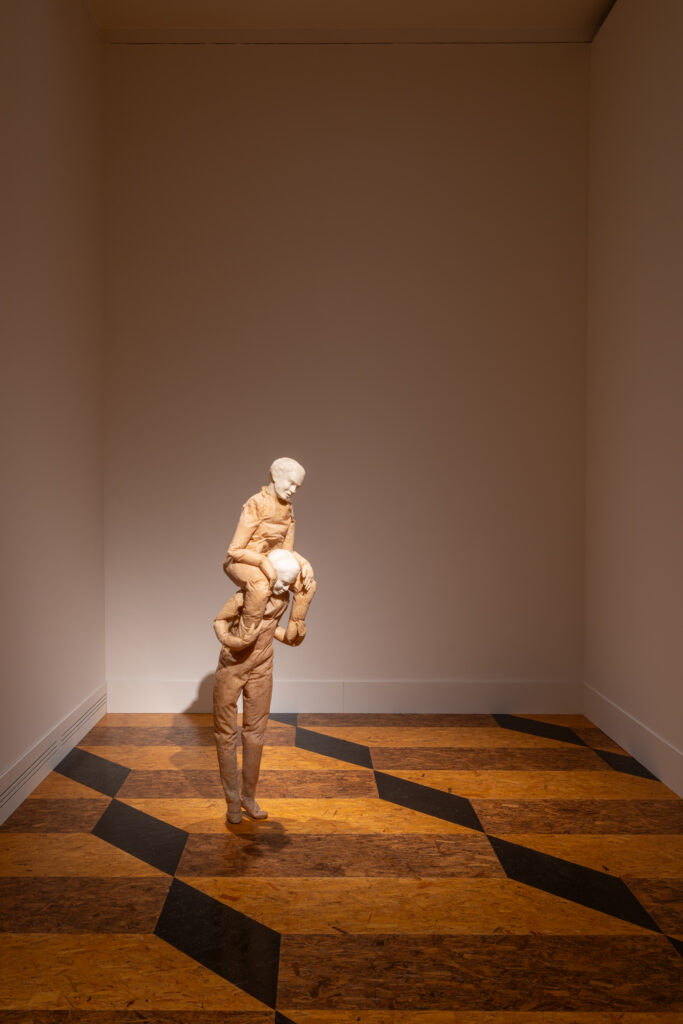
Between equally baroque curtains, the Asian men of The nature of visual illusion They become spectators of our steps, and we will contemplate the superimposed figures of Die Winterreisewith sources in Goya’s engravings and in one of Bernini’s most perfect sculptures in the Galleria Borghese: Aeneas, Anchises and Ascanius. That same subject was painted by Luca Giordano, in a work that can be seen in the Prado and, to complete references, the title of the piece comes from Shubert; It oscillates between stillness and movement.
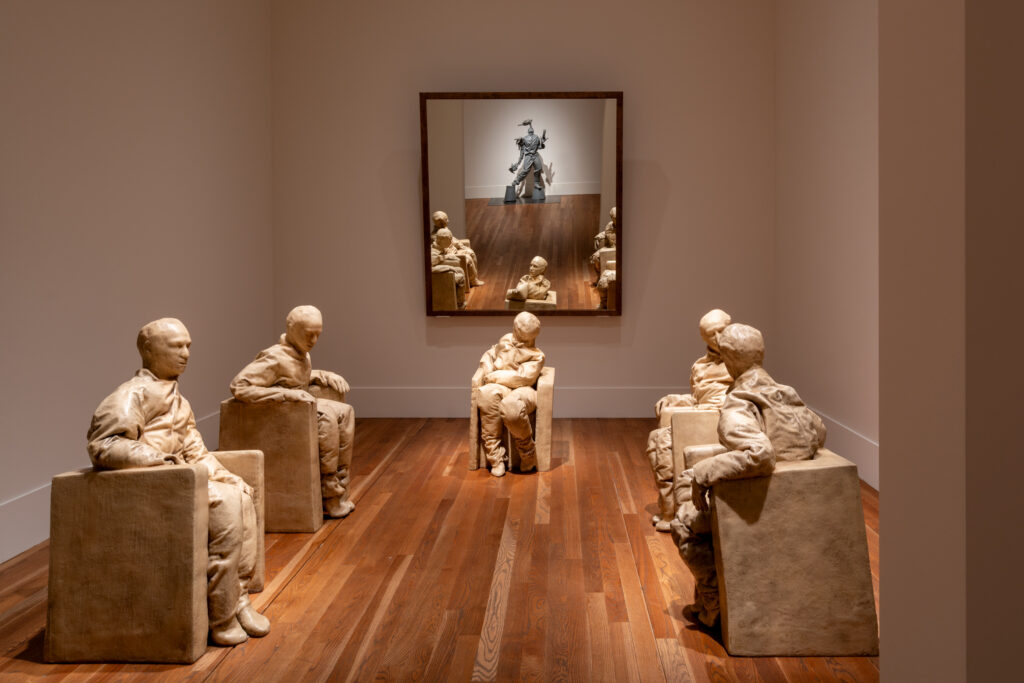
They complete the assembly of room C, one of its conversation piecessome of his dwarfs, figures with broken noses, which refer both to the circus and to Egyptian art, and five seated figures that clearly evoke the construction of Las Meninas when reflected in a large mirror, like the viewer, once again the observed object. The verbatim words of Juan Muñoz will help the public understand the meaning of each of these proposals.
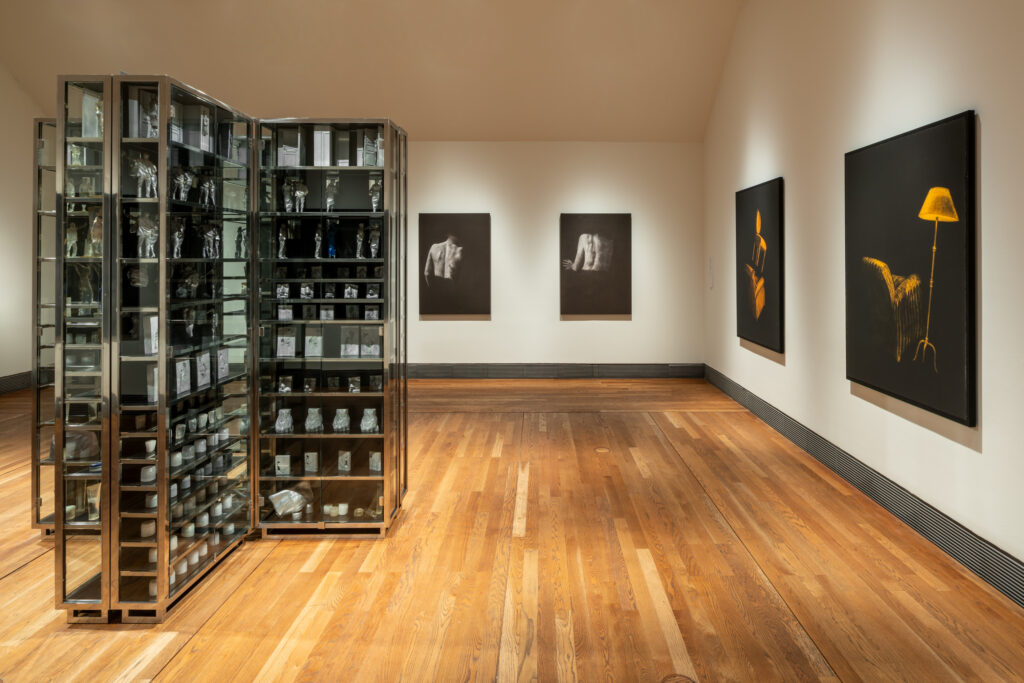
Room D, for its part, has been reserved for one of the least known facets of this author’s production: his drawings, those dedicated to interior furniture, but in out-of-place arrangements and executed on gabardine board; and those focused on male backs, inspired by Ingres. Despite the absence of faces, they are individualized.
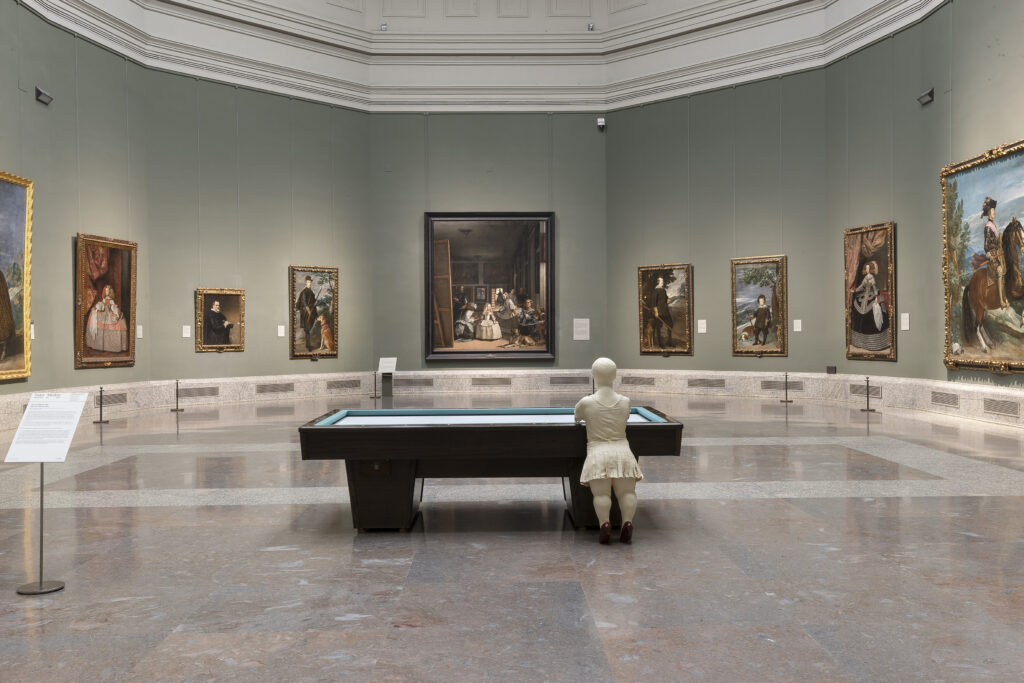
The rest of Muñoz’s works await us in other interior rooms and outside the museum. In front of Velazquez’s greatest work and allowing herself to be watched by Mari Bárbola, the dwarf Sara looks out at a pool table where there is no game, but images of herself. For the sculptor, Las Meninas It asks all of us where we are looking and that act, that of looking, involves distorting what we see; In reality, we cannot fully contemplate anything outside of ourselves.
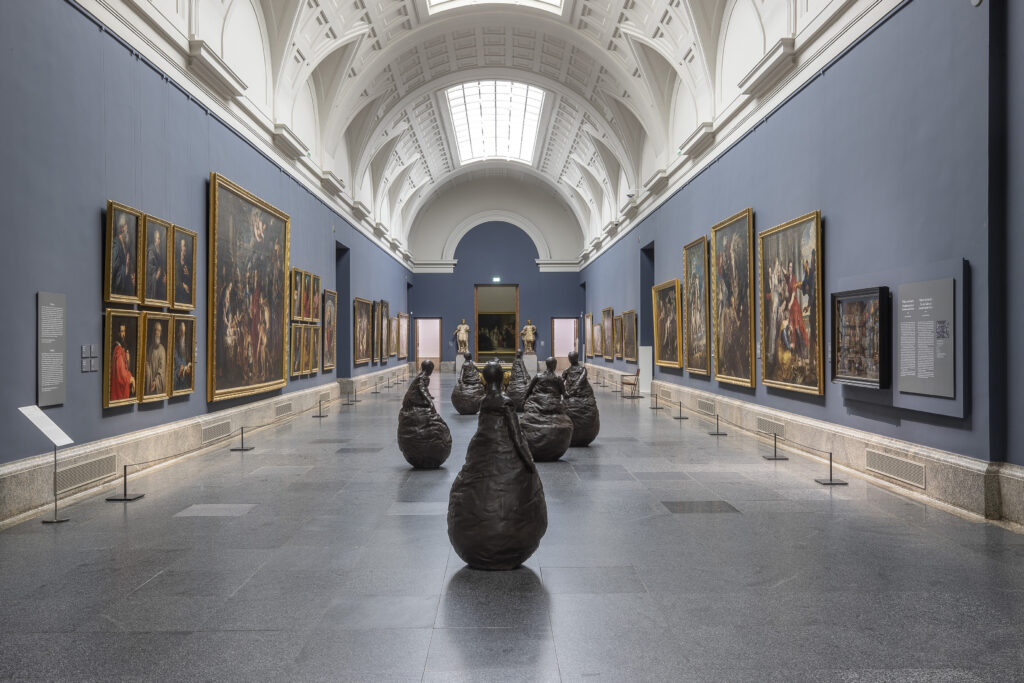
A new story awaits us in the central gallery of the Prado. conversation piecewhich is linked to The garden of love by Rubens. This time his bronze figurines have no legs, so it will be the movement of the spectators that gives them life. Their faces are repeated, but it is their gestures that individualize them, surrounded by paintings that also contain groups of characters in relationship. We could also associate them with the bagged by Goya.
Finally, on the Murillo staircase we will see Après Degas (yellow)based on a figure by the French painter, and one of his hanging sculptures, which refer to the hanged men of the Goyesque engravings, but also to the baroque management of spaces seen from below.
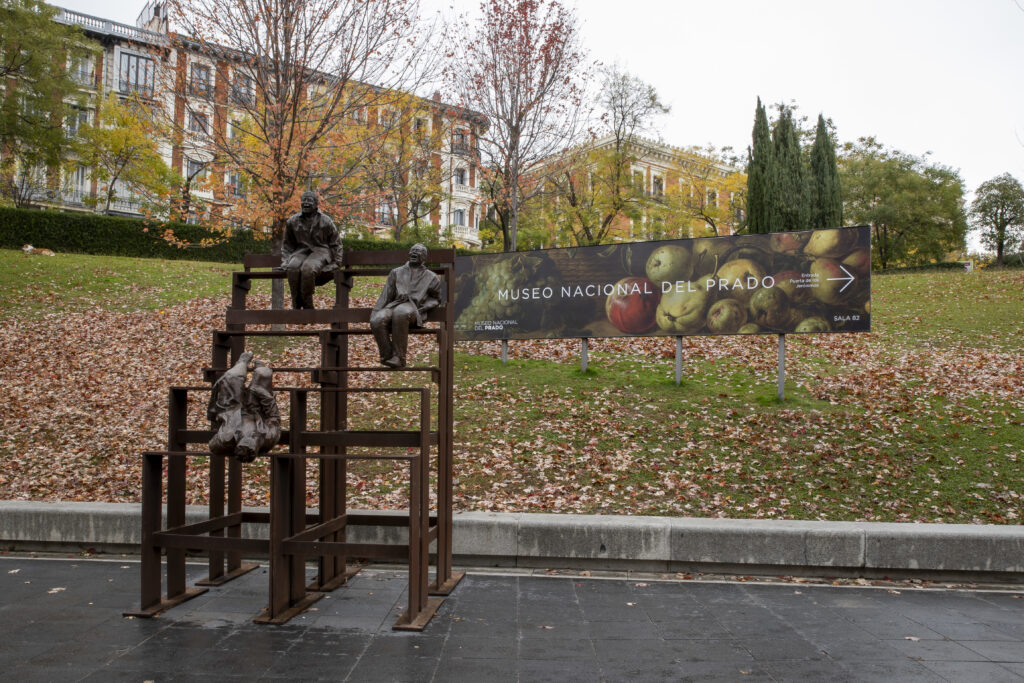
And on the Goya esplanade, at the entrance to the museum, its thirteen laughing at each othersculptural groups in which a figure, apparently pushed, always falls, but its gesture does not seem to distance itself much from the laughter of the rest, recalling the fine line that separates the expression of fun and that of pain. The image is the image and its investment.
Juan Muñoz. “Art stories”
NATIONAL PRADO MUSEUM
Paseo del Prado, s/n
Madrid
From November 17, 2025 to March 8, 2026