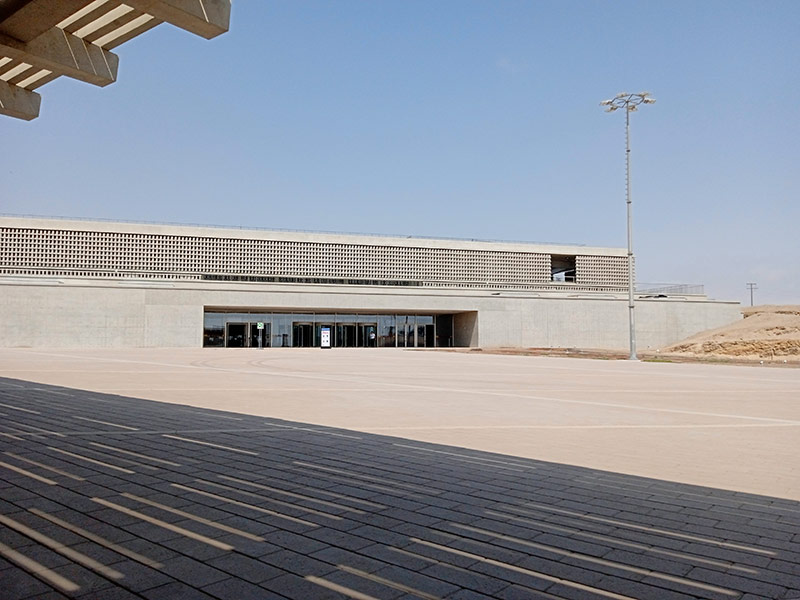
Closed since December 2024, three years after its official inauguration, the National Museum of Peru (MUNA) no longer provides any museum function. The institution supposed to recount the country’s pre-Columbian memory is now out of service due to technical failures.
Inaugurated on July 24, 2021 by President Francisco Sagasti, the museum was to symbolize the heritage modernization of Peru. Its closure is not a result of unfinished finishes, but a series of design flaws and structural malfunctions that affect its conservation mission. The construction, however, mobilized 500 million soles (125 million euros).
The main problem lies in the environmental instability of the building. The humidity and temperature control system, crucial in an area with high salinity such as the region, proves to be faulty. Without reliable air conditioning, the conservation of sensitive organic objects (Paracas textiles, mummified remains) would expose the collections to irreversible alteration. Reports also indicate that the roof does not properly filter rainwater and that there is no pumping device to control the water table under the building. The basements, where the reserves must be installed, are thus exposed to the risk of infiltration.
The closure was followed by an episode revealing internal management flaws: the theft in 2024 of 220 industrial batteries, or approximately 8.8 tons of equipment powering the uninterrupted power system essential for servers, monitoring and climate controls.
Located in Lurín, south of Lima, the building covers nearly 70,000 m² on seven levels. It was designed to house the national collections of pre-Columbian art. However, during its initial opening period between 2021 and 2024, no permanent exhibition had been installed. The rooms accommodated temporary arrangements, due to a lack of stabilized technical conditions for transferring the collections.
MUNA finally suffers from obvious urban isolation. It has neither secure pedestrian access nor a direct public transport connection, and signage remains insufficient. Former Minister of Culture Alfredo Luna Briceño recognized that, even if the rooms were ready, the public did not have the necessary conditions to go there safely.