Rome. Giorgia Meloni promised to return Italy to its rank of “tourist and cultural superpower”. The President of the Council of Ministers is giving herself the means. Literally, since the State spent nearly 45 million euros in one month to acquire two masterpieces of its heritage. After the repatriation of a Ecce Homo by Antonello da Messina (read the JdA No. 671, February 20 2026), acquired for 12.5 million euros from a Chilean collector before being put on sale in New York, a painting by Caravaggio (1571-1610) enters the Palazzo Barberini in Rome.
Antonello of Messina (1430-1479), Ecce Homo And Saint Jerome in the desert circa 1470, tempera on wood, 20 x 15 cm, front and back of the panel.
© Sotheby’s
THE Portrait of Monsignor Maffeo Barberinipainted by Michelangelo Merisi, was purchased for 30 million euros. Authenticated in 1963 by the art historian Roberto Longhi, this work would have belonged for several centuries to the family of the future Pope Urban VIII. It was only during the 1930s, when their heritage was dismantled, that the painting joined a private collection in Florence. During the negotiation phases which lasted a year and a half, the owners allowed the work to be exhibited to the public for the first time at Palazzo Barberini as part of the major exhibition “Caravaggio 2025”. On this occasion, Italian and international critics unanimously confirmed the attribution of the portrait, emphasizing its exceptional importance.
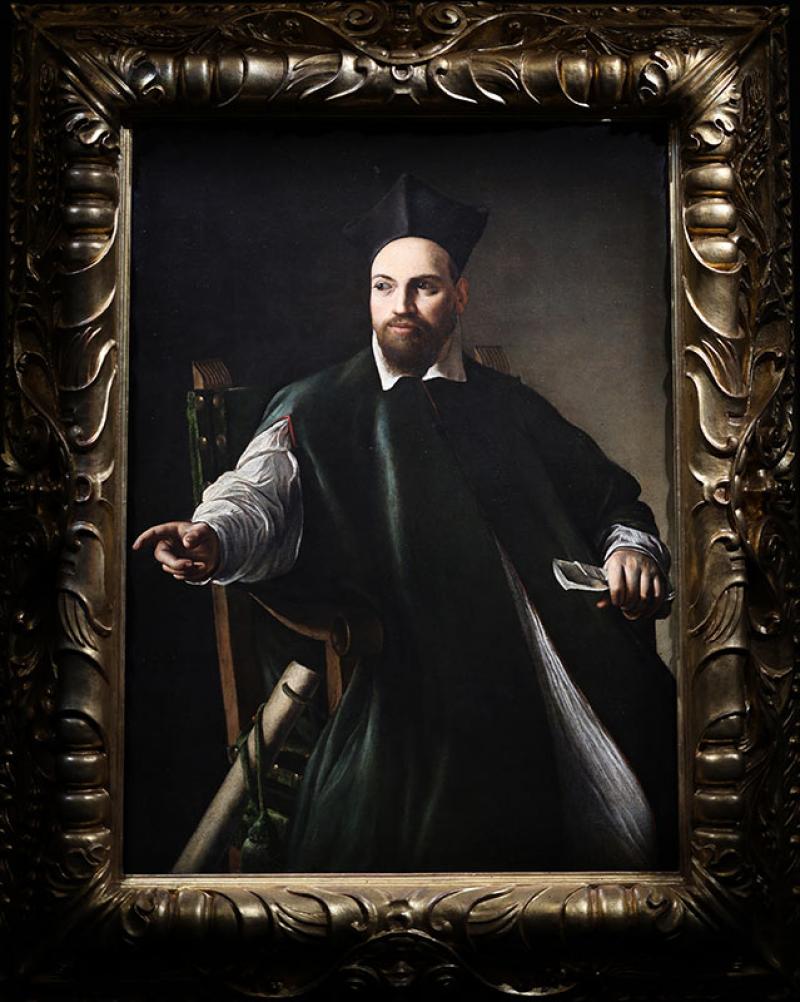
Caravaggio (1571-1610), Portrait of Monsignor Maffeo Barberinithe future Pope Urban VIII, 124 x 90 cm, c. 1599/1604, oil on canvas.
The price of 30 million euros is aligned with that of the market. L’Ecce Homo by Caravaggio, discovered in 2021 in Madrid, was acquired for an amount estimated at around 36 million euros. This purchase is one of the largest ever made by the Italian state for a work of art. An operation which “is part of a larger project to strengthen the national cultural heritage that we will continue to carry out in the coming months, with the objective of making certain masterpieces of art history otherwise intended for the private market accessible to researchers and enthusiasts”, said Culture Minister Alessandro Giuli. It is “a political and cultural victory of historic significance”, rejoiced the president of the culture committee of the Chamber of Deputies, Federico Mollicone, according to whom Italy thus reaffirms “its role as a cultural superpower”.
A role whose cost is important, especially for a country which is crumbling under the largest public debt in the European Union after that of Greece. Unlike previous years, where the purchasing policy was based on pre-emption procedures that were sometimes sluggish or did not result in a purchase, the Ministry of Culture now has an “acquisitions” budget line (Background for the acquisition of blessed cultures). The government secured these credits in 2021 and increased them to 8 million euros annually. The acquisition of Caravaggio was made possible by a special decree for the reallocation of funds that had not been used.
This acquisition frenzy, however, raises questions. Some critics fear that this concentration of resources on “big names” (Caravaggio, Antonello da Messina) is to the detriment of the daily maintenance of the thousands of archaeological sites and churches which are falling into ruin on the Peninsula. However, for the general public, the symbolic effect is undeniable. Seeing the state fight to keep a painting on its soil or repatriate a masterpiece is seen as a sign of national pride. The Meloni government intends to show that “Italy is no longer for sale”, but that she is able to buy again.