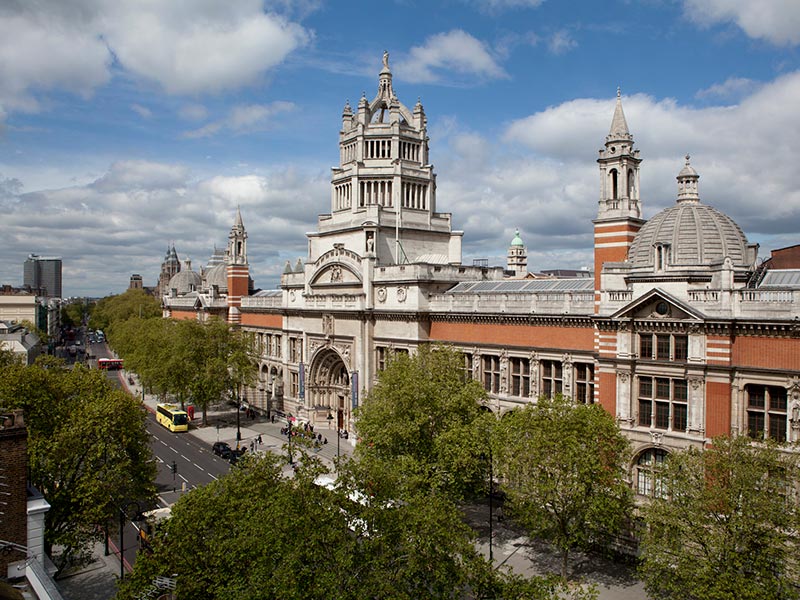
According to revelations reported by the British newspaper The Guardianthe Victoria & Albert Museum has removed a 1930s map depicting British Empire trade routes planned for publication in the “Music Is Black” exhibition catalog, after its Chinese printer C&C Offset Printing reported that the image had been rejected by China’s General Administration of Press and Publication (GAPP).
The map did not focus on China as the main subject but included Chinese territory and its borders, which was enough to trigger the intervention of the Chinese censor who imposed the use of maps validated by Beijing. In another catalog, that of the exhibition “Fabergé: Romance to Revolution” (2021), the museum had agreed to remove another card as well as a photograph of Vladimir Lenin. As revealed by the British newspaper, internal emails from the Victoria & Albert Museum show that teams discuss a constantly evolving list of restrictions, highlighting the unpredictability and gradual extension of Chinese red lines.
In the email to the museum regarding the “Music Is Black” catalog, C&C Offset Printing states that “there is a map on page 10 that concerns China (there is a border of China and we have to use standard Chinese government maps) and GAPP rejected it”suggesting either deleting the image or replacing it with another one. The London institution finally replaced the card with a photograph of migrants arriving in Southampton from the West Indies.
The museum insists on the minor nature of these adjustments, affirming that the changes have not modified the scientific content of the catalogs. The institution indicates that it retains the possibility of refusing a request deemed problematic.
The Victoria & Albert Museum, like other major British institutions (British Museum, Tate, British Library), uses printers based in China, mainly for cost reasons; catalogs can be produced at around half the price charged in the UK or Europe. This choice, however, implies that these printers are subject to the strict rules of the GAPP, which governs the production of maps and images touching on sensitive subjects: Chinese borders, Tibet, Taiwan, Tian’anmen, pro-democracy movements in Hong Kong.
The “Genghis Khan” exhibition in Nantes had already highlighted the way in which Chinese censorship finds its way into Western museum stories. The History Museum had been working for several years on an exhibition entitled “Sons of the Sky and the Steppes: Genghis Khan and the Birth of the Mongol Empire”, in partnership with the Museum of Inner Mongolia in Hohhot, which was to lend 225 works. In 2020 the Chinese National Heritage Bureau demanded the removal of terms like “Genghis Khan”, “empire” and “Mongol”, asked to supervise all content and proposed an alternative synopsis where Mongolian history was integrated into a narrative centered on Chinese territorial unity. The Nantes museum ended the initial project in the fall of 2020. Presented in 2023, the exhibition took up the discarded terms and was built with new partners, including the Genghis Khan museum in Mongolia.