Madrid,
This year marks thirty since Maruja Mallo died in Madrid, the artist who from the Student Residence participated in the first Spanish surrealism and the Generation of ’27, combining popular celebrations with esoteric touches, a dynamic imprint and evident modernity in her work; She was widely recognized in America (where she lived from 1937 until she was sixty) and triumphantly returned to Madrid as a legendary artist and character.
After passing through the Botín Center in Santander, the Reina Sofía Museum today inaugurated “MARUJA MALLO: Mask and Compass”, which is its largest retrospective to date, which has been curated by Patricia Molins, a member of the Temporary Exhibitions Department of the MNCARS itself.
The anthology, which has multiplied its documentation regarding his time in Cantabria, consists of ninety paintings and a selection of works dated between the mid-twenties, when he began to cultivate a style close to magical realism, until the eighties, when his creations moved between the geometric and the fantastic. They have been articulated in series, just as she, meticulous in processes and arrangements, did, and in them some surprise awaits us: in the preparation of this project an unknown drawing and a work that was not in her catalog raisonné has been found.
First of all, we can describe the production of the Galician artist as heterogeneous, since she was interested in both festivals and the paths of the avant-garde, the ethical dimension of art and politics. The most recent interpretations of her legacy have sought to find in it the reflection of the concerns of her time and also the anticipation of some later ones, in relation to the universal nature of certain human concerns, racial and economic inequalities, the vindication of women, the ability of art to detect invisible layers of reality or the preservation of nature; This proposal also emphasizes them and Mallo would thus acquire a certain visionary role.
The tour begins with his visit to the Royal Academy of San Fernando, where in addition to meeting the pioneering comics artist Francis Bartolozzi, he strengthened ties with Dalí. Among his teachers were Chicharro and Romero de Torres, who left their mark on his early creations; Another of her references, for her and for several artists of her generation, was the book magical realism by Franz Roh, published in 1925, for disseminating an alternative language for realism that would renew it in a time of preeminence of cubism and abstraction: it could not contain narration and spring from the popular. Two of those initial paintings from the twenties have arrived in Madrid, from the Provincial Museum of Lugo (Indigenous and Portrait of lady with fan), which indicate her interest, from the beginning, in the representation of contemporary women and distant cultures.
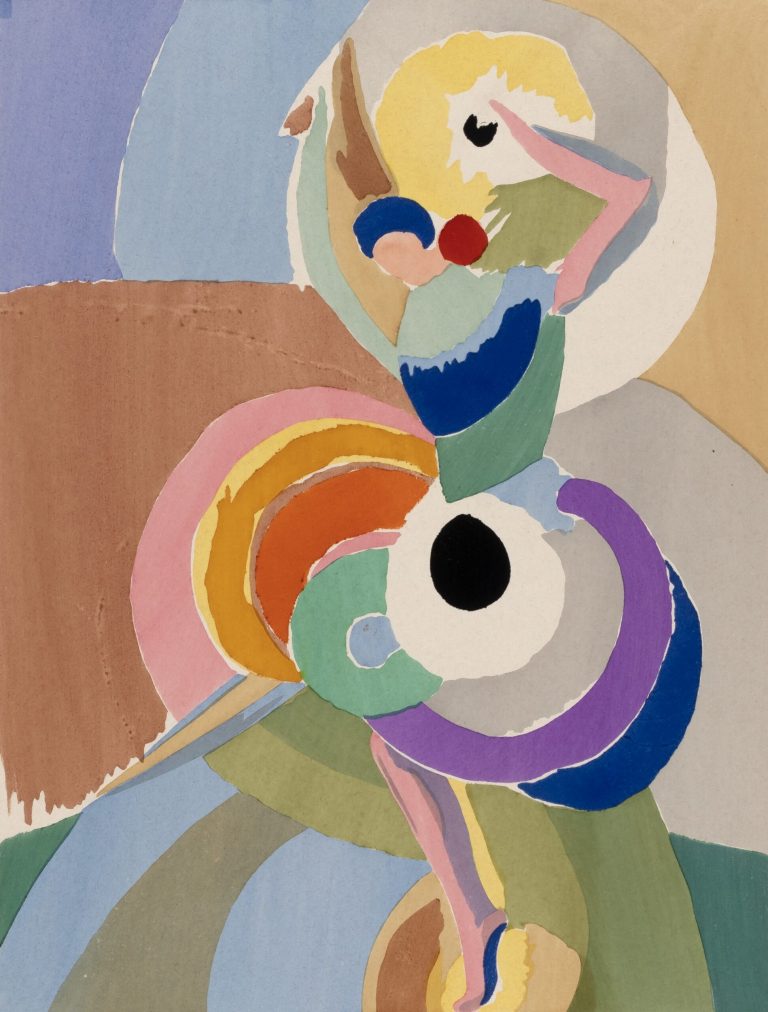
1927 would be an important year for her: she moved to the Canary Islands, whose landscape would be a discovery; He began to make women the axis of his paintings, not as a muse but as a subject; and presented his first exhibition in Madrid, in the offices of the Western Magazinereceiving praise from Ortega y Gasset (to that publication, by the way, he owes most of his commissions since the sixties). In this 27th year and the following year he carried out one of his most widespread compositions, the series The festivalsin which he began to show his own position in the debate, managed by the aforementioned Generation of ’27, on the relationships between popular culture and the art of his time, between traditions and modernity. The structure of the image, geometric with a symbolic meaning, is nourished by the links between the figures and the sets typical of the puppets and the treatment in cinema of simultaneity and superposition; It includes diverse types portrayed from a joke: women dressed as black angels, papier-mâché kings and magistrates, bulls and bulls composing small theaters, and intellectuals riding pigs that pull a merry-go-round that takes them to worlds beyond, like China or the pyramids.
This exhibition is the first to bring together its five scenes of this type since that exhibition in the Western Magazine; two of them (The Wizard/Pim Pam Pumin which he perhaps represented Valle-Inclán, and Kermesse) come from the Art Institute of Chicago and the Center Pompidou.

They clearly contrast with his compositions from the thirties, on which he worked after suffering a serious traffic accident and a tempestuous breakup with Rafael Alberti, and allowing himself to be influenced by the austere aesthetics of the Vallecas School and Benjamín Palencia. We can contemplate Sewers and bell towers (1930-1932), in which the human figure only appears through its residues or traces and, above all, textures and matter become important; Earth and excrement (1932), on similar bases; either The scarecrow (1930), which offers an obituary vision of nature from a surrealist approach. It is possible that in these darker pieces he also expressed his vision of the political and social panorama in Spain.

Between 1931 and 1933 he lived in Paris, thanks to a scholarship intended for him to train in set design. There he met Picasso and Miró, and began to investigate the possibilities of space as a three-dimensional support of the work instead of the pictorial plane (those investigations would materialize in the scenography of Clavileñoa ballet by Rodolfo Halffter that was never performed at the Student Residence due to the Civil War).
Upon his return to Spain he carried out work such as Mineral and vegetal architectures (1933), reducing the figures to lines or anatomical sections and applying the material according to very marked textures, wanting to break the dichotomy between figure and background; either Rural architectures (1933-1935), in which he drew skeletons or casings of silos, haystacks and other constructions used for the cereal harvest, playing with the dichotomy between the animate and the inanimate, constant throughout his career. The matter was also very relevant here, but it was subjected to geometry, a process that would have its culmination in ceramics, in which the earth acquires a constructive and not a destructive value, as in that series of Sewers and bell towers.

1937 was the year in which he headed to America, first to Argentina, and in which the series began The religion of work (1937-1939), in which he adopted archaic or classical images of goddesses or offering ladies, with their faces framed by ears of corn or fishing nets. With them he embarked on a stage that he called “renaissance”, a new classicism in which to develop his vision of art as salvation against time and the destruction of war. He referred to this set as born from his “materialistic faith in the triumph of the fish, in the reign of the ear”; With them human hands interpenetrate and intertwine, in the face of more pessimistic or nostalgic visions of work in the field. From this moment we appreciate in Mallo the use of a low light source that affects the figures laterally, that of the beginning or end of the day.
The physicality of their bodies could then refer to the forcefulness of the return to order, but she rather sought to create a new one by advocating a more open relationship with the popular, in line with the concerns of Ortega y Gasset and the context of the republic. Exile was a time of solitude for her and her artistic activity allowed her, materially, to survive.

In the forties it would be used in Living natures (1941-1943), which refer to feminine, sensual and colorful figures, inserted in compositions that, through their shells and flowers, allude to the animal and plant kingdoms as a metaphor for the human body. Immerse him in nature, just as his women embody the generality of humanity.
From now on, he would seek to incorporate the fourth dimension into his creations, taking into account the findings of physics at that time, which abandoned the static conception of space in favor of a dynamic space-time concept. In paintings like Living nature II (1941-1942) or Living nature XII (1943), the marine elements crossed by plants offer a sexualized and organic appearance.

In Latin America, and especially in Brazil, Mallo discovered landscapes and populations whose physical variety and cultural and racial syncretism led to his work, which began to be populated with black bodies and heads (one of them, Young black woman from 1948, recently acquired by the Ministry for the Reina Sofía). From this moment on, he set out to devise a systematic method of representing a new humanity, partly as a response to the racism and nationalism of the 1930s: he wanted to capture circular spaces and times, both present and eternal, in which heads, masks and acrobats of symbolic and idealized forms are added, a manifestation of his belief in art as a perfected vision of the real and open to the future.
He displayed static heads in which he rehearsed the fusion between races, between races and animals, and between sexes, as in The human deer (1948) or in Gold (1952). Their Masks of those years, in which positive and negative emotions converge, are also indebted to the studies on Freud that Mallo began in that period.
In 1962 he returned to Spain, where he would settle permanently three years later, and made his last series: Void Dwellers and ether travelerslinked to real or imaginary trips, crossing the Andes or crossing the Pacific, which he had interpreted as levitating experiences in which he would have contacted suprahuman dimensions. In part, their infinite sidereal spaces would arise from them, in which circular shapes give way to serpentine and complex geometries and the figures become beings subjected to symbiotic or metamorphic processes that correspond to the complete evolutionary process, from the cell to space machines through animals.
The exhibition ends with the works he created during his last years, recovering motifs from his different periods and expressing them with symbolic tones (ranges of blues, reds and yellows); also with vignettes that he had made for the covers of the aforementioned Western Magazine and with a series of engravings from the seventies, photographs that intertwine art and life (she made extensive use of that medium without being a photographer) and an interview where she gave an account of her audacity.
His love for science, astrology, the racial issue, the micro and the macro was ahead of the interests of numerous current creators; and her vindication of women (always active) and popular culture, and her care for her ways of presenting herself and representing herself, of performing her image, both in her compositions and in her television appearances, were typical of someone ahead of her time.
Patricia Molins has recalled that, beyond her self-confidence and irony, Mallo intrigued her the times she crossed paths with her on the street and continues to provoke questions: she explained a lot about herself, but there was also a lot that she would have hidden.
It is very likely that the study of his entire archive, which can be examined at the Reina Sofía as it belongs to the Lafuente collections, will allow us to radically reread his legacy. The museum will also host, in 2026, conferences on its creative techniques.

“Maruja Mallo: Mask and compass”
NATIONAL MUSEUM REINA SOFÍA ART CENTER. MNCARS
C/ Santa Isabel, 52
Madrid
From October 8, 2025 to March 16, 2026