Hernani,
We’ll call him an artist, but it’s quite difficult to label Koen Vanmechelen’s work. His interests affect essential issues of contemporary society (identities and globalization, human rights and communities) and his projects, constantly in progress, arise from collaboration and also from travel.
Within the framework of the Basque International Architecture Biennial Mugak/, which celebrates its fifth edition, between the months of October and November, under the motto Castles in the air, or how to build utopia todaythis Belgian author presents what is his first exhibition in Spain at Chillida Leku: “Limina: Cosmopolitan Chicken Project 30”.
Taking advantage of the fact that in this location, and in the germ of Chillida’s own work, nature, art, science and architecture intersect, Vanmechelen has focused his proposal on that chicken of the title, conceived as an architectural construction because, in his words, represents the blocks that make up life: genetic structures that combine to generate vitality. And architecture, in its essence, should also contain life.
That same animal takes it as a symbol to refer to diverse and lost forms of coexistence and food, and to celebrate what is close: Through the chicken, I have made a deconstruction of what humanity has done: create a monoculture that impoverishes character. In architecture, this same reduction leads to sterile landscapes. If we want to celebrate beauty, we must return to diversity. That is what the chicken symbolizes: a living and decolonized architecture (…). My work also leaves behind what is constructed to reconnect with what is authentic. The global only exists thanks to the generosity of the local. It’s about celebrating what grows locally and allowing it to evolve into the global.
Cosmopolitan Chicken Project It is not, at all, a new project: Vanmechelen began to shape it twenty-five years ago. And in a very daring way: crossing breeds of chickens from different countries to create a cosmopolitan chicken that incorporated the genes of all those ancestor breeds. Its purpose was to build from biology and emphasize that diversity is essential to guarantee the continuity of living beings and landscapes: At the heart of my practice is a genuine fertility—biological, cultural, and creative—that is born of exchange. It is a living movement, where construction and destruction coexist: a sculpture emerges when stone is carved; a chick, breaking its shell.
A priori establishing links between Chillida’s refined sculpture and this artist’s methods is difficult, but if our sculptor explained himself and his art, like a tree rooted in its earth, but with branches open to the worldthe Belgian is convinced that the global only exists because of the generosity of the local, as these crossings would prove. To them has now been added the Euskal Oiloanative to the Basque Country, which would enrich this cosmopolitan hen designed.

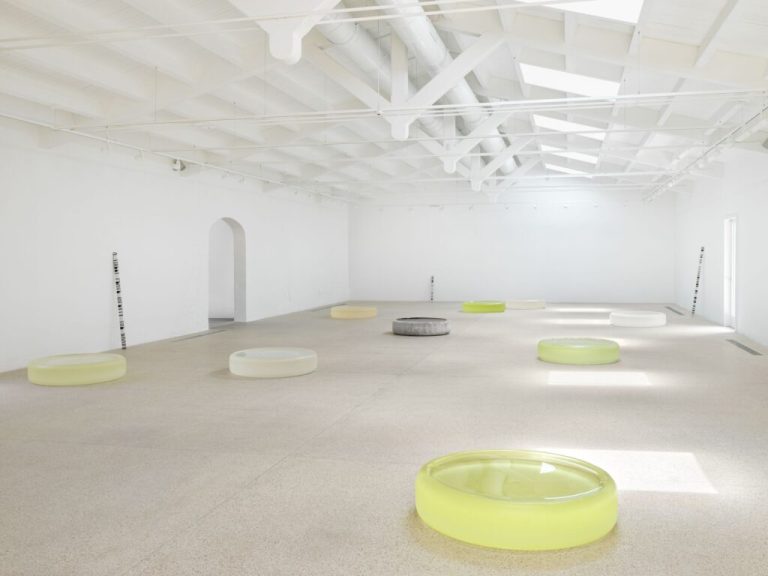
What awaits us in Chillida Leku? Pieces designed to question the hierarchies between the human and the non-human and to blur the barriers between the domesticated and the wild. In a tour curated by Jon Garbizu and Victoria Collar, from the Garbizu Collar Architecture studio, and Gonzalo Peña Sancho, from Kri Arquitectura, sculptural interventions will come our way, perhaps future archaeologies, that will take us beyond the usual exhibition spaces: to outdoor and wild areas where the links between creation and nature emerge organically.
Some pieces stand out for their large format: T-Rexa six-meter sculpture as a fossilized sign; Instead of Sleepinga gathering of moths around a fragile light; and Paradise Losta pristine egg cradled in a maple tree, suggesting the original and the potential, in relation to the environment in which they are arranged.

Next to the farmhouse we will see a chicken coop that has adhered to the stone of the building and that we have to cross to access the interior, through a door that had not been opened before. It gives way to a narrow tunnel that represents a threshold—physical and symbolic—between the wild, outside, and the cultural, inside. It is also proposed as a transition space, the moment in which the human being stops being an observer and becomes the object looked at by the chickens. Vanmechelen tries to make the viewer not feel public, but rather a species.

Already in the interior rooms, the exhibition is divided into three acts that narrate a symbolic and biological evolution of the links between species and culture: Origin, Domestication and Crossing.
In Origin Questions are raised about the origin of the chicken and its relationship with man: a video and the sculpture Natural Knowledge —with primeval chicken legs on books of knowledge— symbolize the ancestral shadow of all crossings.
Domesticationfor its part, brings together enlarged portraits of cosmopolitan hens, a giant marble hand that picks up a chick, and the installation Breaking the Cagewith metal cages with eggs and incubation lamps fitted into the windows. They refer to what this domestication has as a privilege and punishment.
Finally, Crossing underlines what this Cosmopolitan Chicken Project is clearly in favor of genetic and cultural diversity. Sculptures, diagrams and genetic material define hybridization as the basis of living structures born from interdependence.


Koen Vanmechelen. “Limina: Cosmopolitan Chicken Project 30”
CHILLIDA LEKU MUSEUM
Jauregui neighborhood, 66
Hernani
From October 17, 2025