Lens (Pas-de-Calais). The plural is chosen on purpose, and even constitutes the heart of the subject. By titling its exhibition “Gothics”, the Louvre-Lens immediately displays its ambition: to explore Gothic art in its plural dimensions, including of course its birth in the medieval era, but also its multiple transformations over the centuries. “The exhibition ranges from the construction of the great Gothic cathedrals to today’s “goth” counterculture, and this is what makes it unique,” underlines Annabelle Ténèze, director of the Louvre-Lens, who is curating it with Florian Meunier (chief curator of the Department of Objects of Art at the Louvre), Dominique de Font-Réaulx (curator specializing in the 19th century) and Hélène Bouillon (until recently curator at the Louvre-Lens).
Following the Gothic movement over nearly a millennium is ambitious, especially since the journey is intended to be exhaustive, as far as possible that is. Rich in more than 250 works, it interweaves painting, sculpture, architecture, furniture but also cinema, photography, fashion… A great diversity of disciplines gradually invested over the centuries.
Angels, monsters and other fantastic creatures
It all began in the 12th century with the birth of the first Gothic art in Ile-de-France. The transition, for the representation of the body, to a more anatomical art, in search of more natural proportions and postures, becomes tangible, just like the architectural revolution which took place during this period. This turning point resonates even in the immersive scenography imagined by Mathis Boucher, which punctuates the spaces with a series of broken arches evoking the interior of a cathedral. A beautiful setting to showcase the multitude of sculptures, illuminations, stained glass windows, pieces of goldwork and ivories. Masterpieces from the Arras Museum of Fine Arts (Pas-de-Calais), the pair of so-called “Saudemont” angels, with their admirably preserved wings, testify to the refinement of sculpture at the end of the 13th century. Further on, a small selection of Italian paintings shows how the influence of Gothic art is felt in the postures, drapes, but also gables and trefoiled arches which adorn the frame.
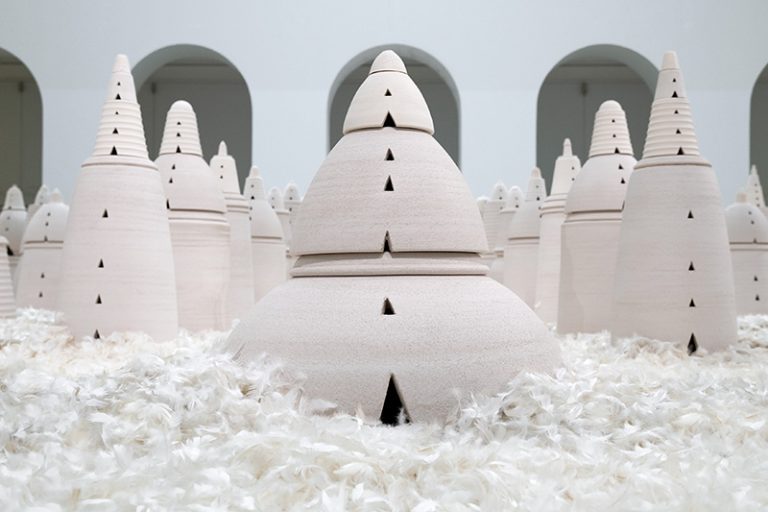
View of the “Gothiques” exhibition at the Louvre-Lens.
© Laurent Lamacz
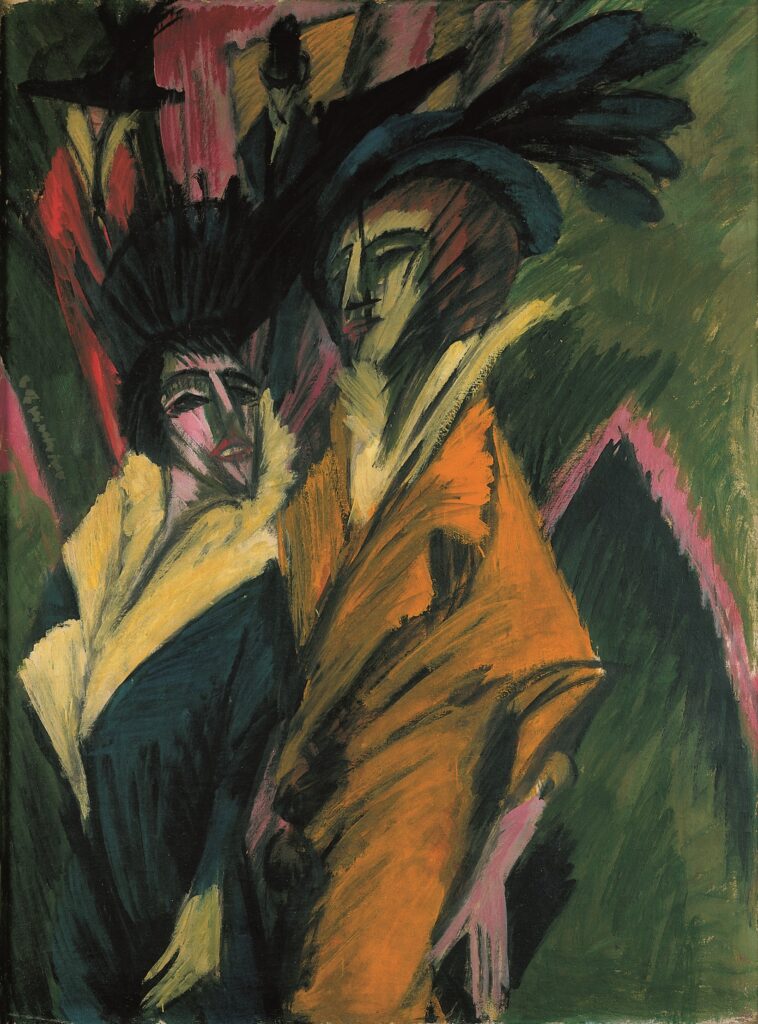
Inseparable from the Gothic imagination, monsters and fantastic creatures also punctuate the route, even if their presence would have deserved a more assertive theme. We find the dragon in a fragment of a 13th century pavement, a profusion of monsters in a Vision of Saint Anthony engraved after Martin Schongauer (circa 1445/1450-1491)… But the small room devoted to the Gothic bestiary leaves a feeling of unfinished business, especially considering the influence exerted by these hybrid and marvelous beings over the centuries. This heritage is clearly visible in the 19th century, when a new taste for Gothic developed. The motif of the gargoyle fascinates, the use of the supernatural and the strange is essential in literature as in theater. A more nostalgic universe is constructed, conveyed by the vision of ruined Gothic buildings. The table René’s Farewell to his sister, by Lancelot Théodore Turpin de Crissé (1782-1859), for example, illustrates this romantic vision of the Middle Ages with a sepulchral church which stands against the backdrop of a tumultuous sea. This darker inflection, which coincides with a desire to preserve the monuments of the past, materializes in the transition to deep red picture rails.
Transformations and recurrences
But, if the form taken by the exhibition is very successful, is there any relevance in designing a grand tour of the Gothic from its beginnings to the present day, instead of opting for a more precise angle? The answer seems to lie somewhere in between. “We wanted to take a new look at the Gothic over time, which allows us to highlight its continuities and paradoxes,” explains Annabelle Ténèze. And in fact, the journey manages to maintain a common thread despite the plural realities grouped under the term “Gothic”. The chronological progression allows us to detect transformations such as recurrences, cleverly highlighted in thematic sections which question the evolution of color, writing or even gothic music.
Covering so many centuries, however, creates a certain imbalance in the course, even if it seems logical that each period is not treated with the same attention. The medieval part, which occupies half of the exhibition, details with great precision the subtle variations of Gothic art, its receptions in other regions of Europe, all punctuated with maps and didactic diagrams. In contrast, other parts are treated very succinctly, to the point of sometimes making their contribution quite superficial. The contemporary section, in particular, skims over the emergence of a goth counterculture and relegates the legacy of goth in pop culture to a simple “bookstore corner” and a mood board. But whether through the cathedral dress of Iris van Herpen (born in 1984) or the impressive steel sculptures of Wim Delvoye (born in 1965), she points out the obvious: the Gothic has not finished inspiring.

View of the “Gothiques” exhibition at the Louvre-Lens.
© Alexandre / Louvre-Lens