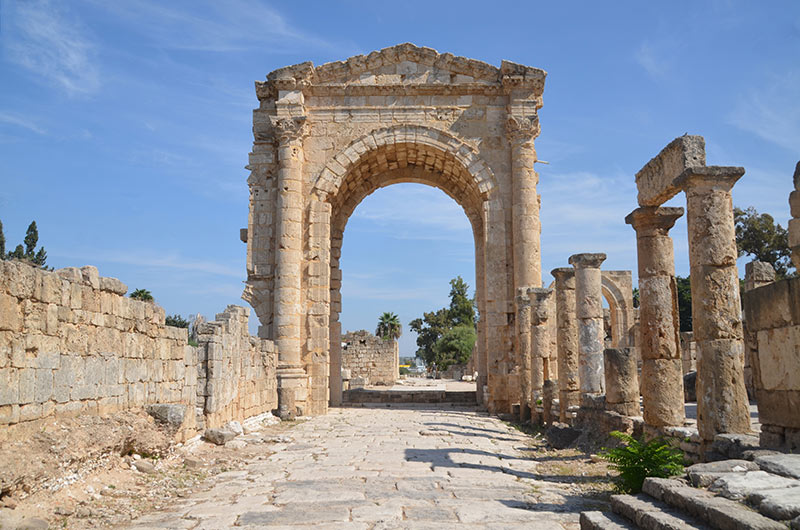
Lebanon. The recent bombing campaign by the Israeli army has left more than a thousand dead and forcibly displaced at least a million Lebanese according to authorities. If the stated objective is to target Hezbollah allied to Iran, the airstrikes also affect populations and heritage. Lebanon has many classified archaeological sites and six UNESCO World Heritage sites, including Tyre, Byblos and Baalbek. The city of Tyre, located in southern Lebanon, has been hit by several attacks since the beginning of March, but UNESCO cannot yet confirm the extent of the destruction. The city is famous for its Phoenician, Greek and Roman sites, including a very well preserved 20,000-seat hippodrome and a remarkable necropolis (2nd-3rd centuries CE). At least one missile fell on the site and its museum under construction on March 8, according to Lebanese authorities.
Bleachers at the Tire racecourse in South Lebanon.
© Carole Raddato
The Minister of Culture, Ghassan Salamé, recalled that there was no “no military or security presence” on these sites, which is disputed by the Israeli army which is targeting Hezbollah strongholds in the area. The director of excavations for southern Lebanon, Nader Saqlawi, specifies in the press that the Israeli authorities “know very well where the sites are” for the many years that they have carried out military operations there, and because UNESCO systematically notifies the belligerents of the registered sites. These operations have had a serious impact on the built heritage of southern Lebanon: in Nabatiyeh, nearly 70% of historic buildings have been destroyed in recent years, according to the Lebanese NGO Biladi. Elsewhere in Lebanon, it is mainly the south of Beirut which is suffering destruction, the extent of which remains to be confirmed, while the historic center has not been rebuilt after previous bombing campaigns and the explosion of the port in August 2020.
Several international initiatives in recent years aim to protect Lebanese heritage and restore it. In November 2024, the UNESCO Committee for the Protection of Cultural Property in the Event of Armed Conflict granted enhanced protection to thirty-four Lebanese sites, at the request of the Lebanese authorities. This status brings“the highest level of immunity against attack and use for military purposes”, within the framework of the 1954 Convention. Tire and Baalbek are part of this list, the effectiveness of which remains limited as long as the bombings continue. The Aliph Foundation recently announced additional measures for Lebanese heritage, and is funding a damage assessment mission to Tyre, in collaboration with L’Œuvre d’Orient. In Beirut, Aliph is financing emergency measures for storage locations for cultural property, as well as for the security of museums and their reserves. The foundation is also participating in an emergency fund for the protection of Lebanon’s heritage, launched in Paris jointly with the Arab World Institute (IMA) and the French Development Agency (AFD): the sums announced, however, remain modest given the stakes (100,000 dollars from Aliph, 50,000 euros from the IMA and 25,000 euros from the AFD).