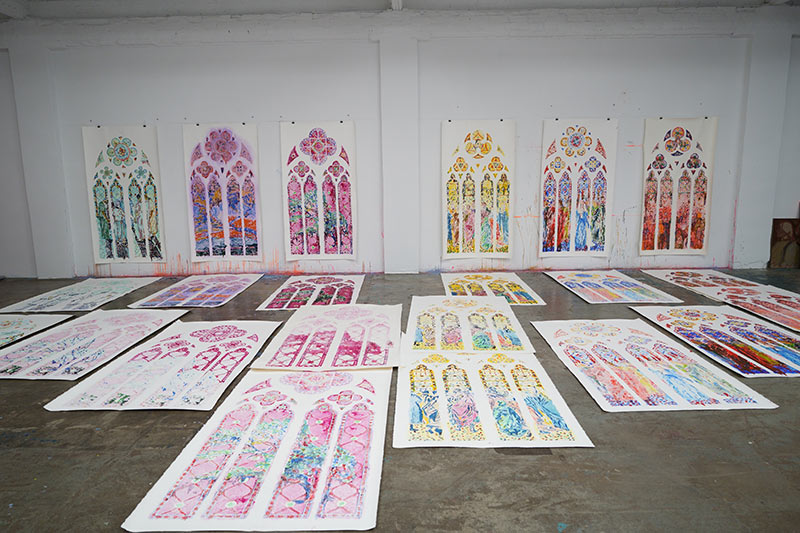
Following the fire which ravaged the Notre-Dame de Paris cathedral in 2019, the wish of the President of the Republic and the Church to carry out a contemporary gesture in the restored Notre-Dame de Paris cathedral arouses the ire of certain heritage defenders. Despite a negative opinion from the National Commission for Heritage and Architecture, issued in July 2024, the artist Claire Tabouret won the public contract dedicated to the creation of 6 new contemporary stained glass windows.
On November 27, 2025, the Paris administrative court confirmed the legality of this market which had been contested by the Sites & Monuments association and Jean-David Jumeau-Lafond – a donor to the national subscription whose interest in taking action was quickly dismissed. On the merits, the association maintained that the installation of the contemporary stained glass windows did not constitute an operation of ” conservation “ or “restoration” within the meaning of the missions entrusted by the law of July 29, 2019 to the public establishment in charge of Notre-Dame.
However, cultural heritage law does not define these terms and uses more the technique of “framework concept” or “variable content concept” allowing sufficiently extensive freedom of interpretation. Consequently, the court found that “the terms “conservation” and “restoration” do not imply a return to the last known visual state before the fire (…) and do not exclude the possibility of an architectural approach as provided for by the market for the creation and installation of contemporary stained glass windows”. The public contract therefore not having been signed by the public establishment outside of its missions, the court rejected Sites & Monuments’ request. The latter indicated its intention to refer the matter to the Paris Administrative Court of Appeal.
Beyond the “contemporary anti-stained glass” are also rejected on two points that they often highlight. The first lies in the fact that the negative opinion of the National Commission for Heritage and Architecture is for the magistrates “non-binding and cannot therefore be usefully invoked”. The second is that the International Charter on the Conservation and Restoration of Monuments and Sites of 1964, known as “Venice Charter”has no direct effect in domestic law. Indeed “if it can clarify the definition of the terms “conservation” and “restoration”, these definitions, which are not binding on the legislator, cannot be invoked to clarify their meaning and scope, since the legislator has not appropriated the terms”.
The first round of this stained glass dispute was won by the public establishment but the battle is not over. In spring 2026, the work authorization should be issued and the association has already made it clear that it will contest it. An action which is reminiscent of that brought against Daniel Buren during the work of his “Columns” in the main courtyard of the Palais Royal, classified as a historic monument. On December 28, 1992 the Council of State validated the work because the “authorized modifications (did) not have the effect of rendering the classification irrelevant and (were) not the equivalent of downgrading”. Whatever the outcome of this next episode, Claire Tabouret’s stained glass windows will help clarify this jurisprudence which is taken for granted in doctrine.