Decisive elements were lost during excavations carried out without authorization in Maastricht, in the church where d’Artagnan could have been buried. At the center of the controversy is a retired Dutch archaeologist. Last May, Wim Dijkman was briefly arrested for refusing to return bones taken during excavations carried out a few months earlier on the site of a church in Maastricht. During the excavation, valuable clues were compromised, complicating the scientists’ identification work. It followed the chance discovery of a skeleton, which historical sources suggest could be that of Charles de Batz de Castelmore, known as d’Artagnan.
The Maastricht town hall confirmed that these first excavations had taken place without official authorization, and without respecting the rigorous archaeological protocols. Errors which risk preventing the conclusion of the investigation, despite the fact that the bones were finally returned to the authorities.
In February 2026, renovation work on the floor of the Saint-Pierre-et-Saint-Paul church in Wolder, a district of Maastricht, uncovered human remains. It did not take long for the connection with the musketeer popularized by Alexandre Dumas to be mentioned. Research, notably that of the French historian Odile Bordaz in the early 2000s, had already put forward the hypothesis of a burial in this Wolder church. It was therefore in haste and driven by the euphoria of a potential historical discovery that these first excavations were carried out.
A few clues seemed to confirm d’Artagnan’s trail. A coin dated 1660 was discovered nearby, without its association with the burial being established in the scientific report published in July. Fragments of oxidized iron had been observed in the ribcage of the deceased, corroborating the hypothesis of death following a musket shot, which is to this day considered to be the cause of d’Artagnan’s death during the siege of Maastricht in 1673. But analysis showed that it was a fragment of a nail forged from iron, with no proven link to the death.
The state of research does not currently allow the precise identification of the skeleton. Although the characteristics of the body appear to match d’Artagnan’s profile – approximately 1m74, between 45 and 65 years old – recent isotopic analyzes have cast doubt, attributing to the remains a diet hardly compatible with that of a 17th century Gascon. Carbon-14 dating only gave a very wide range, between 1500 and 1900, which neither confirms nor excludes a burial in 1673.
This case recalls the importance, but also the limits of the archaeological environment, a central element of the modern discipline. The location of the skeleton’s discovery was the main factor in linking it to d’Artagnan, and the documentation problems which marked the first phase of the excavations currently compromise the confirmation of the hypothesis, as well as the latest scientific analyses.
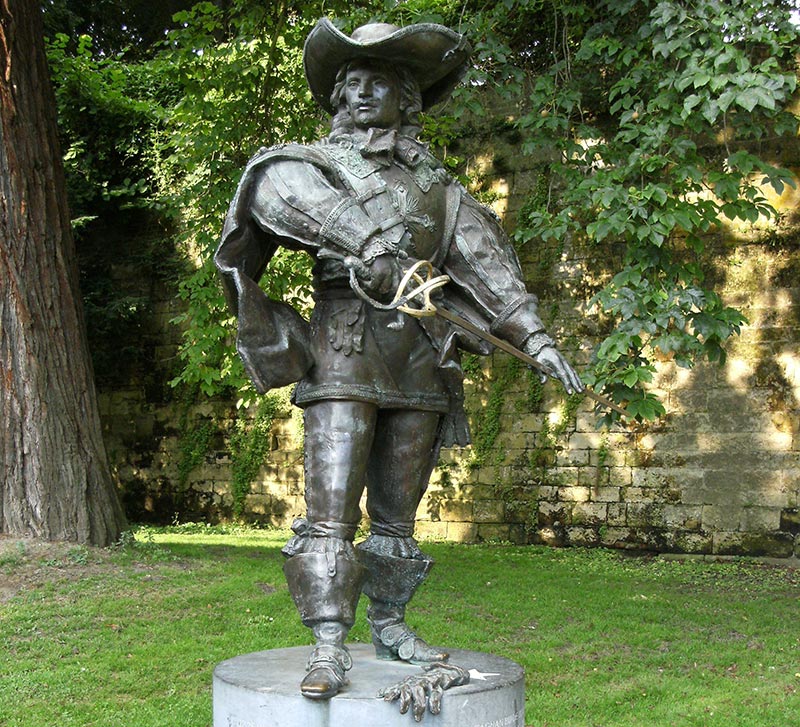
The impact of this discovery is commensurate with the fame of the figure it concerns. In France, the musketeer is above all a literary hero, in the same way as the Count of Monte Cristo. In Maastricht, he is also Charles de Batz de Castelmore, captain-lieutenant of the first company of the king’s musketeers, during the Dutch War, of whom a bronze statue stands in Aldenhof Park.
Jean-René Cazeneuve, deputy for the first constituency of Gers, spoke of a possible transfer of the remains to Gers if their identification was confirmed, while recognizing that an agreement from the Dutch authorities would be difficult to obtain.