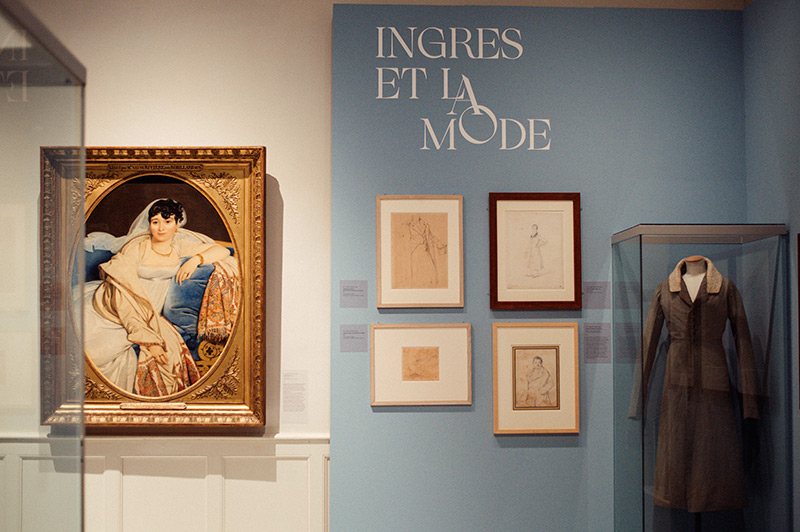
Montauban (Tarn-et-Garonne). A paisley patterned shawl draped around an elegant beauty. Metal buttons catching the light on soft velvet. And, here and there, delicate lace and vaporous fabrics with almost palpable textures. In Montauban, the painter’s hometown, a wide selection of paintings and drawings by Jean-Auguste Dominique Ingres (1780-1867) highlights the particular attention the painter paid to fabrics and accessories. Because if he himself was not the greatest of dandies, as evidenced by a few portraits where he wears the same threadbare coat, the artist expected his models to dress in the spirit of the times.
A taste for the preciousness of fabrics
“Ingres sought to characterize them not only by their faces, but also by their clothescomments Florence Viguier-Dutheil, director of the Ingres Bourdelle Museum. Moreover, if he delegated elements of decor or possibly furniture to his workshop, this was never the case for clothes. » It has been more than ten years since the chief curator matured the project of illuminating Ingres’ work through the prism of fashion, the theme having never been the subject of a full-fledged exhibition. This intersection of perspectives draws on the expertise of Alexandra Bosc, a specialist in the history of 19th century fashion, who is co-curator of the exhibition.
View of the exhibition “Ingres and fashion” at the Ingres Bourdelle museum.
© Iampphotographie
This dialogue between Ingres and fashion finds all its strength in the diversity of the pieces brought together, paintings, drawings, textiles, accessories and period documents. We find fine samples of embroidery showing this taste for preciousness that Ingres excels at transcribing, while jewelry and sketches by great jewelers echo the meticulously reproduced ornaments. Caricatures, fashion plates and technical treatises also underline this inclination to distort the silhouette, compared with the anatomical liberties taken by Ingres. If the route is sometimes a little saturated – which can hinder the observation of some of the painter’s large formats – this profusion of pieces is fully justified, as it reveals the importance that clothing has in the construction of his portraits.
Rather than an unfolding of fashion history, the curators have judiciously favored a thematic journey. “Our plan was not to systematically exhibit the garment next to the painting that represents it,” underlines Florence Viguier-Dutheil. It is less a question of dwelling on the evolution of fashion than of understanding what clothing brings to the portrait.
A mirror of time
Under Ingres’ brush, the refinement of clothing details contributes to the portrayal of an opulent bourgeoisie. In the Portrait of Madame de Senonnes (1814, [voir ill.]), one of the artist’s most striking, the excessive abundance of jewelry with which Marie Marcoz is adorned questions Ingres’ relationship to adornment. As for the portrait of Philibert Rivière (1805, [voir ill.]) presented alongside that of his wife, both on loan from the Louvre, the discreet elegance of the high official reflects the sobriety taken by the rising bourgeoisie at the beginning of the century.
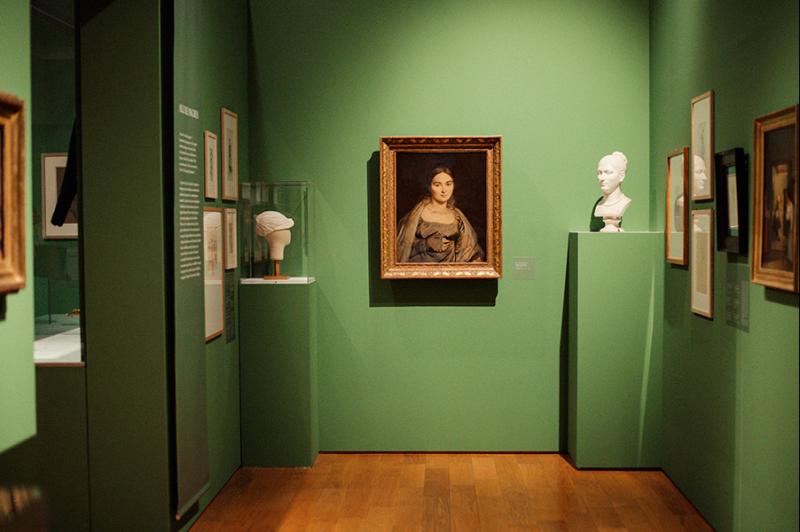
View of the exhibition “Ingres and fashion” at the Ingres Bourdelle museum.
© Iampphotographie
If some major paintings from Ingres’ career could not be brought together, the exhibition skilfully compensates for these absences. First with quality copies, like that of the Portrait of Mr. Bertin produced by Louis François Cabanes (1867-1947), author of several revivals of Ingres commissioned by the State, or even that of Joan of Arc at the coronation of King Charles VII, executed by his student Pierre Auguste Pichon (1805-1900) under the close supervision of the master. THE Portrait of Madame Moittessier has not left the collections of the National Gallery (London), but the famous crinoline dress featured there, made of silk taffeta and flower prints, was recreated for the occasion by costume designer Sébastien Passot. The route is also punctuated by some well-chosen contemporary pieces, including a photograph by Joon Sung Bae (born in 1967) which explicitly revisits the famous blue dress of the Portrait of Princess de Broglie (1853) preserved at the Metropolitan Museum of Art in New York.
Conversely, from this selection emerge lesser-known pieces which enrich the reading of the work. The exhibition does not leave men’s fashion aside, presenting accessories rarely kept such as these “false calves” intended to artificially accentuate the silhouette. As for the numerous drawings by Ingres hung, many taken from the museum’s reserves or loaned by the Bonnat-Helleu Museum in Bayonne (Pyrénées-Atlantiques), they allow us to understand how sensitive the artist was to dressing, draping and attitudes.