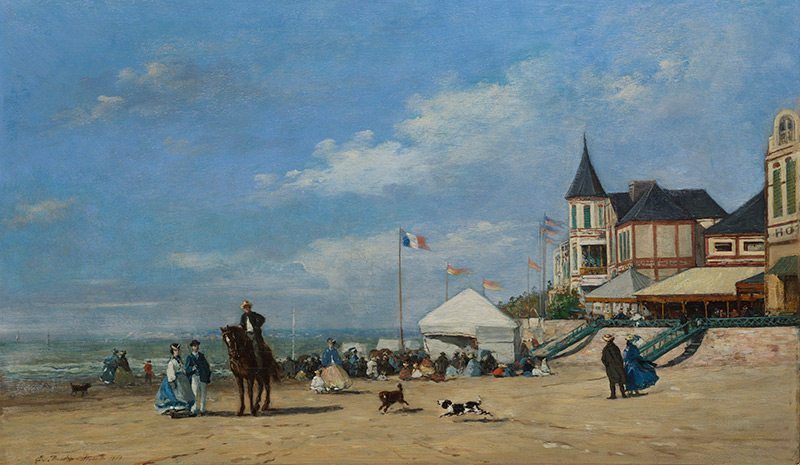
Paris. If his works often appear in the demonstrations devoted to impressionism and particularly to Claude Monet, Eugène Boudin (1824-1898) remains unknown to the general public. This despite a retrospective organized in Muma (Le Havre) in 2016 and a museum in its name, in Honfleur (Calvados), which in 2024 presented the entire legacy he granted it. The painter’s specialist, Laurent Maneuver, who participated in these exhibitions, is the commissioner of that presented under the title “The father of Impressionism” at the Marmottan Monet museum. Bringing together 90 oils, watercolors and pastels of sausage related to ten works by Monet (1840-1926) and one by Johan Barthold Jongkind (1819-1891), she chrono-thematicly traverses the career of the one Camille Corot nicknamed “The King of Ciels”. Since what he called them “Dining room paintings” (Dead lifes and bouquets) who made him live in his youth to the views of Venice, the public can follow his evolution, both in the sketches and pochades quickly made on the motif in this kidnapped style which is today the artist’s celebrity, as in the living room paintings or the more “finished” controls painted in the workshop. Only lacks the kind of portrait he practiced in his early days.
Eugène Boudin (1824-1898), Venice, Campanile, the Ducal Palace1895, oil on canvas, 49 x 73 cm, collection of Mr. Yann Guyonvarc’h.
© Studio Christian Baraja SLB
The route adapts intelligently to the configuration of exhibition spaces. Thus, after the introductory room presenting only two oils, the second, much greater, acts as a prologue devoted to relations with Monet. The last room, difficult to exploit, welcomes the theme “Le Havre, the city of disillusionment”, an evocation of the complex relationships that Boudin maintained with the city which helped it in its beginnings and then despised (although some of its large collectors lived there). Le Havre which, by a pirouette of fate, today retains the second public fund of his work. Visitors that these vicissitudes will challenge can read the detailed report in a catalog which, has become rare, largely comments the works and publishes their pedigree.
The collection of a passionate amateur
This work is an investment for the future since the exhibition is a kind of test gallop, a step in an adventure that will continue in Switzerland. Of the 101 hung works, 80, of very high quality, belong to the collector Yann Guyonvarc’h, presented to the public by a short text at the start of the course and an interview opening the catalog. Twenty years ago, this Franco-Swiss entrepreneur born in 1973 bought on a love at first sight Deauville beach, October 5, 1893which reminded him of his child’s vacation in Normandy. Son of an amateur painter who copied marquets, he was not keen on art history. It was his passion for Boudin that led him to take an interest in it and to acquire 200 works of this painter – the largest private collection in the world, according to Laurent Maneuver – and a hundred of the hand of contemporaries: Jongkind, Berthe Morisot, Alfred Sisley, Henry Moret, for example.
This collection has never been exhibited. But now, Yann Guyonvarc’h works on a museum project (read the box below) and continues to track the important tables that appear on the market, such as Beach meeting (1866), one of the three major known beach scenes and the only private hands, bought in the United States in July 2024. In time to be integrated into the exhibition.
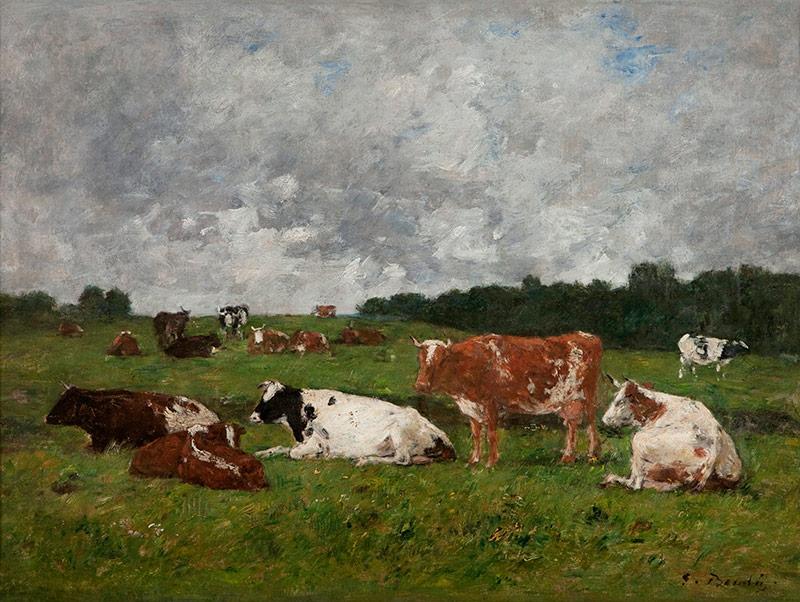
Eugène Boudin (1824-1898), Pasture cows1880-1885, oil on canvas, 41 x 55 cm, collection of Mr. Yann Guyonvarc’h.
© Studio Christian Baraja SLB