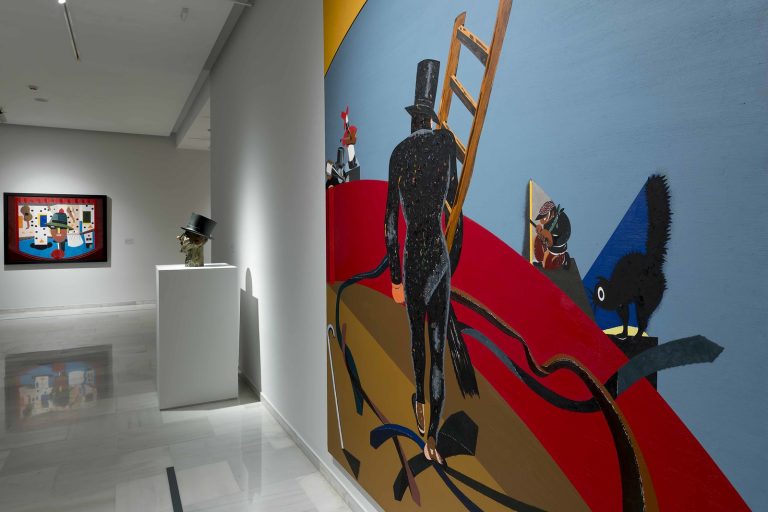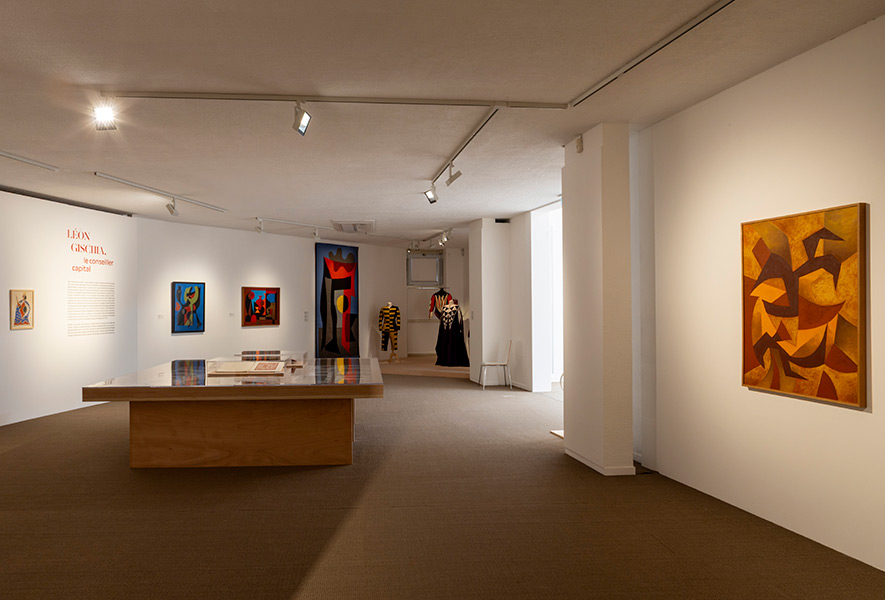
We know Jean Vilar as the founder of the Avignon Festival and director of the Théâtre national populaire (TNP) less as the man of the theater who wanted to bring painters on stage. It is this slope that the Paul Valéry Museum in Sète places at the center of “The Colors of Jean Vilar”, organized by Camille Bertrand-Hardy, director of the Sète Museum Center, with Ingrid Junillon, responsible for the collections of the Paul Valéry Museum and presented until November 8. The exhibition brings together nearly forty paintings and around a hundred graphic works, to which are added costumes, tapestries and models.
The point is not to illustrate the history of the TNP or Avignon. Rather, it seeks to show how Vilar constructed a scenic aesthetic in dialogue with the artists of his time. Vilar refused to reduce their role to that of decorators: he wanted “theater painters”making color a dramatic element. Around him, from the 1940s, a circle largely drawn from the New School of Paris was formed: Léon Gischia, Édouard Pignon, Mario Prassinos, Gustave Singier, Alfred Manessier, but also Jean Bazaine, Roger Chastel, Jacques Lagrange or, more occasionally, Alexander Calder.
Léon Gischia logically occupies the heart of the route. His first collaboration with Vilar dates back to 1945, for Murder in the Cathedral. For nearly twenty years, he played the role of decisive artistic advisor to him. In Avignon then at the TNP, he helped to eliminate illusionistic decorations and superfluous accessories in favor of a simplified, sometimes almost bare space. The color of the costumes and a few moving elements then structure the scene and remain legible from a long distance. The meager means of the beginnings thus become an aesthetic language.
View of the exhibition “The Colors of Jean Vilar” at the Paul-Valéry Museum.
© Ghutchinson
The interest of the exhibition lies above all in the connection between independent works and creations for the theater. At Édouard Pignon, the shapes and palette of his paintings reappear in the models or the large painted curtains of On ne badine pas avec l’amour in 1959, breaking with the austerity of Gischia. Jacques Lagrange introduced with Ubu, in 1958, a burlesque register close to his work with Jacques Tati.
Mario Prassinos brings a fantastic and sometimes monstrous universe: his models for Macbeth or Macbetto, dominated by black, extend his tapestries and a painting on the borders of abstraction. Gustave Singier made his relationships of tones the very driving force of dramaturgy, while Alfred Manessier transposed in 1962, for The Life of Galileo, his research on light and the opposition between darkness and brightness.
The route ends in particular with the banners, which have become one of the visual signatures of Avignon. Inspired by the Italian Palio, they were initially accessories for certain productions before Vilar asked, in 1961, the artists who had worked with him to design them for the fifteenth season of the Festival.
The choice of Sète is not only biographical. Vilar spent his summers there in contact with a network of artists. His wife, Andrée Schlegel, practiced engraving, ceramics and tapestry; his sister-in-law Valentine Schlegel participated in the early years of the Festival. Gabriel Couderc, then director of the museum, and François Desnoyer belonged to this circle. A room is dedicated to Andrée Schleger-Vilar and the route dialogues with the collections of the Paul Valéry museum.
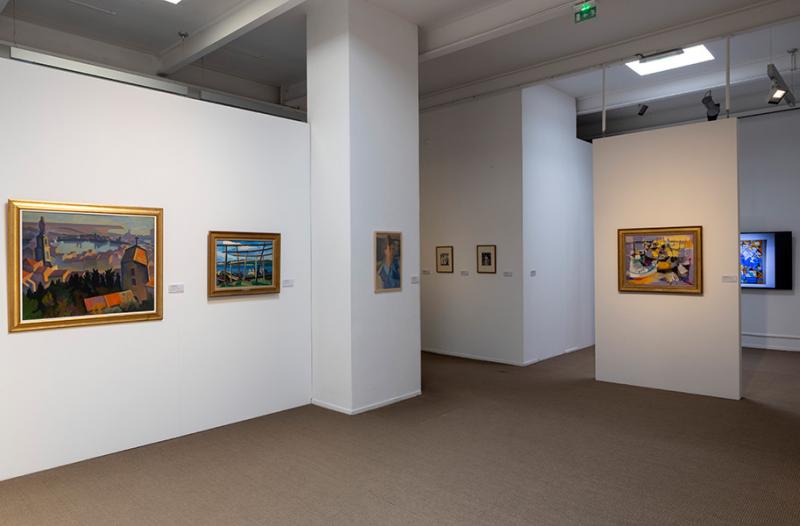
View of the exhibition “The Colors of Jean Vilar” at the Paul-Valéry Museum.
© Ghutchinson