
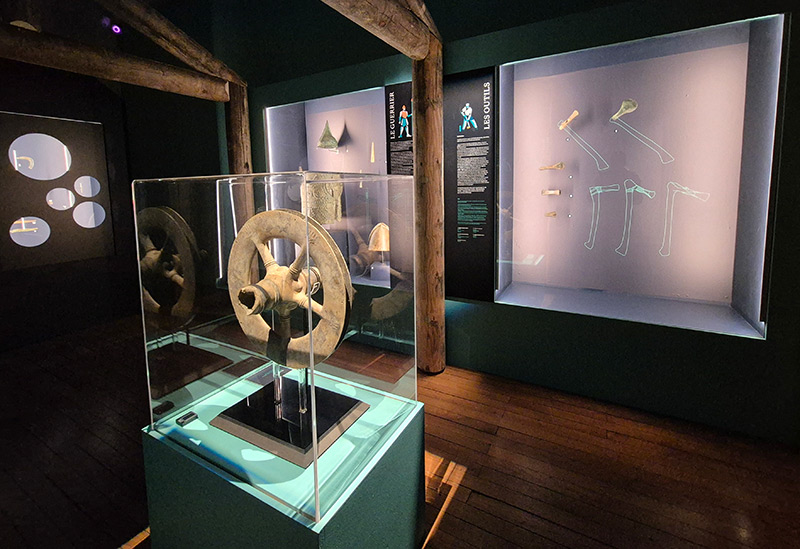
Moulins (Allier). For its ninth thematic season, INRAP has chosen … Bronze Age ( – 2500/ – 800): a field of study that has passionate researchers for fifteen years, carried by the discoveries of preventive archeology, but which struggles to infuse the imagination of the general public. “We are going with a big deficit to the public, who does not know at all the period on a chronological frieze”, notes Emmanuelle Audry-Brunet, head of the archaeological collections of the Department of Allier, and commissioner of the exhibition “The Bronze Odyssey”.
Labeled among the events of this “bronze year” (and also qualified “of national interest”), the exhibition of the Anne-de-Beauje museum therefore logically begins with a chronological frieze. And to be of course that the visitor will not emerge from the course by confusing this period with the Neolithic (which precedes it) or the Iron Age (which succeeds him), this frieze runs over several meters of picture rails.
A strategy taken up throughout the route, in order to inevitably deliver for the visitor most of the information. The voids are tremendously exploited by the MO-TO scenographic agency, especially through the graphic work that animates the picture rails. Great characters thus reconstitute, cautiously, what a silhouette of the Bronze Age could be, while small sketches arise on the frieze, worked illustrations which give its identity to the route.
Bernières-d’Ailly helmet, final bronze age (-1100, -900 BC), H.26 cm.
© Musée Métropole Rouen-Normandie / Yohann Deslandes
This light but scientific tone makes it possible to make the Bronze Age better known, by staging some objects which helped make this period confused. Thus, one of the helmets of Bernières-d’Ailly, discovered in Calvados in the 19th century, served as a model in the drawing of the head cover of Asterix, as well as the cuirass of Véria, found in the Jura in 1860, inspired Auguste Bartholdi for its Vercingétorix from Place de Jaude in Clermont-Ferrand. Two Gauls having lived, really or fictitiously, eight centuries after the end of the Bronze Age.
Always with the concern for not losing the profane visitor (and particularly the young audience), the course follows the principle of the funnel, laying the foundations in a large first part before devoting itself to the few particularly interesting local discoveries. Because Bourbonnais is one of the Bronze Age households: there are copper and tin mines, the two metals necessary for the manufacture of the alloy which gives its name to this era.
The presentation of the numerous ritual deposits discovered in the region is also addressed to lovers of local archeology and a more specialist audience, by informing about the issues linked to the interpretation of these mysterious vestiges: why were so many wealth abandoned in deposits? Do they correspond to abandonment of ritual sites? The filing of Ringères (Allier), discovered in 1911, with its gold objects, but especially the important deposits of Jenzat (Allier), which are at the heart of a current scientific program, let the extent of the phenomenon perceive.


