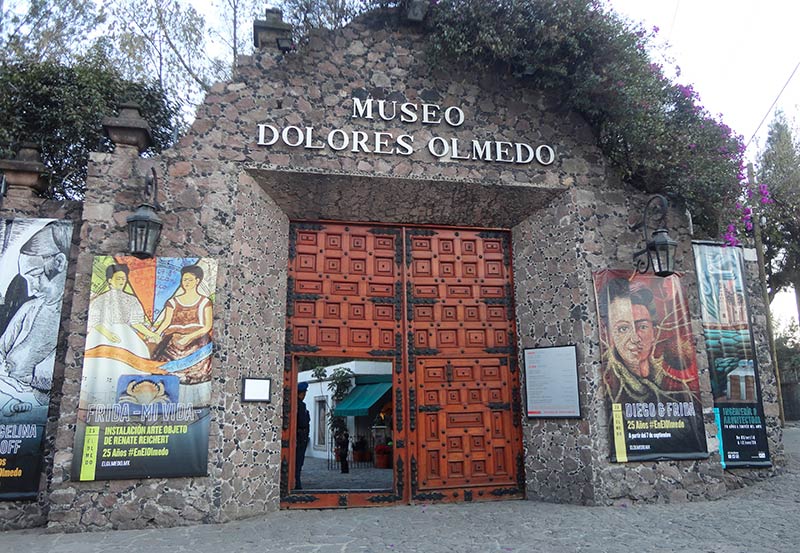
The Dolores Olmedo Museum, named after the Mexican collector who was notably the patron of Diego Rivera (1886-1957), reopened its doors on May 30. Since closing in 2020 during the pandemic, the La Noria hacienda, Dolores Olmedo’s former estate transformed into a museum, has been renovated and redeveloped. Its inauguration gives visitors access to the largest collection of paintings by Frida Kahlo (1907-1954) in the world.
The museum in Mexico City houses 26 paintings by the Mexican artist, including masterpieces like The broken column (1944). This self-portrait shows the figure covered in nails and dressed in an openwork straitjacket, which reveals a body crossed by an Ionic “column”, in the style of a surrealist literary game. The collection also includes Henry Ford Hospital (1932), an oil on metal that depicts the trauma of her miscarriage in a dreamlike setting. All of the paintings would have been acquired for the equivalent of $1,600 at the time, reports the New York Times. A ridiculously low sum compared to the current market, which makes this purchase an exceptional investment.
Frida Kahlo, The Broken Column1944, 40 × 30.7 cm, Dolores Olmedo Museum collection.
Guadalupe and Dolores Phillips Margáin, the granddaughters of Dolores Olmedo, intend to make it bear fruit. The current managers of the museum wish to include Frida Kahlo in a journey which had been designed essentially for the work of the artist’s husband, Diego Rivera. It was only after Kahlo’s death in 1954 and at his request that Dolores Olmedo acquired the paintings which, today, constitute the main wealth of the collection.
The museum is deploying a new story, in which the world-famous painter is honored. The museography has been revised to give it a more prestigious place: its works have been removed from the narrow wardrobe in which they were piled up, and now have two rooms out of the sixteen renovated. While biographers agree on the conflictual nature of the relationship between Dolores Olmedo and Frida Kahlo, the Margáin sisters want to focus their museum discussion on the similarities of the two women “cultured, non-conformist, and having married much older men”underlined Dolores Phillips at New York Times. The reassessment of the relationship from a feminist perspective allows us to highlight Frida Kahlo’s place in the hacienda, with the ultimate objective of promoting the collection.
But the development strategy through the Kahlo legacy comes up against constraints of different kinds. The location of the museum in a rather residential area does not allow it to exceed 125,000 visitors per year, a number much lower than that of the Casa Azul, located in the tourist and cultural district of Coyoacán, and whose number of visitors per year is estimated between 300,000 and 500,000. It had been envisaged to move part of its collections to the Chapultepec park, but the project, which had upset some of the inhabitants of Xochimilco, was abandoned due to the legal structure of the museum. As Luis Cacho, former head of legal affairs at the Mexican Ministry of Culture, explained to New York TimesDolores Olmedo had protected her collections and her estate by placing them in a trust, making any long-term relocation project impossible.
Committed to the preservation of Mexican archaeological sites, a fervent defender of the art of her country, Dolores Olmedo devoted a large part of her life to the dissemination of the work of Diego Rivera. After having been his model, then his patron, she was entrusted with the management of his work. The collections of the museum that she founded mainly for Rivera include 137 works and nearly 40 pieces by his first wife, the Russian visual artist Angelina Beloff. It is located in a huge property of more than three hectares in which Dolores Olmedo lived, after making her fortune in real estate development.
The museum wishes to promote its Frida Kahlo collection, while the work of the Mexican painter is scattered. The majority of his paintings are kept between the United States and Mexico, and approximately 10% are in Europe. Around sixty paintings by the artist belong to private collections, 18 of which are in the Gelman collection, dedicated to Mexican art. In 1984, a presidential decree declared all of Frida Kahlo’s work “artistic monument”in order to regulate its temporary export and prevent it from leaving Mexico permanently. This restrictive legal framework increases the rarity of Kahlo’s works and therefore their price. The painter currently holds the auction record for female artists, with the painting El Sueño (La cama) sold for 54.6 million euros during the “Exquisite Corpus” sale at Sotheby’s New York, November 20, 2025.