Dordogne, 1940. On a beautiful September day, Marcel is walking with his dog when he spots a hole in the ground. Intrigued, the teenager returned a few days later, armed with a few makeshift tools. Pocket knife and lamp in hand, he enlarges the opening as best he can before slipping in with three of his comrades. This is how we discover the Lascaux cave. Twenty years later, the observation is clear: the overcrowding of the site threatens its conservation. On the walls, a “green disease” and a “white disease” proliferate. The first is the development of microscopic algae, favored by the humidity and artificial lighting of the cave. The second, even more harmful, manifests itself by veils of white calcite formed in reaction to the excessive concentration of carbon dioxide, released by the breathing of visitors. In 1963, a decision caused a stir: André Malraux, then Minister of Cultural Affairs, banned access to the cave to preserve the rock paintings. Therefore, a question arises. How can we ensure rigorous conservation while responding to (very) strong tourist demand? The solution: make a copy.
Restore the emotion of the real cave
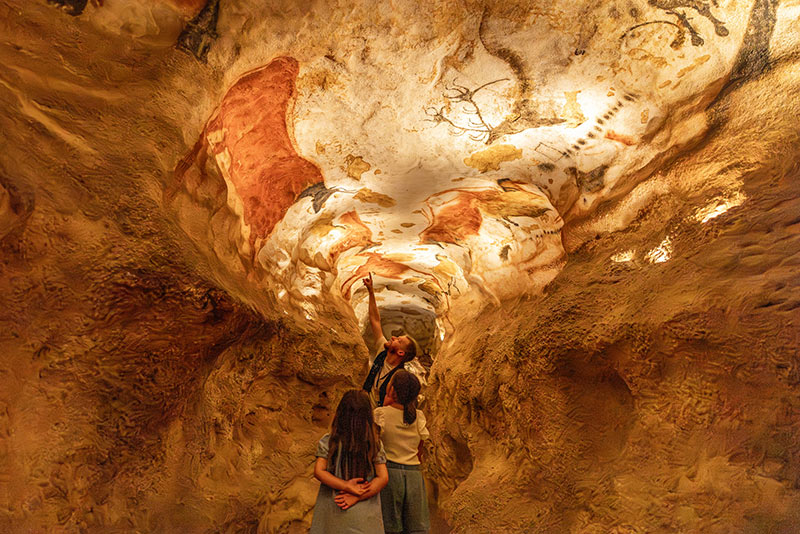
Show a heritage that is too fragile or inaccessible. Make the invisible visible. Even, in certain cases, keeping track of sites destined to disappear. These are the challenges of these replica creations, marvels of ingenuity and technology. It took eleven years to create Lascaux II, the first facsimile of a prehistoric cave in the world. Five years to design the structure and six to reproduce the paintings. When the replica opened its doors in 1983, on the same hill as the original cave, immersion was required. “It’s a facsimile made to the nearest square centimeter, which is very precise for the time! », admires Ludivine Texier, co-responsible for Lascaux II. “Those who created it weren’t looking for perfect precision. The goal was for the visitor to be able to feel even a tenth of the emotion that the real cave provides. » Only two galleries of the cave, the most emblematic, are reproduced from the ground to the vault. To faithfully restore their reliefs, the sculptors relied on measurements made by stereophotogrammetry, the technique allowing the walls to be modeled in three dimensions. Then the manufacturing work begins. A metal frame is made then covered with mortar, the ideal material for modeling, correcting, scraping or adding material. And to complete the illusion, a touch of Carrara marble imitates the calcite found on the original walls. Then comes the crucial stage of reproducing the cave paintings, entrusted to the painter Monique Peytral. “Inhabited” by the cave, it seeks to rediscover the gestures, the visual effects, the spirit of the Paleolithic artists. So we stamp, we blow with a blowgun, we use stencils, we work with pigments based on iron oxides found in the cave to recreate the yellow ochres… A story of trial and error, of incessant attempts where the artistic gesture meets experimental archeology.
The replies are necessary
Revolutionary for its time, Lascaux II opened the way to a new way of bringing decorated caves to life. Other reproduction projects flourish, rarely those of entire caves, but rather of carefully chosen walls. In the Prehistory Park of Tarascon-sur-Ariège, a Large Workshop brings together reproductions of the large frieze from the Marsoulas cave and panels from the Niaux cave. In Angles-sur-l’Anglin, a replica reproduces in the smallest details the sculpted frieze of Roc-aux-Sorciers. Even more ambitious, a second facsimile of the Lascaux cave, logically called Lascaux III, reproduces a part of the cave never reconstituted until then. These few panels, designed to be itinerant, have been traveling around the world since 2012. Marsoulas, Le Roc-aux-Sorciers, Lascaux: for all these caves closed to the public, the replica serves as the sole spokesperson. The same goes for the Chauvet cave (Ardèche), inaccessible since its discovery in 1994. It all started from a chance discovery. Three cavers notice a slight draft emanating from a blocked cavity. They unclogged it, rushed in and discovered a vast cavity in an exceptional state of conservation. On its walls, more than 1,000 representations dating from 36,000 years ago, the oldest known in France. Well aware of the importance of the discovery, and learning from the Lascaux example, the authorities automatically ban all tourism. Only a few scientists have the chance to access it, under strictly controlled conditions. At the same time, the idea of a replica develops and, little by little, it becomes reality. Here, no facsimile stricto sensu due to a major constraint: the size of the cave, which would require a surface area of at least 8,500 m2. Opened in 2015, Chauvet 2 is certainly two and a half times smaller than the original cave, but nonetheless remains, to this day, the largest decorated cave replica in the world. One hundred and thirty kilometers of hand-shaped steel rods, 14,000 hangers to hang the replica, 27 wall panels recreated at scale 1, 550 molded animal bones… For thirty months, the Déco Diffusion and Arc et Os workshops deployed all their know-how to show this underground treasure.
Entrance to the Niaux cave.
© Sesta
A second replica of Lascaux
Inaugurated barely a year later, Lascaux IV also required thirty months of hard work, carried out by the Ateliers des Fac-Silés du Périgord (AFSP). Cutting-edge technologies, precision to a sixteenth of a millimeter obtained thanks to 3D scanning: in just a few decades, the art of facsimile has risen to the rank of highly technical scientific expertise. “We work with bodybuilders, resiners, locksmiths for metal structures, building painters to quickly apply flat colors… Such a project is a real combination of know-how,” indicates Mathilde Vignaud, executive assistant at AFSP. In this process, the human gesture remains fully central. “We apply the dye with brushes of just one, two or three hairs to deposit exactly the same quantity of material, in the same place. » But why redo a replica when Lascaux II already existed? First of all to offer a much more complete restitution of the cave, but also because the incessant comings and goings of visitors on the hill generated vibrations in the ground likely, in the long term, to affect the original cave. For Lascaux II, the gauge is therefore set at 70,000 visitors per year. As for Lascaux IV, located on a slightly more remote site, it now accommodates around 370,000. Here, only the small galleries at the end of the cave, very difficult to access, have not been reconstructed. Low light, muffled sounds, and reliefs reproduced to perfection, all that’s missing is humidity to complete the illusion.
Cosquer, masterpiece in danger
Protection issue, preventive conservation issue… There remains another case where the replica takes on its full meaning: when the very location of the cave makes it inaccessible. In the creeks of Marseille, at a depth of 37 meters, lies the entrance to the Cosquer cave. Access to the site, dangerous even for an experienced diver, is via a long hose going up to a surface area. Suddenly, the decor changes: colossal stalagmites, handprints, a profusion of drawn and engraved animal figures… It is in 2022, more than thirty years after its discovery, that the cave can be seen through its faithful reconstruction, which takes place in a building adjoining the MuCEM – Museum of European and Mediterranean Civilizations. Due to spatial constraints, the cave is fragmented into several parts, like a sort of ” tetris” giant, in order to optimize space by integrating the most beautiful parts of the cavity. We then had to deal with a very specific constraint: the designers and technicians did not have access to the original cave to immerse themselves in it. The replica is therefore entirely based on a virtual model, which made it possible to reconstruct all the topographical richness of the cave. The importance of such a creation is self-evident. To satisfy the curiosity of current visitors of course, but also for posterity. The inexorable rise in water levels makes the Cosquer cave an endangered masterpiece, threatened with disappearance. While 4/5ths of the cave have already been submerged, how can we not also see a duty of transmission? When the replica participates, in its own way, in the survival of the authentic.
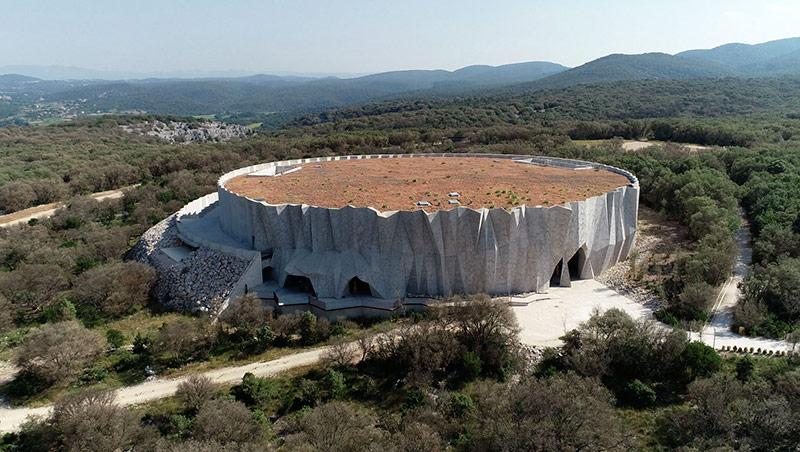
The Chauvet-Pont d’Arc cave in Ardèche.
© Caverne du Pont d’Arc
Are you afraid of depths? This is clearly not the case for diver Henri Cosquer who, during an exploration in 1985, discovered the entrance to the cave 37 meters below the surface of the sea. While some rooms are completely submerged, others preserve representations of aurochs, chamois and even penguins. Above all, the meeting of water and rock has formed an extraordinary geological landscape: columns bringing together stalactites and stalagmites, fistulas and other concretions similar to chandeliers… A true underwater cathedral.
Lascaux Cave
“We have not invented anything,” Pablo Picasso is said to have declared when faced with the striking spectacle offered by the frescoes of Lascaux. Whether or not these words were spoken, the facts speak for themselves. Grandiose, mythical, the most famous of the decorated caves has no less than 680 cave paintings and 1,500 engravings. Animals in profusion, mysterious geometric signs and, among them, a single human representation: a man with the head of a bird facing a bison. Hunting scene? Shamanic vision? Lascaux has not finished revealing all its secrets…
488, chemin de la Grotte, Montignac-Lascaux (24), lascaux.fr
Niaux Cave
Bison, horses, aurochs, fish, ibexes, deer and even weasels! An impressive bestiary covers the walls of the Niaux cave for around 13,000 years. These drawings, many made in charcoal, darkened the walls of an impressive gallery in the heart of the cave, which has since taken the evocative name “Salon noir”. A marvel to see with your own eyes since the cavity, visited since the 17th century, is still accessible to the public today.
Cave of Pech-Merle
Imagine traces of red or black hands left in negative, spectacular spotted horses… No need to dream them, just go to Quercy to discover one of the rare decorated caves still open to the public. At Pech-Merle, we admire not only the animals and curved female figures that populate the walls, but also the great geological richness of the site. A small underground world shaped by concretions of all kinds!
Rouffignac Cave
On one wall, mammoths. Opposite, mammoths… A little further on, more mammoths! If the Rouffignac cave contains other animal representations, it is especially famous for its approximately 158 mammoths drawn or engraved in the rock. It alone brings together more than a third of the representations of mammoths known in cave art. An omnipresence which raises questions, especially since these pachyderms have only rarely traveled the lands of Périgord…
Chauvet Cave – Pont d’Arc
What is immediately striking here is the power of the movement which animates the animal representations. Running felines, rhinoceros fighting, herds on the move… An incredible dynamism at the time, reinforced by the flickering light of the torches that our ancestors carried along the walls. In this 36,000-year-old cave, the oldest decorated cavity known to date in France, the artists already demonstrated astonishing technical mastery: blurring of lines, effects of perspective and use of the natural reliefs of the rock to give volume.