Ivry (Val-de-Marne). “Infinite garden” at the Center Pompidou-Metz and “Jardins” at the Grand Palais in 2017, “We Les Trees” at the Cartier Foundation in 2019 … Exhibitions on the forest, trees and gardens are flourishing in institutions in recent years. Ultimate exhibition on the theme, “a modern nature” could put off more than one. Claire Le Restif, director of Crédac and curator of the exhibition, nevertheless offers a good reflection on nature as a place of resilience.
“A modern nature” presents photographs and drawings of gestures belonging to horticulture, landscape architecture and sweet forestry. These gardens and forests are “ Resistance spaces “to use Gilles Clément’s formula. The garden cultivated by Derek Jarman after the announcement of his seropositivity – object of the newspaper Modern naturewhich gave its name to the exhibition – is a fight for the survival of plants in hostile territory, immortalized by the objective of Howard Soley. But, are the pictures of the Jarman and Pierre Creton gardens, and are the sketches of the Somotor Léa Muller works of art or archives of gestures? One thing is certain, the Crédac raises the question of the activity sectors that a contemporary art center can claim to cover.
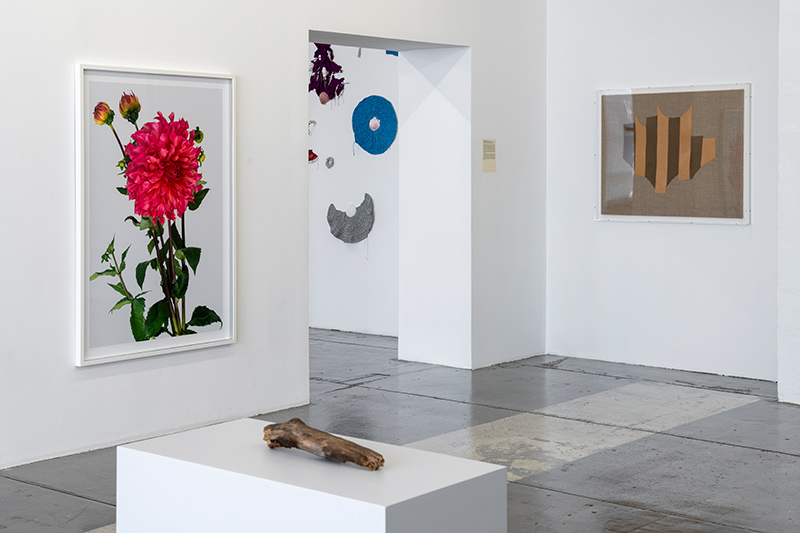
Guillaume Aubry, The pond in devil2025, view of the exhibition “A modern nature” at the Crédac.
© Marc Damage
© Adagp Paris 2025
The plastic works selected for the exhibition also form a coherent and homogeneous quality corpus. The weeds of the series Weed (2007) sculpted by Tony Matelli are disturbing of realism. His oxidized bronzes and then painted by hand transcribe the browning and scorching of the leaves wonderfully thanks to the thoroughness of its green and brown grades. These works make him a worthy heir to Giuseppe Penone. The pioneer of the Arte Povera described his own anti-sculptures bronze trees because of their ability to blend into the environment: the different patinas reflect the colors and nuances of the vegetation. Further on, Silvana Mc Nully shows the extent of his talent for weaving and hook. In the wake of the dead leaves sewn and connected to each other by Susanna Bauer, natural and manufactured objects gleaned by MC Nullity access a second breath. His shells inserted in crochet wire networks, looking like a mandalas, are very delicate.
The economy of means irrigates the scenography of the exhibition. This could be qualified as frugal: all the pieces of furniture come from old exhibitions of the Crédac and several series of photographic prints have not been supervised in order to limit the production of museographic equipment. The exposure texts were printed on simple sheets of paper. The art center has also bet on a transport of local works: the works are kept in France, with the exception of a creation from Germany. While institutions are often content to approach the ecological question in their programming without changing their practices, sobriety and sustainability are here at the heart of the Curatorial project.