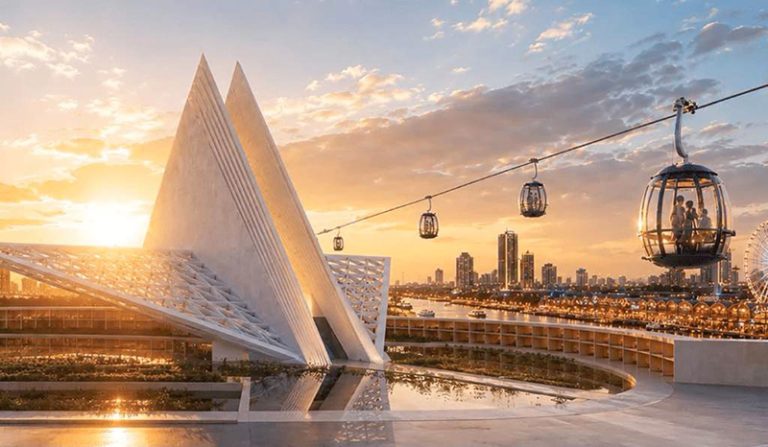
Taipei (Taiwan). Designed by the Taiwanese architect Kris Yao, the new Taiwan museum housed in a building of more than 32,000 m² cost around 85 million euros (2.9 billion Taiwanese dollars). Mainly funded by the municipality of New Taipei, a vast agglomeration of 4.6 million inhabitants surrounding Taipei, the museum reflects the ambitions of the mayor Yu-Ih Hou, candidate of Kuomintang who arrived second in the presidential elections of 2024.
Directed by Hsiang-Ling Lai, the NTCAM currently has 48 employees. A experienced figure in the museum world, Lai has piloted several institutions in Taiwan (Moca Taipei, C-Lab) as well as Rockbund Art Museum in Shanghai. Asked about the museum’s mission, she insisted on her vocation both local and transregional, while exploring the multiple facets of visual culture, from crafts to architecture. It underlines its commitment to the local community and the international influence of the institution, in order to enhance the contemporary Taiwanese scene while connecting it to the rest of the world by targeted programming.
The NTCAM has its own permanent collection, partially inherited from the municipality, while pursuing a policy of acquisitions, including by orders. This is accompanied by a residence by artists, including the French Sara Ouhaddou will soon be part. After a first phase by invitation, a call for applications should be launched in 2026 for a two -month residence the following year.
Hsiang-Ling Lai also surrounded himself with five major figures from the museum world to form the international advisory committee (International Advisory Committee) of the museum: Mami Kataoka (Mori Art Museum, Tokyo), Clara Kim (Museum of Contemporary Art, Los Angeles), Hanru Hou (former director of Maxxi, Rome), Patrick Flores (National Gallery Singapore) and Aric Chen (leaving for the Nieuwe Institutut, Rotterdam for the Zaha Hadid Foundation, London).
The double anchoring, both local and international, is reflected in the two main inaugural exhibitions. Encounters in Reflection (Mirror meetings), designed from the permanent collection, traces a century of creation in Taiwan and New Taipei. It explores the migratory history and the industrial fabric of the region, which was the first “workshop of the world” in the 20th century, before the rise of China. The emphasis is placed on the diversity of artists, including ethnic minorities (canvases of Si Jinoboya and Puhungan) and sexual (video of Posak Jodian dedicated to the transgender artist Hao). The second exhibition, Radical reimagining cities (Imagine the radical cities otherwise), explores town planning from a transcultural angle. Wu Chuan-Lun, Taiwanese artist shared between Berlin and Tainan, illustrates this approach in an original way with an installation composed of industrial ceramics produced around the world. The exhibition also brings together international artists, such as Korean Haegue Yang, the Singaporean Ho Rui An and the American Michael Rakowitz, who question contemporary town planning.
The museum attracted a large audience when it was opened, benefiting from free access until the end of June. Coming from a project developed over ten years, its strategic location takes advantage of complementarity between the canton of Yingge, a high place of ceramics, and that of Sanxia, family residential area, welcoming the National Taipei University campus. Located thirty minutes from Taoyuan airport, it forms a well served triangle with Taipei. This local link was reinforced by upstream initiatives (exhibitions out of the mother, research work, conferences) which allowed the population to familiarize themselves with the project. Designed as a place of life, the museum also welcomes various businesses (including fruit and vegetable merchants) in its enclosure, alongside the usual shops and cafes, thus promoting the commitment of local communities.
The inauguration of the NTCAM illustrates the dynamic museum at work in Taiwan, despite the geopolitical turbulence that surrounds it. According to the Taiwan Museum Association, the island has 490 museums (art or other) in 2025, a dozen more than before the pandemic, with a balance between public (55 %) and private (45 %) institutions. The recent openings are proof of this, whether it is public institutions, such as the NTCAM, or private, such as Fubon Art Museum inaugurated in Taipei at the end of 2024. At the same time, the major museums are growing: the branch of the National Palace Museum in Chiayi and the Fine Arts Museum (TFAM) are engaged in extension projects, planned for 2026 and 2028. Taiwan thus displays one of the strongest Museum densities in Asia with 21 museums per million inhabitants, a figure equivalent to that of South Korea, and five times higher than that of the People’s Republic of China (4 museums per million inhabitants).