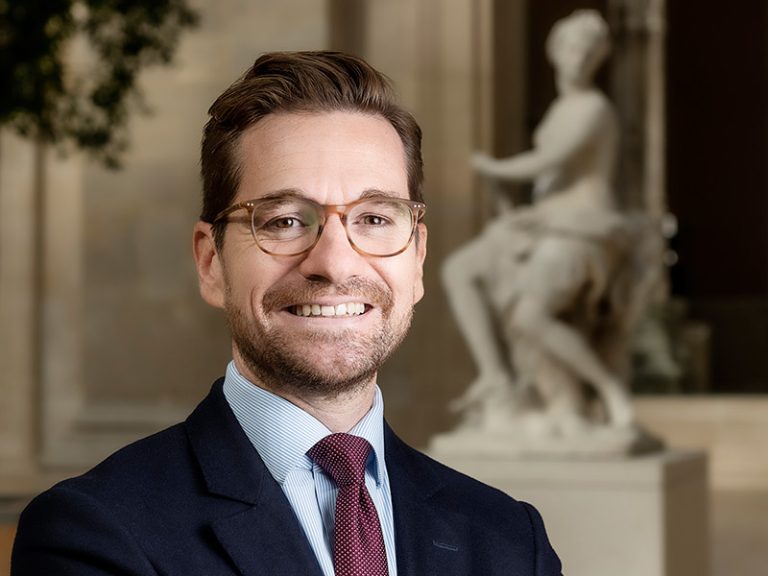
Beauvais. First seat of the bishop of Beauvais then court, then museum, the 16th century building which houses the Museum of Oise (Mudo) experienced several lives of which he retains traces. Partially restored in 2015, it reopened at the end of March 2025 after two and a half years of work intended to restore its identity to the second floor while modifying the visit route. If the first floor offers a barely revamped course centered on religious art in the 19th century and the history of the great political canvas of Thomas Couture (1848-1852), the second floor had a facelift to present Art Nouveau furniture and the canvases of the 20th century: the previous course, where no furniture was not, had not been modified “Since 1981” According to Alexandre Estaquet-Legrand, director of Mudo. In addition to a room devoted to symbolism and ceramics, the course extends over several large rooms, the first of which is devoted to sets of Art Nouveau furniture, “Typical elements of the beautiful era spirit, never exposed so far”according to the director. This specifies that the exhibition modules were made to measure with the scenographers to allow fluid circulation, despite the ground surface they occupy. These modules respond with their curved forms to the Ovoid room seats which dot the route and give it a poetic touch. Art Nouveau furniture with flamboyant patterns (parrots, flowers) constitute the culmination of the first part of the route.
From the Great War to the Second World War, the course then unfolds the history of the 20th century with fairly exceptional pieces, from Vallotton, Denis, Dufy, Picabia, Hélion and Lempicka. The Mudo collections therefore reveal their wealth, including graphic arts, a small selection of which is available in side rooms. All the rooms have walls covered with dual gray skin with discreet geometric patterns which covers the original walls. The gray shade declined in nuances remains fairly close to that “XVIII woodworke century “ From the Great War room, according to the director. These woodwork was also kept during the catering: in this new route, the architecture of the building is indeed skillfully integrated, although the site has reserved some surprises according to the heritage architect Charlotte Langlois. She quotes for example “XII masonry coverse or XIIIe century, and others from the XIXe century, not documented despite the diagnosis made in 2019 ». Restoration had to combine “ valuation of different periods and adaptation to the new museography ” According to Charlotte Langlois, a fundamental aspect for the second floor which housed the private apartments of the bishop and therefore has beautiful volumes to enhance.
The total cost of work is 3.55 million euros, the state of which has financed the essentials via the national land development and development fund (€ 1.2 million). The reopening seems to dopy the ambitions of Alexandre Estaquet-Legrand which announces regular temporary exhibitions in the towers of the entrance chatelet, and a project for the third floor where the visit would relate to “Architectural interest” Since space is not suitable for the presentation of works.
The quadrilateral redefines its identity
Ciap. Built in 1976 by André Hermant, the quadrilateral hosted the national tapestry gallery until 2013. Having become an art center and then closed for two and a half years of work, the concrete building reopened in April with a new identity. In addition to the large exhibition spaces on the ground floor, the quadrilateral now houses a center of interpretation of architecture and heritage (CIAP) and an unprecedented route of the Gallo-Roman vestiges. The renovation, which cost 9 million euros (including 5 million from the city), modernized entry and access to exhibition halls with a beautiful staircase all in curves (Chatillon architects). All the rooms (2,000 square meters) have white walls with “an aesthetic of White Cube “, According to the director of the quadrilateral Lucy Hoefbauer. The basement, previously exhibition space at the ocher walls, is devoted to the CIAP which retraces the history of Beauvais in a lively way: multimedia table on the evolution of the city (compulsory in a CIAP according to the director), panels on local industries and town planning, models of the cathedral. The scenography and its color code per historical time makes the route very readable. At the same level are the Gallo-Roman remains, vestiges now open to the visit. A bridge makes it possible to browse the remains of a “monumental structure in an arc of circle of the 3rd century AD”, whose function remains vague according to the archaeologists of the city. These vestiges, witnesses of Beauvais’s richness in Antiquity, complete the CIAP. The architectural link with exhibition spaces is not obvious, but Hermant wanted to include contemporary art and archeology in the same building, and this renovation respects its wish. The quadrilateral therefore inherits a triple cultural function.
The Beauvais quadrilateral.
© Antoine Mercusot / Chatillon Architects