Madrid,
In the case of Huguette Caland, the biography matters: daughter of the first president of the independent Lebanon and born in her capital in 1931, she developed a good part of her career in Paris and Los Angeles to return to Beirut at the end of her life (she died in 2019 ). Both this and his artistic career were marked by the search for freedom, in every way – at the time of living, creating, exercising motherhood, focusing their relationships – and the conviction that all people were entitled to Find your place in society.
Although it cost him to reach international recognition, he got his production part of the collections of centers such as the Hammer Museum and Los Angeles, the MoMa and the Met of New York, the Tate Modern or the British Museum in London; From there they come a good part of the pieces that now integrate “a life in a few lines”, the anthology that the Reina Sofía Museum offers in collaboration with DeichTorhallen; Others, which he carried out during his youth in Lebanon, have not been able to travel to Madrid because of the Palestinian-Israeli conflict. One of them gives title to this exhibition.
There are about three hundred the works gathered, including drawings, paintings, textiles and collages, sometimes unpublished, and the purpose of this assembly, attending to his police Beyond his well -known transgression of the conventions of his time and his country, of his management of uprooting after settling in Europe and the United States and his positions Theoretically apolitical.
Caland’s works are exhibited in Reina Sofía in a dozen rooms, attending to chronological criteria, continuing their progress with their past and linking their personal and artistic development with the scenarios where it resided, from the convulsive Beirut freshly independent, to the utopian Paris of the sixties and the following decades, the creative bohemia that Los Angeles took, and Venice Beach, during the nineties and 2000, and the last return to Lebanon, where he would die.
The artist’s closeness with the political universe was narrow and was not only due to her family history, no matter how much she tried to stay out and did not formulate closed opinions: her husband, father of her three children, was a member of the party opposition of the French ancestry over her country, and she, in 1969, co -founded INAASHa non -governmental organization that today continues to help the Palestinian women of the Lebanese refugee fields to obtain benefit from the traditional work of the Palestinian embroidery, the Tatreezpresent in some of his compositions along with other forms of embroidery.
Caland, who at some point handled the desire to be a writer instead of a plastic artist, did not consider that the tools of art had to be their instruments to be: he wanted to bring to his work his meetings with lovers, friends, family, cultures, artists and writers, animals, insects and even landscapes; Without leaving aside his tendencies and beliefs: he manifested himself in favor of sexual freedom and against various forms of social conservatism.
The first picture of this author, Red/cancer sunhe carried out just after his father’s death because of that disease, representing both the way he had devoured him as the new beginning that he opened before her; He would then enter the American University of Beirut, where he formed a style that drank from very diverse sources, from Surrealism to pop through the contemporary currents of graphic design. Throughout his career he made a good number of self -portraits and one of the few in which he presented himself specifically as an artist, with signs of his production both in his body and in the background, he can be seen in the MNCARS: Self Portrait in Smockof 1992.

Fantastic creatures and urban and natural landscapes also populate the works of their first period and tell us about their desire to go out of their known environment and to advance in the treatment of body, language and graphic signs. Pieces like Take your finger (1971), executed shortly after leaving their country, report their thirst for expressive freedom when it is in their country, in the years prior to the civil war.

Established in Paris, Caland found in Caffa a kind of identifying and liberating garment, strictly physical and in mental frames: he did not want to adopt European clothing. Although at this time he barely exposed, he did not stop working: it was then that he began his best known series, Corps/body pieceswhich stands out for its chromatic power, which seems to refer to the colored fields, and their formal minimalism. We find in these works forms of brilliant tones that become suggestive representations of asexual meat, erotic landscapes in which the palette wins the line.
Gradually, especially after the end of the bloody war in Lebanon, those pieces began to adopt different scales, even the size of a postcard, and those parts of the body acquire eyes and almost caricaturescas with wide and gathered lips, adding new holes to Your repertoire. That evolution would culminate its rawness in compositions such as INCIVILE GUERRE (1981), in which bodily fragments no longer suggest pleasure, but agony, no matter how much a latent eroticism in their usual coexistence with death.

Reina Sofia has also arrived, her drawings of sinuous lines: in the use of the continuous line, the one based on not lifting the pencil until she had resolved her ideas, John Carswell had instructed her. The procedure responded, anyway, one of its reveries: A single line that crosses the universe. It has been my great fantasy … It is an elastic and totally imaginary line. For me it exists. Every time we draw something, we caught that line and then let it go. These linear drawings came to take them to their caftans, as embroidery that encourage the body under clothes; He exposed them about mannequins.
In his French stage, as we see, the body and its relationship with the treatment of individuality and autonomy were the center of their work, in which the parts of that body and the less visible emotions externally won prominence. His paintings approached three -dimensionality: in FUNAMBULE (1984), a figure challenges gravity while walking on a tense rope; It is possible that he found a certain personal identification with her.
After traveling with his then lover, the sculptor Georges Apostu, to limestone quarries surrounded by oak, incorporated into his creations landscapes that they sent, although altering his scales, at early works in Beirut or the bodily undulations of Corps Bribes. Those references flow naturally: Nothing looks so much like a body and a landscape … the same lines could resemble a face, a flower, a landscapehe said.
Nothing looks so much like a body and a landscape … The same lines could resemble a face, a flower, a landscape.


That confluence of nature and landscape would maintain it in Los Angeles, where it moved in 1987. In the collage self -portraits that the writing and painting be mixed there, and even illegible fragments of the letters they had sent to a Lover decades before, previously torn apart. These images appeal to communication, but also to silence, which she defined as the best way to express itself. In America it also made the series Money does not buy happiness, but it contributes greatly to itformed by small pictures built ironically from coins, obviously erotic compositions, or the series Silent lettersits return to the language exam: writing becomes linear expression that springs from lines made in pages of handwritten cards for real recipients.
In parallel, and in grids, Caland explored the way in which the line could acquire meaning in the urban landscapes in which it lived, in rectilinear organization; We can identify them with the quadriculated apples of Venice Beach, but also with Beirut’s chaotic urbanism: it is possible that they transfer their desire to locate and specify a sense of home that began to be elusive.
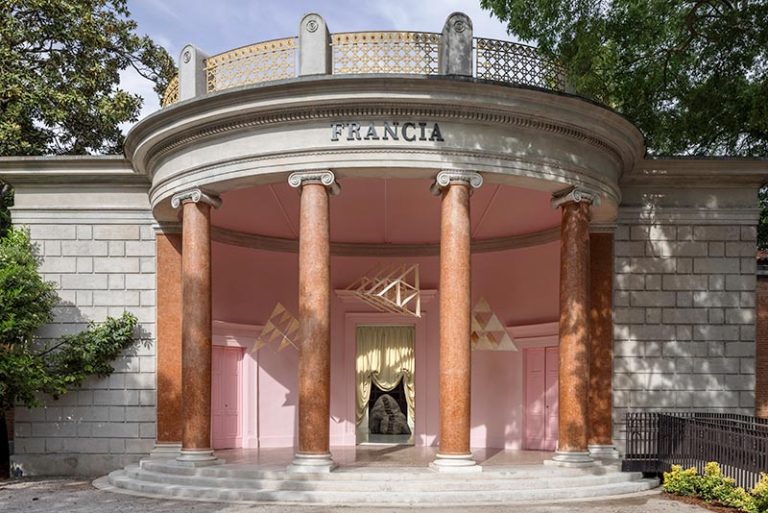
Already in 2013 he returned to Beirut, where he would create from a language -based language, grooves, cross points and diacritical marks; With them it generated caricaturescos faces and fantastic insects inserted into patterns that remembered the Palestinian handkerchief. He also worked, at the end of his life, in large canvases, almost murals, although sometimes they resemble tapestries or mats he painted in parts, after previously dyeing his fabrics in the washing machine. In bright colors, they suggest dreams of youth, visions of places that never saw or evocations of death. Before death he had time to participate in the 57th Venice Biennial, in 2017.

“HUGUETTE CALAND: a life in a few lines”
National Museum of Art Center Reina Sofía. MNCARS
C/ Santa Isabel, 52
Madrid
From February 19 to August 25, 2025