Nice (Alpes-Maritimes). If the previous exhibition, “counterpoint Yves Klein in the collections of the Matisse Museum”, was unconvincing especially in the slow demonstration that it made the influence of Matisse on Klein, the implementation (s) of the new proposal of the museum which explores the links between the artist and the Mediterranean is more successful. It is true that the subject is more usual.
The links which unite Henri Matisse (1869-1954) and the Mediterranean were many times discussed in books and exhibitions. They are also very well described by the artist himself: “As importance, it’s the Mediterranean. I did not know her, who was a man from the North, it is the Mediterranean who struck me the most. (1) “
Exceptional loans
Henri Matisse, Bathers with turtles1907-1908, oil on canvas, 181 × 221 cm.
© Saint Louis Art Museum
The course proposed in Nice is distinguished by exceptional loans that the museum obtained during the Biennale des Arts and the Ocean and the Third United Nations Conference on the Ocean. He is also appreciated by the links that the commissioner weaves between the work and the environment of Matisse, often a matrix and source of inspiration for the work.
“Matisse Mediterranean (s)” opens onto a fertile dialogue between Bathers at the turtle (1907-1908, Museum of Art of Saint-Louis, Missouri, [voir ill.]), very influenced by his discovery of Giotto during a trip to Italy, Luxury, calm and voluptuousness (1904) and Dance (1907), a small wooden sculpture. It is an incredible chance to be able to contemplate together these works, the first of which will undoubtedly not emerge from the United States before decades, but the strength and qualities of the exhibition does not reside only in the capacity of the commissioner to bring together and make masterpieces dialogue.
The rest of the route intelligently combines geography and chronology, making the public travel through the places visited and figured by the painter thanks to a blue line overlooking the works (paintings and watercolors) and on which the topography is mentioned (Corsica, Saint-Tropez, Collioure, Marseille …). The works of this section are numerous, perhaps a little too much (24 on a single wall). This first part, conventional in its hanging, can disappoint the initiated visitor, the works lacking significantly breathing, but it should seduce the general public with its didactic approach.
The desire for pedagogy is indeed one of the main qualities of this exhibition. In this perspective, the corridor usually devoted to chronologies presents a cartography retracing the geography of Matisse’s travel in the Mediterranean. Its precision leads the spectator into the successive trips of the painter. She prepares him to identify and recognize in the following rooms the places represented by the artist in his works.
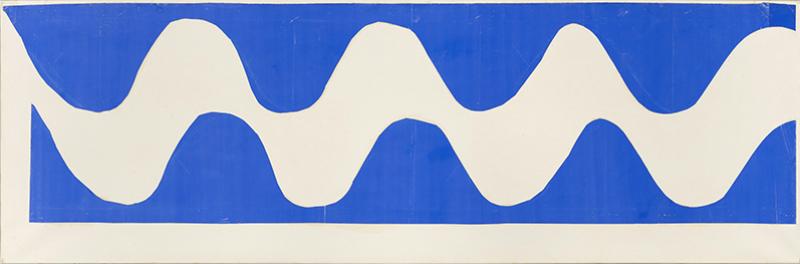
Henri Matisse (1869-1954), The waveNice, around 1952, cut papers cut, assembled and marouflaged on canvas, 51.5 × 160 cm, Nice, Museum Matisse, donation of the heirs Matisse, 1963.
© François Fernandez
If the museum houses many treasures in its collections which allow to light up the work of Matisse (the city of Nice has received a significant set of paintings, drawings, prints, letters and gouaches cut), the furniture and the objects with which the artist lived – 150 objects in all preserved by the museum – had so far had never been so precisely put in perspective with the works of the master. This is one of the interests of this exhibition: to confront a selection of works with the models and/or the objects present in the workshop of Matisse and figured in his paintings.
Among other examples, we will note from the first room the presence of a vase and a wooden sculpture. Further on, a showcase very rightly presents a coffee cup, a tin pot, a porcelain jug, a coffee maker as well as a vase brought back from a stay in Spain, treasures found on the wall represented in the paintings, often in the form of still lifes.
Finally, in the last room sits the rock chair, from 1946, whose armrests are singing sea snakes and feet, hippocamples, while a photograph testifies to its presence in Vence. The Red House, which in the Cimiez Arena Park has housed the Matisse museum since 1983 – this domestic space, with its terracotta floor, its decorated ceilings and its lounge – has often been considered unsuitable for the presentation of the Master’s works, because probably a little too far from the White Cube To magnify them. This dialogue between the parts of the collections takes on its full meaning here and allows what would perhaps have been impossible, in any case less eloquent, in a white cube.
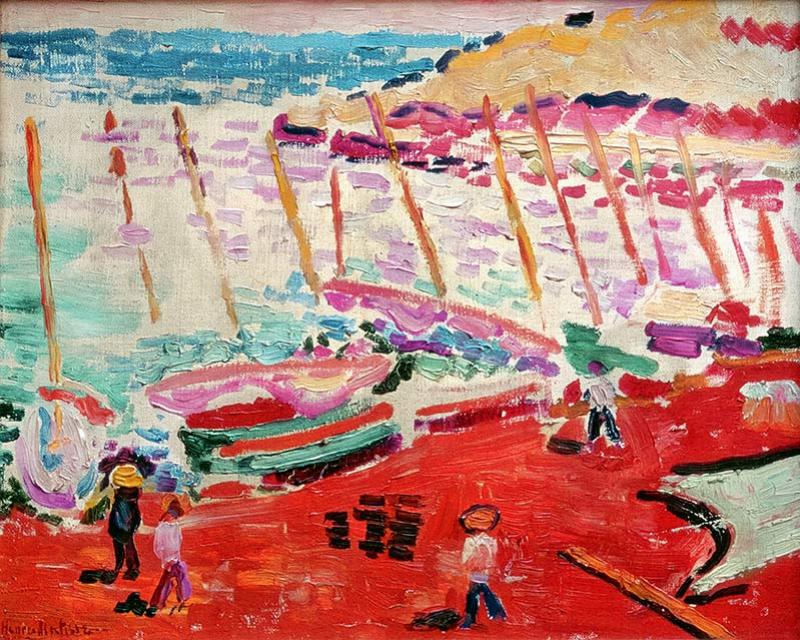
Henri Matisse (1869-1954), Red beach1905, oil on canvas, 33 × 41 cm, private collection.
© DR
(1) Pierre Courthion ,, Serge Guilbaut (dir.), Paris, Skira, 2017.