Next November will mark five years since the death of Carmen Laffón, the Sevillian artist who made the most everyday objects, as useful as they are unused today, and the landscapes that were equally close to her, the axis of emotional paintings, almost always soft in her palette, and of intimate and silent atmospheres – in her mature production the human figure rarely appears, and when we find them they will be, in most cases, sleeping children.
The first major monograph since his death, and also his first retrospective since the one given to him by the Reina Sofía Museum in 1992, can be visited starting tomorrow at the Thyssen-Bornemisza National Museum. It has been curated by Paula Luengo and, if that first appointment at the MNCARS summarized her work up to that point, the one that is now opening pays attention above all to her last two decades of career, although she combines it with previous paintings.
In those paintings after 1992, which for Guillermo Solana was a turning point in his career, Laffón preserved his lyrical intimacy and his love for the closest interiors and belongings, but he developed the desire to go further: it was then that he created his landscapes of the Bajo Guadalquivir in large format, marked by a chromatic articulation of a Rothkian air and by a greater intensity, at times, in those tonalities. He also continued sculpting, but with greater ambition in the scale and materials of his pieces; Laffón always remained attentive to the international development of these disciplines, from minimalism onwards.
A working mechanism that he neither before nor after that year abandoned was that of serial creation, fully characteristic of pictorial modernity and which will imply the almost definitive displacement of the concept of a unique, singular masterpiece, the result of numerous previous trials aimed at its achievement. Since Monet, all the pieces that make up one of these sets may have an equivalent value and the same truth, associated with the experience and sensations of the artist and not so much with an external validation. So intrinsically modern is this notion of a series that some living creators unwilling to embrace contemporaneity without nuances have not appropriated it until very recently; This is the case of Antonio López.
Laffón worked on these sets and variations early on, after the scholarship that led him to train at the Royal Academy of Spain in Rome in 1955: among his first are those dedicated to people from the Modiglianesque air field or to the Marcelina doll; From the latter we will see a couple of compositions at the Thyssen, one of them recently published. These projects, dates aside, reveal his conception of the work of art as research in progress, not as an object capable of being finished and remaining closed in its implications.
In this exhibition, these fundamental series have been represented, along with some images that are not strictly part of them, but that we can consider variations, reflecting an evident recurrence of motifs. Her production contains a clear tendency towards the cyclical, towards growth in the form of germ, insinuation and development: it is difficult to think that this author considered either the themes or the exploration of her treatment as concluded. Her painting grew organically and without her throwing anything out the window.
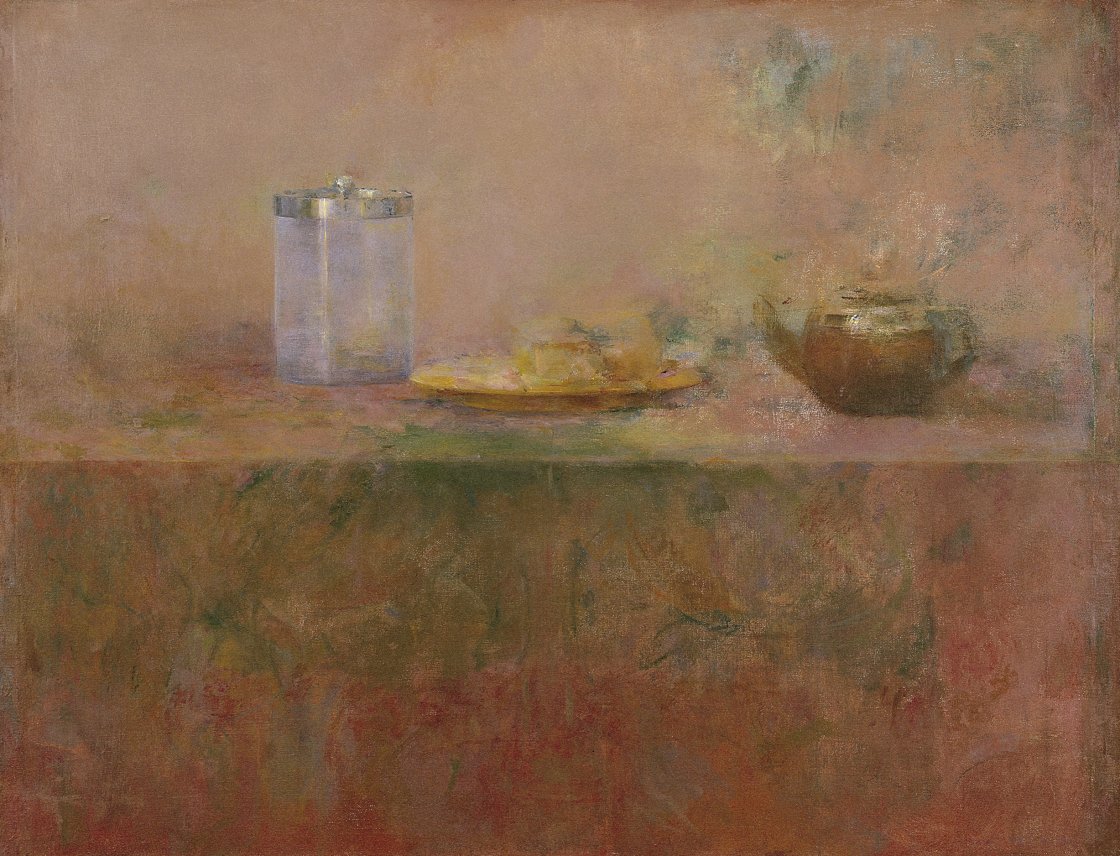
Carmen Laffón. Still life of the cookie maker1991-1992. CaixaBank Collection. © Carmen Laffón, VEGAP, Madrid, 2026. Photography: Claudio del Campo
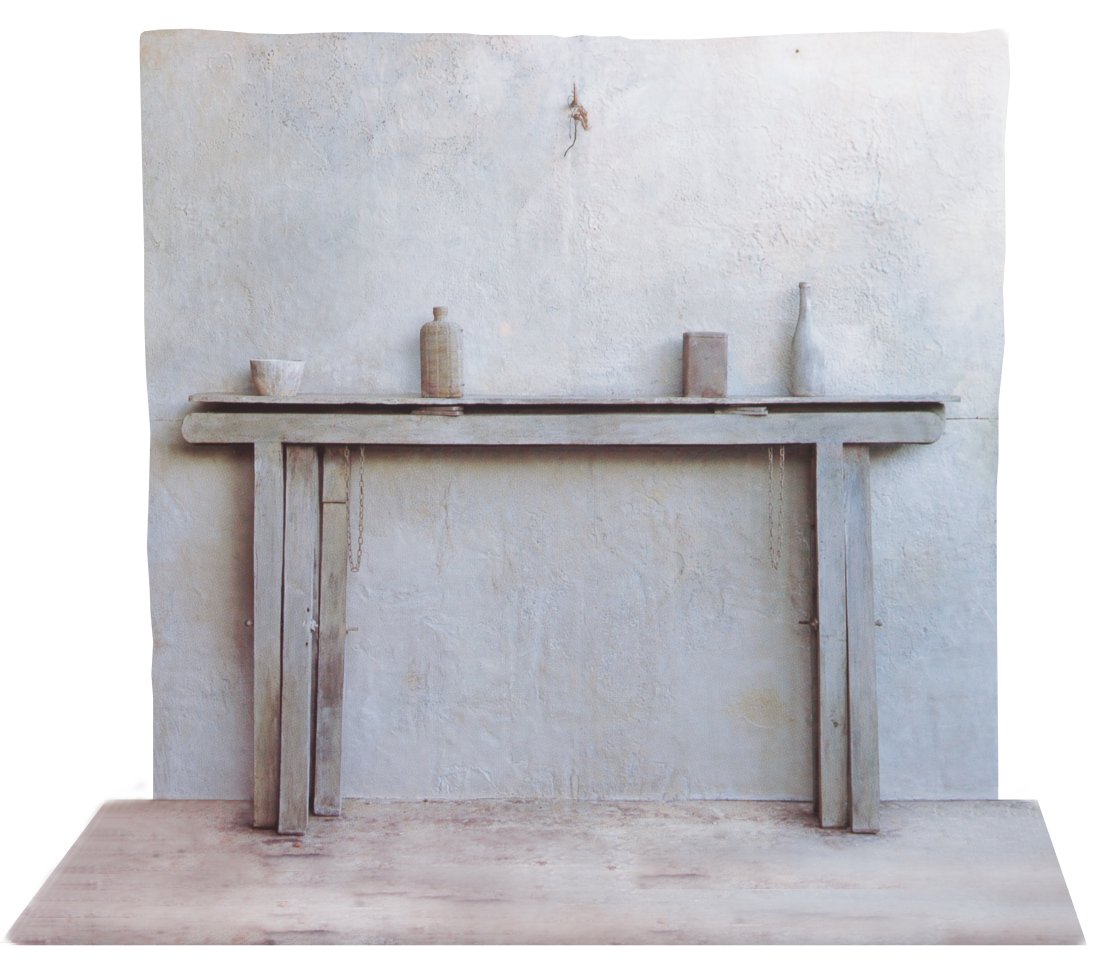
Carmen Laffón. improvised shelf2002-2003. Private collection. © Carmen Laffón, VEGAP, Madrid, 2026. Photography: Claudio del Campo
The anthology is structured into up to nine thematic sections that combine works from various chronologies, starting with a first section focused on the doll and the cradle, both motifs that connect with childhood and that he cultivated up to thirty years away. Marcelina’s scenes give off a certain magical realism; those of the cribs seem to accentuate the vulnerability of the newborn they shelter, inserted, moreover, in pure light.
Both precede his great inclination towards still life, with whose formats and techniques he would experiment again and again through, as we said, very modest objects. Normally these are horizontal still lifes arranged in two planes; He gave his attention to the surface on the table and blurred the surroundings until, in the nineties, he incorporated landscapes as a background or decided on verticality; even in three dimensions.
Laffón had some favorite objects, among them wicker baskets, which first appear in a more discreet way and then become absolute protagonists of his canvases; also traditional sewing machines. Both of them alluded to the sphere of the domestic and the then feminine, and in themselves incorporated games between the visible and the invisible, occasionally being hidden under fabrics, a procedure that served to test his virtuosity while generating mystery and which he never stopped using.
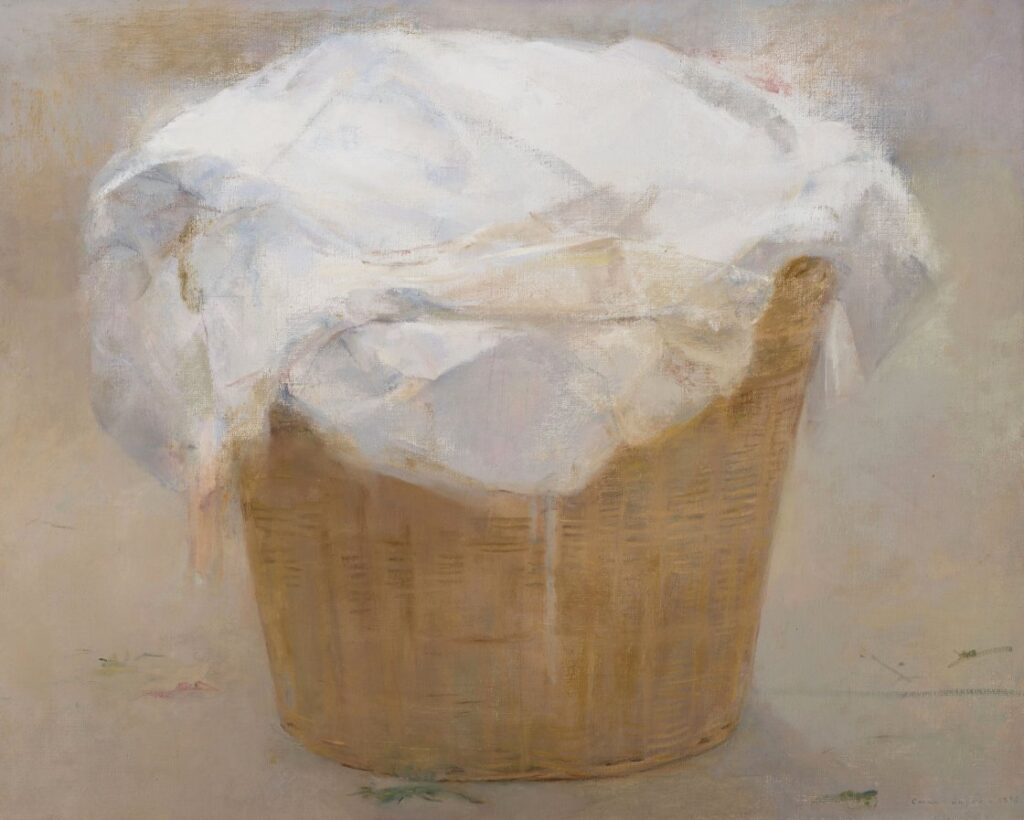
Carmen Laffón. Basket with white clothes1992-1996. Alberto de Alcocer Collection. © Carmen Laffón, VEGAP, Madrid, 2026. Photography: Claudio del Campo
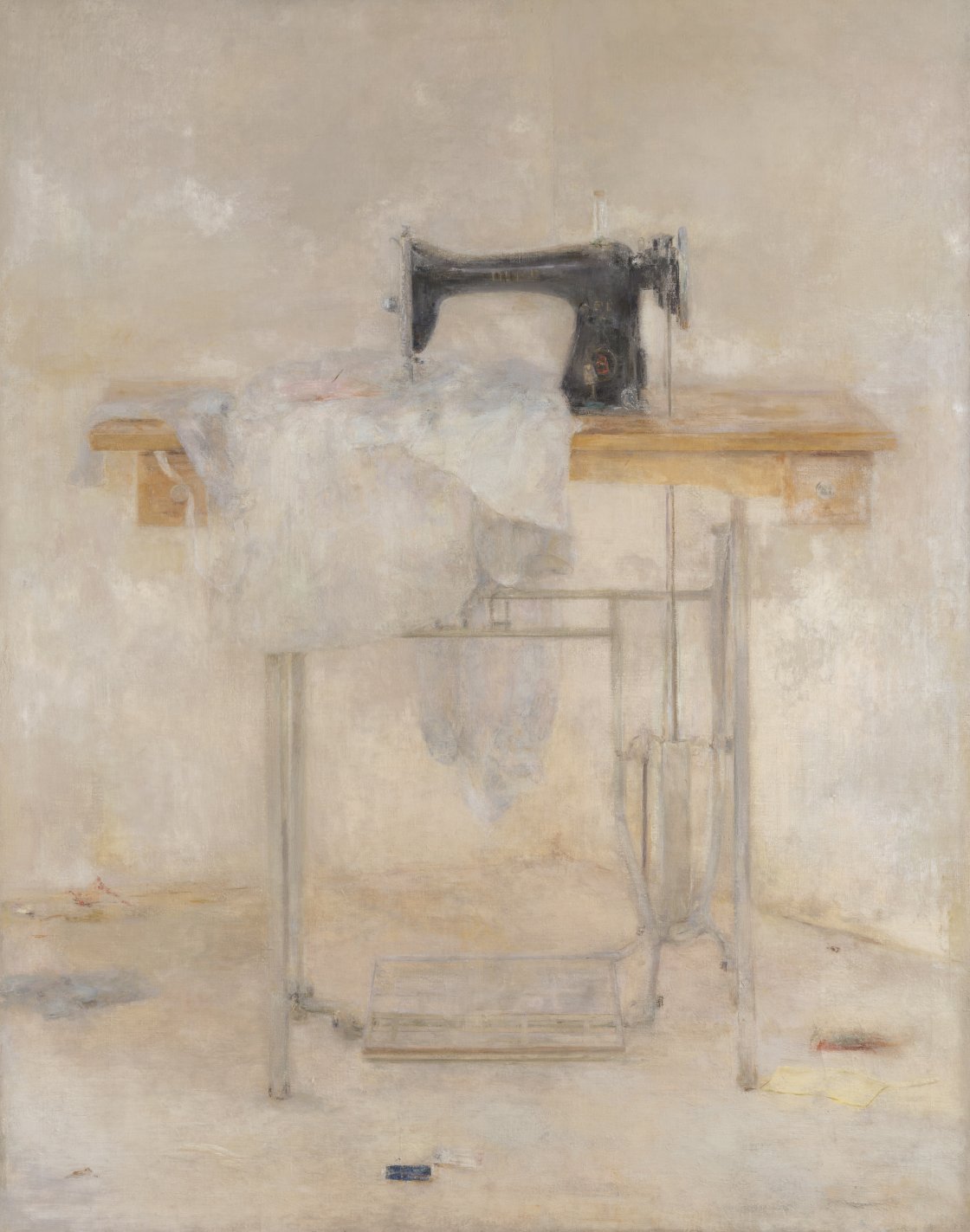
Carmen Laffón. Sewing machine in use1966-1967. Private collection. © Carmen Laffón, VEGAP, Madrid, 2026. Photography: Claudio del Campo
Arriving in the sixties and seventies, this author began her famous views from rooftops of Madrid and Seville (and later, Sanlúcar de Barrameda). Again, he arranged them in two clear parallel horizontal planes; the lower one, corresponding to the terrace itself, was gradually diluted in favor of the city and the sky.
However, the landscape with which we most associate, and rightly so, the artist is that of the Doñana preserve, which she began to paint in 1978 in horizontal panoramic views, in pastel tones, and which she returned to no less than in 2011-2014, from more abstract parameters and paying attention to the atmospheric phenomena typical of the seasons.
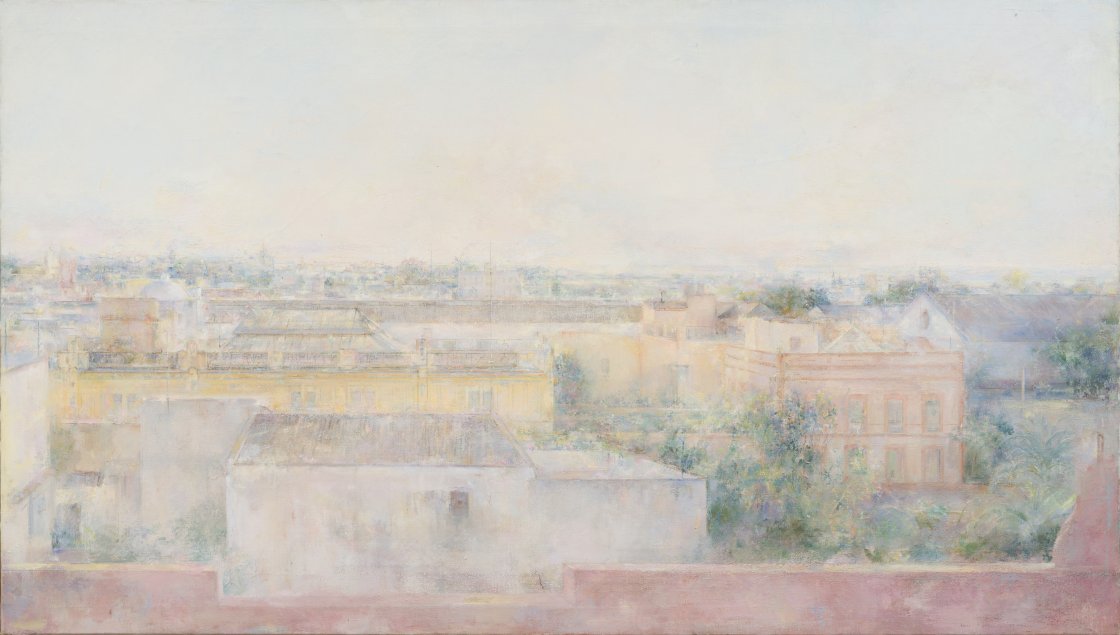
Carmen Laffón. Sanlucar de Barrameda1977-1978. Private collection. © Carmen Laffón, VEGAP, Madrid, 2026. Photography: Museo Nacional Thyssen-Bornemisza. Claudia Ihrek
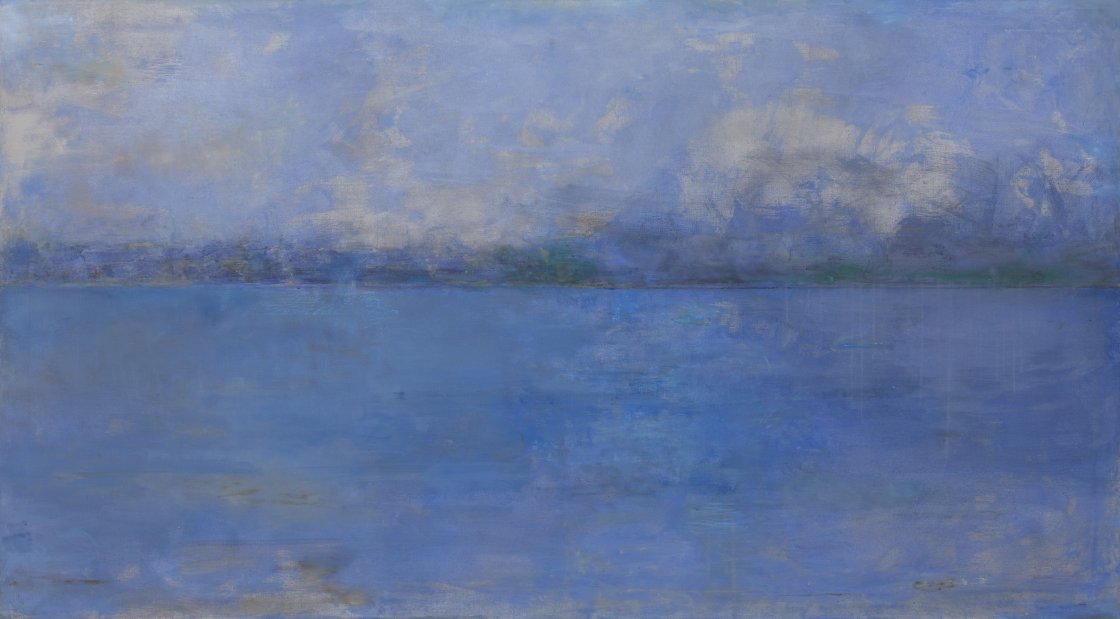
Carmen Laffón. El Coto from Sanlúcar I2005. Private collection. © Carmen Laffón, VEGAP, Madrid, 2026. Photography: Museo Nacional Thyssen-Bornemisza: Jonás Bel
Another topic that he did not fail to address, in that same broad time frame, was that of closets: open, closed, in different tones, more or less occupied or empty… We could establish series within series with them. We are talking about versions of the same cupboard that he came to sculpt, and that he captured again and again at the pace of his own evolution: first from a realistic approach without ifs and buts and then on neutral backgrounds and blurring their contours. Even dispensing with their shadow, almost making them float.
The route culminates with two series connected by their powerful, but nuanced targets: The lime and The salt; the first dated between 2011 and 2015, the second between 2017 and 2020. In the first he did not look only at calcium oxide, but at the tools common among whitewashers that are used in Andalusian farmhouses (drums, buckets, tables, wheelbarrows), which tell us about the efforts of these workers without making them present; The second was inspired by the Bonanza salt flats and examined them with extreme delicacy, bringing them closer to abstraction and even evoking movement by breaking them down.
But the exhibition, which also has a half-hour audiovisual profile of the artist, culminates in the Thyssen hall, where charcoal drawings that make up the The vineyarda series that arose from the one she cared for in Sanlúcar and was exhibited for the first time in Silos. He monumentalized his grapes in a bronze installation that immerses us in the harvest without empty customs.
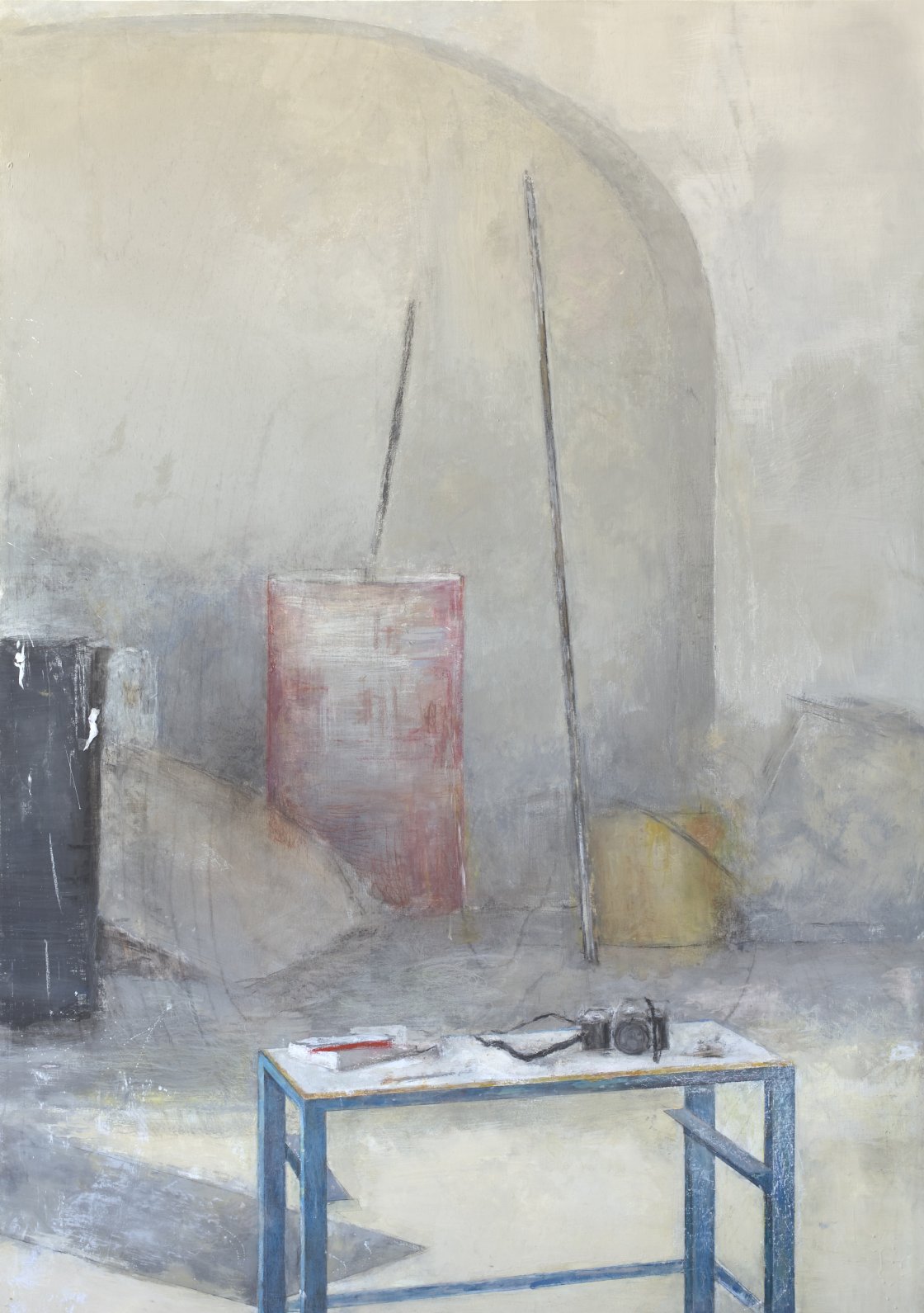
Carmen Laffón. The lime Blue drum and table2013. Private collection, Seville. © Carmen Laffón, VEGAP, Madrid, 2026. Photography: Claudio del Campo
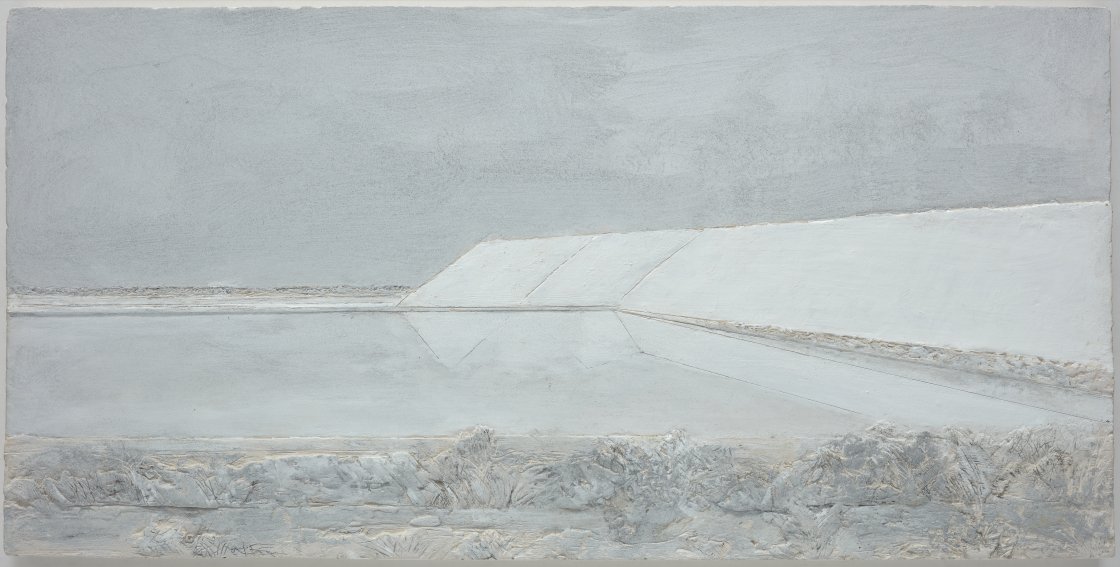
Carmen Laffón. The salt2019. Reina Sofia National Art Center Museum, Madrid. Indefinite deposit of the Reina Sofía Museum Foundation, 2021 (Donation from Helga de Alvear) © Carmen Laffón, VEGAP, Madrid, 2026. Photography: Photographic Archive Museo Nacional Centro de Arte Reina Sofía
«Carmen Laffón. Variations»
THYSSEN-BORNEMISZA NATIONAL MUSEUM
Paseo del Prado, 8
Madrid
From June 23 to September 27, 2026