Paris. “The main Nabis are at the Luxembourg Museum and I am no longer among them! “,wrote Henri Gabriel Ibels (1867-1936) in the typescript of his Memoirs, Walks around 1900, now published (ed. Fage, 2026). Long hidden while with Paul Sérusier he had “ [fondé] this group in 1888″, he returned to the forefront in 2025 when his posters appeared in the exhibition at the Musée d’Orsay “Art est dans la rue” and in that of the National Library, “Impressions nabies” (2025-2026). However, for several years, Fabienne Stahl, at the Maurice-Denis Museum (Saint-Germain-en-Laye), and Fanny Girard, at the Toulouse-Lautrec Museum (Albi), have been working on her first retrospective, the catalog of which also constitutes her first monograph. First presented in Saint-Germain-en-Laye in a chronological configuration, the exhibition is now in Albi, with a thematic route and a slightly larger number of works – around 230. This thematic approach corresponds to that which Ibels himself had adopted in his only personal exhibition, in 1894, and to the way in which he grouped his memories in Walks around 1900.
An atypical Nabi
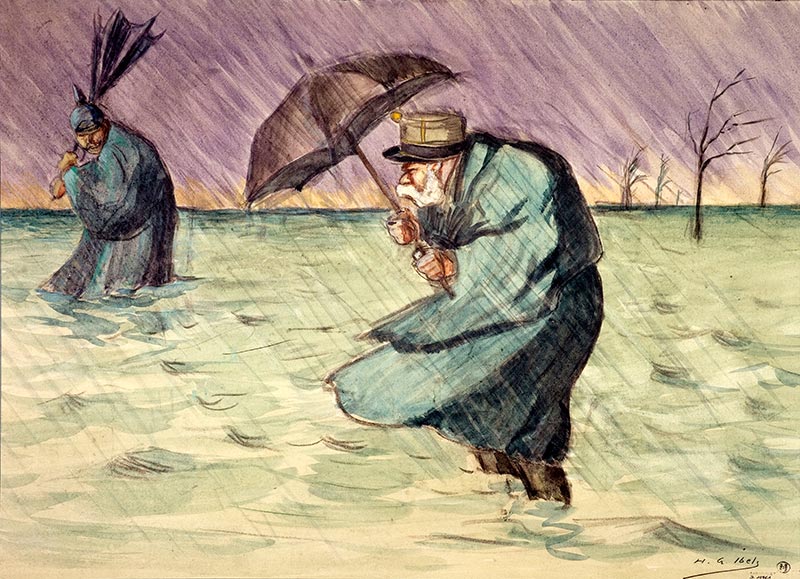
For his comrades, Ibels was the “Nabi journalist” and this nickname already set him apart a little: he expressed himself through drawing and prints and not through painting, which was more valued; he was politically engaged and he was a Dreyfusard, unlike Maurice Denis, whom he continued to associate with throughout his life; he was interested in contemporary society, in the life of the people, in the circus, in the theater, close in his inspiration to his friend Henri de Toulouse-Lautrec. His character, too, undoubtedly played a role. He was certainly generous, but Armand Seguin, another forgotten Nabi who Fanny Girard believes deserves rehabilitation, gave a scathing portrait of the man of whom he was one of the best friends in a letter to Roderic O’Conor: “His enthusiasm is easy. […] But he is also a resourceful man, too busy with business, taking advantage of everyone, happy with notoriety, very selfish, lavish for himself and not stingy for others, a man above all of action, who will never put off until tomorrow what he can do today, very and too practical to be entirely an artist. »
Henri Gabriel Ibels (1867-1936), At the circusThe original print, Album I, 1893, lithograph, 49 × 26 cm, Gérard Tournier collection.
©DR
The truth is that, father of five children, Ibels was pulling the devil by the tail, always recovering thanks to an illustration commission or collaboration on a show, certainly using his vast relational network but also bubbling with ideas, overflowing with enthusiasm. He recounts in his Memoirs how, arriving an hour late for a dinner at Rodin’s, whom he did not yet know, he managed to cheer up the sculptor by flattering him and then obtained from him a cast of his bust of Victor Hugo, intended for the high school in which he taught. An opportunist and jack of all trades but also a wildly talented designer and lithographer, this is the Ibels who emerges throughout the exhibition. Its synthesis works wonders in lithography At the circus [voir ill.], which appeared in 1893 in the first album of The original print, and again in The Clown with the bandoneon (circa 1924), a painting kept in a private collection. Surrounded by a rhythmic halo, the circus artist wonderfully embodies the power of music.
Little represented in public collections, Ibels is the joy of enthusiasts. The curators were assisted by the family, which still has important collections and documents, and were able to find a number of works in private homes. They also reached a hitherto untapped fund, at the National Library of France, of costume designs for the stage and disguise. Very close to the actor, director and theater director André Antoine, Ibels was passionate about the art of costume, which he even taught. He understood how to characterize a character by his outfit, and a visit to the exhibition could focus solely on this aspect, leading from Good lady (1891) wrapped in her cloak with a refined play of black and orange diamondsHarlequin (1920s) through the coattails of the clown Mevisto, represented many times in the 1890s. Always ready for a new experience to combine the pleasure of drawing with the exploitation of a potential silver mine, in 1919 the artist created the Atelier Ibels of theatrical costumes and disguises for the Printemps department store. Until 1926, it provided the stage, masked balls and cinema. The Galliera Museum loaned a Pierrot costume (1920s), belonging to its collection from this workshop.
One of the commissioners’ ambitions is to encourage individuals to find Ibels in their homes. We know, for example, that he regularly exhibited sculptures, of which only one copy could be found in a public collection, Portrait of Léo Gausson, a waxwork executed around 1892. Fanny Girard has no doubt that many other works will appear in the near future: she is already receiving information and photographs suggesting this.