Madrid,
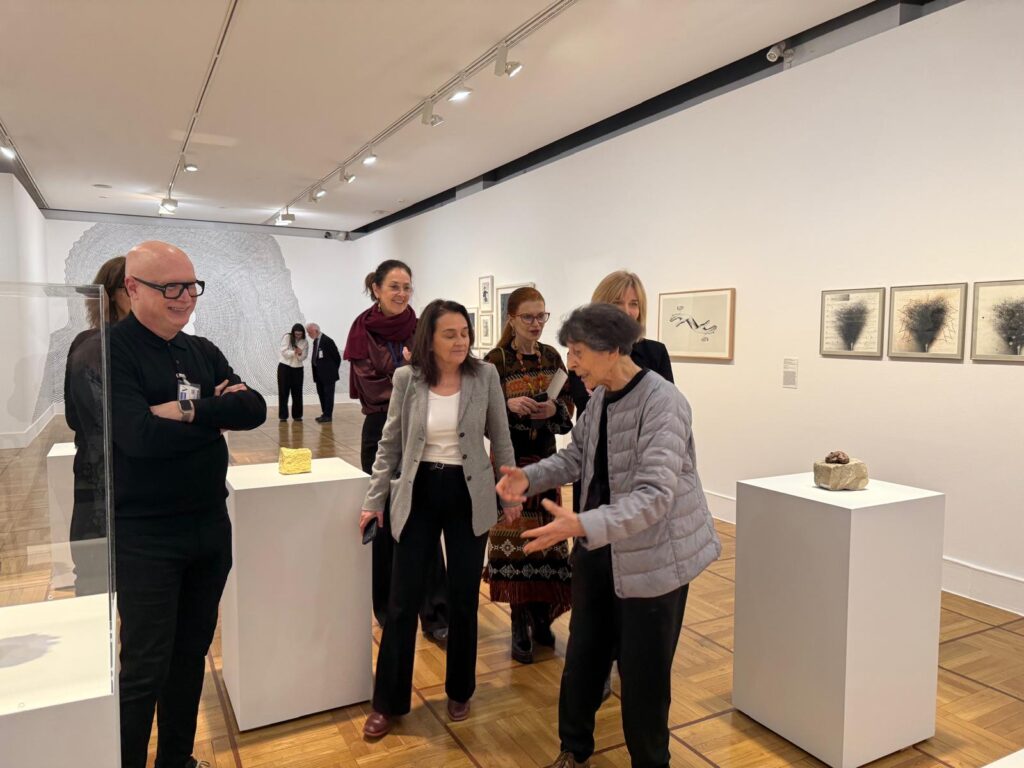
After receiving the Tomás Francisco Prieto Prize last year, awarded by the Royal Mint, Esther Ferrer has presented at this institution an anthological exhibition that reviews her creations since the seventies, avoiding chronological articulation to propose contacts, internal relationships, between her series from different stages.
The retrospective is titled “Fold and process”, it has been curated by Beatriz Martínez Hijazo and will allow us to review the vital concepts and dualities present in Ferrer’s production (space and time, rigor and absurdity, accident and chance, geometry and poem, word and action or silence and emptiness) and also his continuous questioning of the artistic object in its materiality. A member of Zaj at the time, and an admirer of Duchamp and Cage, this Basque artist has based her practices on the generation of relational and serial processes in which she has made room for both repetition and difference, both structure and chance.
The route of the Madrid exhibition analyzes precisely these processes, presented from continuity and in fact, in many examples, still unfinished. More relevant than the finished works, they have been captured in models, sketches, scores and documents, and in Ferrer they are always relevant, but especially in the case of his performances, in which body and action are extensions of his plastic projects.
Some of the pieces in the exhibition are unpublished and three installations have been conceived specifically for the occasion: at the entrance, a vinyl floor, based on his Poem of prime numbers, which recalls Ferrer’s tendency to go beyond traditional supports; Profileswhich could be seen in his first individual exhibition in Spain, at the Joan Miró Foundation in 1984; and The other fallmade with coins for the exhibition “Fuera de forma” (1983), lost after it and recreated here for the first time.
The first also refers to the beginning of Ferrer’s career, when he wanted to try to consolidate a system that would distance him from his own subjectivity and he did so based on the OuLiPo experiments or the Fibonacci sequence used by Mario Merz; in their Space projectswhich we must understand from mathematical rigor, used the sequence of prime numbers to organize space and time.
From then on, his concerns materialized in ephemeral interventions, essays on tracing paper, canvases and large-scale works, structured based on compositional nuances: we will see those of The Spiral of Ulamin which numbers arranged in a helical fashion reveal diagonal alignments; The gapswhich teach us how the spaces between numbers expand; The sieve of Eratosthenesstarting point for its installation at the Reina Sofía Museum in 2017; and Sophie Germain’s Prime Numbersa tribute to that French mathematician. In these projects, a minimal element is repeated in works of very different formats, from small models to interventions in public spaces. In both proposals matter and emptiness converge.
Another fundamental notion in her work is the infinite, which she conceives as space without time and which centers one of its most complex installations, Piaround the endless expansion of the decimals of the number. It consists of around twenty paintings in which each figure is associated with a tone, relating the rigor of the mathematical system to the very free color.
The rhythm at which the succession of tonal strips gives rise leads the viewer towards a projection that seems to exceed the limit of these works: while the grids structure the first six thousand decimals, all the others will be calculated on the screen while the exhibition remains open. This work is completed with audio excerpts in which several people answer the question: What is infinity for you? As in the previous Poems about prime numbersin Pi The resort to repetition and variation is accompanied by an exercise of research into the process itself and into our conception of space and time. That is partly the reason that order and ethos converge in these projects.
Regarding his spatial projects, we will see instructions for the performance at the Casa de la Moneda. A space is to be crossedinspired by one of his first actions, in which Ferrer invited the public to tour a stage marked by sounds and footprints, visible or not. These indications are accompanied by outlines of the possible results: intermittent lines that, when repeated, make or break the limits of the chosen scenario.
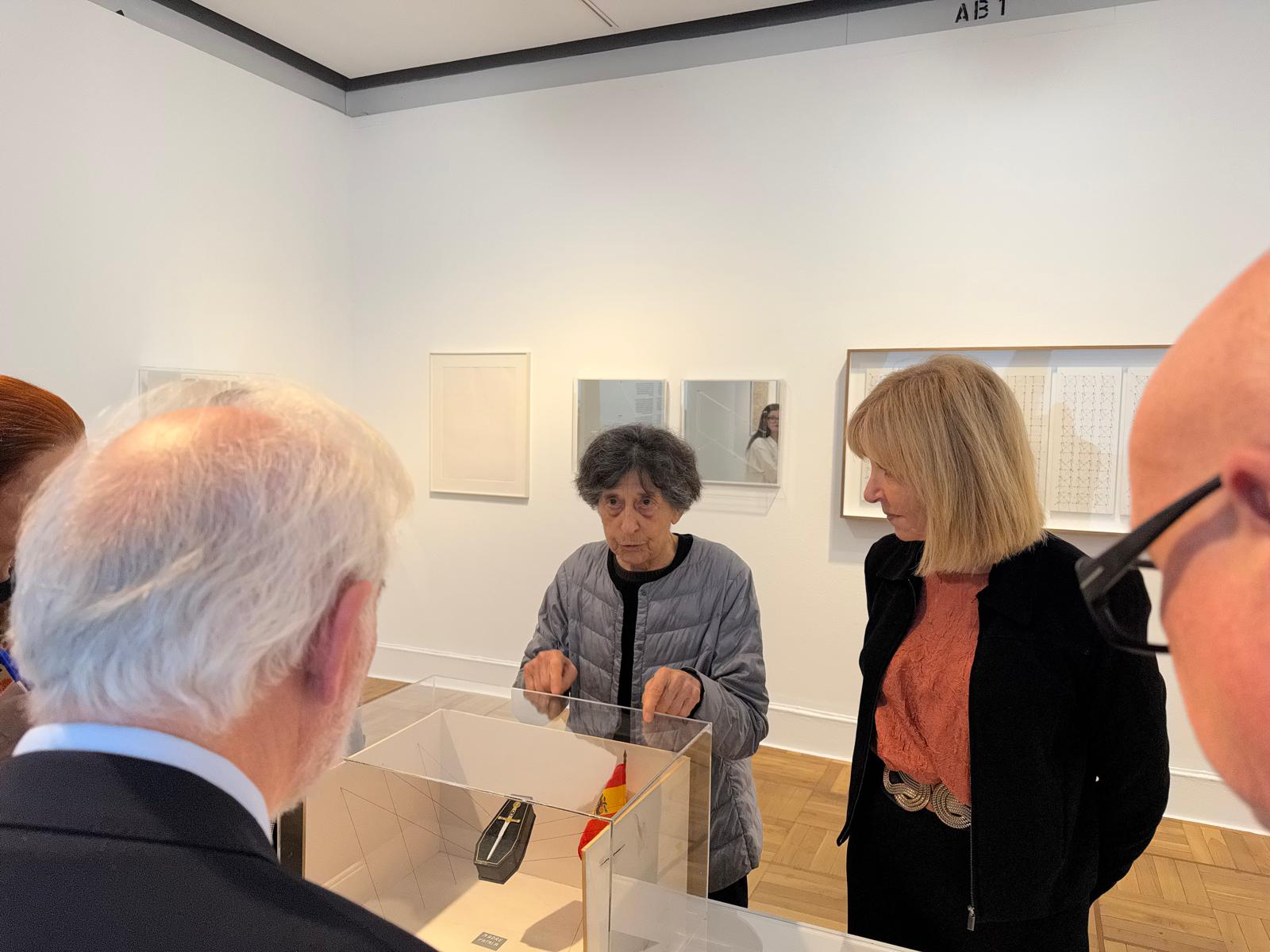
These investigations into space have also been present in Ferrer’s career since its beginnings. Using very simple means or materials, such as a line or cotton cords in a box, he generated enclaves from which to delve into the possibilities of geometry and the fusion of the physical and mental planes. Some of these designs gave rise to actions and installations, in the same way that, at other times, installations and actions were reduced to models: Go around a square in all possible waysfor example, began as a sketch, continued as a model and ended up becoming a score for one of his most famous actions. Other works were neither carried out nor feasible, and some more are not preserved due to their fragility or ephemeral nature; both constitute indications of the constant links between action and object when it is the process that constitutes the work, ultimately and first. His handling of the ephemeral has also been articulated in gestures and everyday elements, evanescent compared to the durability of conventional art forms and close to the spirit of Fluxus.
The series Paves He carried it out after the riots of May 1968, stripping the cobblestone of the symbolism it had acquired then and turning it into an emblem of the absurd, and in Revised Malarmado A roll of the dice evokes the fall of a cobblestone on the sound floor of a stage. If each object can express the performative relationships it establishes with the body, the same body also becomes an object in Ferrer’s creations, being an instrument or support and, equally, a reflection of the way in which his time treats it.
Bárbara Hang and Agustina Muñoz have explained that repetition and disappearance are characteristics of performance; The first is subject to chance and also depends on time: it never occurs completely, nor can the disappearance of anything be complete today. The difficulty of this definition is evident in his work What is a performance?which has created its own space here in which we are invited to read all of its creations in the light of this discipline.
The Tomás Francisco Prieto 2025 Prize, for its part, has gone to the Brazilian Regina Silveira, an author linked to minimalism who stands out for her use of light and shadows and emptiness; also for his political commitment.
Endowed with 20,000 euros, the award involves the commitment to design a medal minted by the Royal Mint and Stamp Factory, in addition to the organization of these exhibitions. Its jury was made up of Isabel Valldecabres Ortiz, president-general director of this institution; Javier Blas Benito, from the Royal Academy of Fine Arts of San Fernando/National Chalcography; Guillermo Navarro Oltra, from the Faculty of Fine Arts of the University of Castilla la Mancha; Yolanda Romero Gómez, curator of the Bank of Spain Collection; and Candela Álvarez Soldevilla, patron and collector, Gold Medal of Fine Arts.
“Esther Ferrer. Fold and process”
MINT HOUSE MUSEUM
C/ Doctor Esquerdo, 36
Madrid
From December 16, 2025 to April 12, 2026