Madrid,
History does not repeat itself, but it rhymes. This quote, which has been attributed without evidence to Mark Twain and which, through repetition, has ended up becoming a mantra of our time, gives its name to a new cycle of exhibitions at the Reina Sofía Museum. It will be displayed in front of your Guernica and will show us pieces that contain thematic or aesthetic parallels with the Picasso mural and come from other geographical and cultural contexts; The objective will be to make the public aware of artistic scenes that, until recent times, have been relegated in traditional historiography.
The first of them is the South African one. This chapter has as its protagonist Dumile Feni, whose life was brief (he did not reach fifty years, from the 1940s to the 1990s), but long enough to capture the conditions of the daily existence of many under apartheid, in compositions where myth and fantasy have a place and which draw on his cultural roots, the crafts and ceramics of his country, its masks and its idiosyncrasy, but which, likewise, are nourished by his cosmopolitan vocation.
A compulsive draftsman who carried out hundreds of works, he was entirely self-taught, but he was able to soak up the vibrant creative scene of Johannesburg in the sixties; Despite the segregation that affected black artists, it was a good time for jazz and theater, when they circumvented the prohibitions, and several galleries also showed their creations.
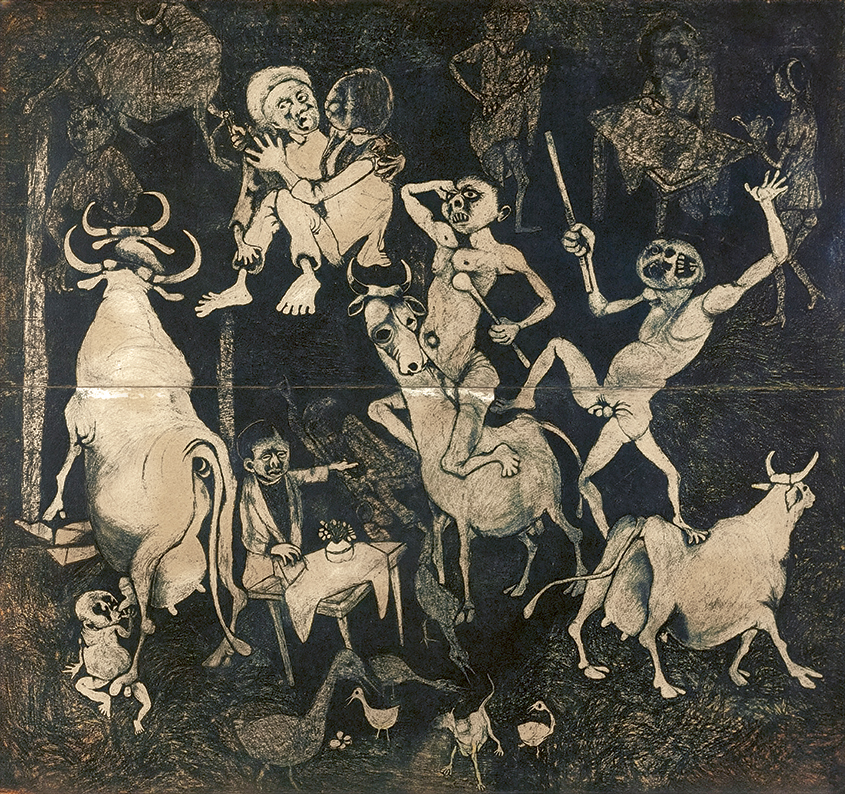
In this context, the work that focuses this new exhibition at the Reina Sofía, curated by Tamar Garb, emerged: African Guernicawhich could be seen for the first time in 1967 at Gallery 101. It was not the artist who titled it, but Picasso was indeed well known at that time in South Africa, thanks to the reproductions – also Goya or Käthe Kollwitz – and Dumile Feni entered into a conscious dialogue with him on a monumental scale, without detaching himself from the cosmology that was closest to him. There were not many authors – Garb has pointed out today – who used pencil and charcoal to draw history paintings; this one is.
It is known by all that many of Picasso’s works, and his own career, would not be what they are if it were not for his knowledge of African sculpture, which he collected, so, taking into account that Feni proposes in African Guernica a tribute to its roots as well as a look at the European influence (monochromaticism, distortions, fragmentation of the figures), the links between both pieces, now face to face, can be approached from multiple perspectives and imply the closing of several circles. In addition to very different incarnations of modernity: that of the South African also challenged the belief that black artists had to produce primarily native art or crafts focused on the taste of tourism.
Regarding their thematic and protest background, both compositions respond to violent and dehumanizing situations – which is why the curator refers to them as anti-totalitarian totems-, but, as is easy to understand, far from equivalent. Picasso made the Guernica after a year of Civil War, and its image would be an emblem of anti-war, while Feni’s piece, in whose glass the previous one is unexpectedly reflected, does not allude to an open conflict, but to the less noisy brutality of racism, capturing a nightmare in which human but hybrid figures interact with nature in unusual ways.
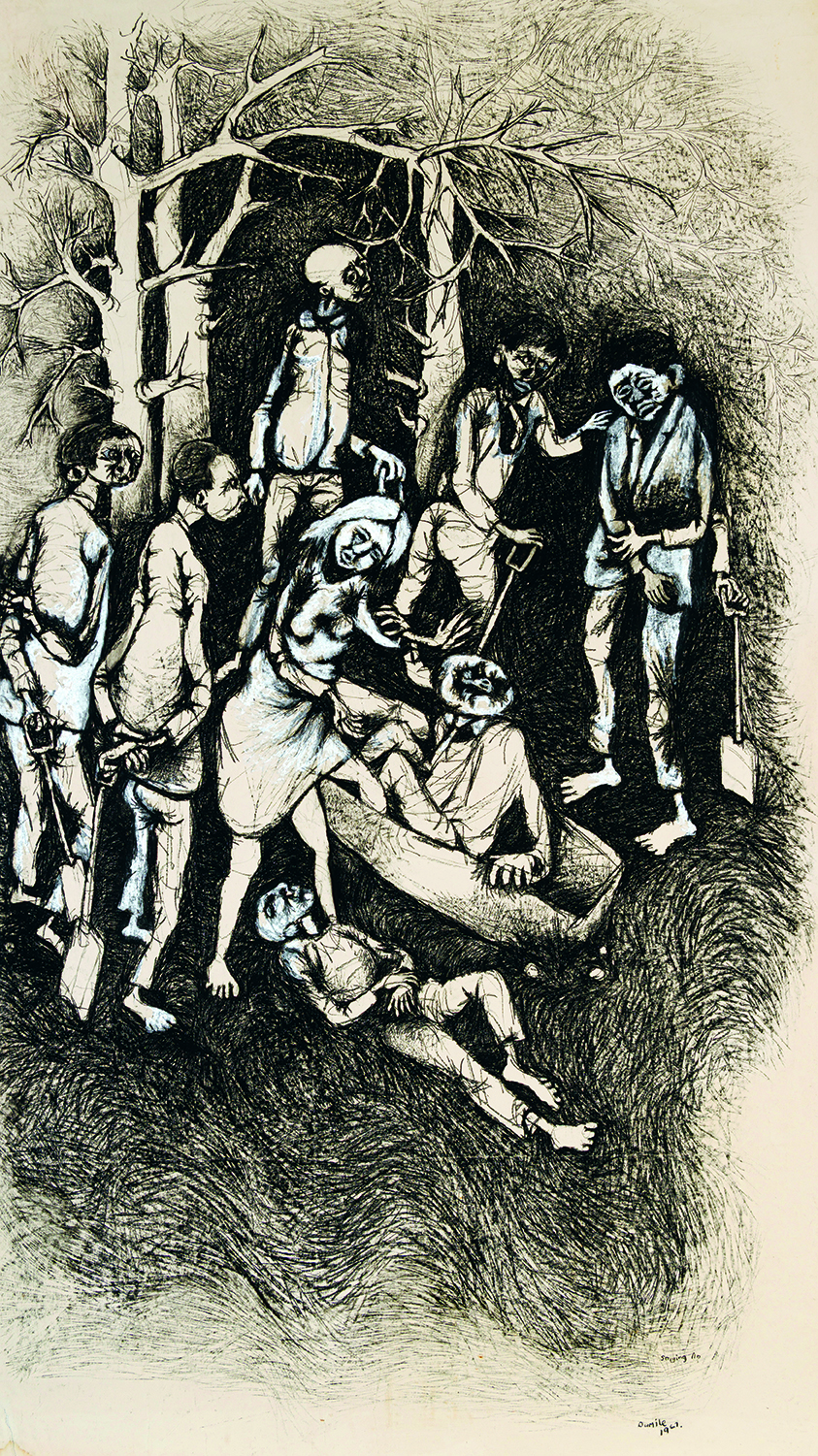
Next to African Guernicawhich leaves South Africa for the first time, three monumental drawings are exhibited at the MNCARS, also made in Johannesburg in the sixties and another two made later, in exile, first in London and then in New York; In this last city Feni died, since he could not return.
All of these pieces come from South African collections, public and private. The three earliest works are The Classroom, woman and boy and Saying No. In the first, figures scattered throughout the paper seem to challenge the norms of school segregation; in the second, a woman resembling an ancestral statue holds a child as if he too were an archaic figurine; the third embodies his refusal to have his creation labeled as native art.
Already in London, in the mid-fifties, it was used in a very extensive visual diary on a roll of paper more than fifty meters long. We will see part of it in a showcase (and the rest on video): it offers a procession of fantastic creatures, proper names, poetic references… in which he gave an account of his vision of the world and his daily work. And the last piece of the set is the work, again in large format and in charcoal, Hector Pieterson (1987), which is inspired by a photograph taken of the child murdered in 1976 during the Soweto uprising, in which 176 people protesting apartheid were massacred. Feni turned the little boy, carried in the arms of another young man as in the Pietà del Guernica, into a banner of razed innocence.
Although, over the decades, the figure of Dumile Feni has been widely politicized, we cannot say that he was a trench artist. He was interested in the ways in which art could be more useful to society, and confront oppression and censorship, but above all in an intellectual sense: he was opposed to the use of creation as propaganda and, as Garb has pointed out, the consideration of artists as cultural workers.
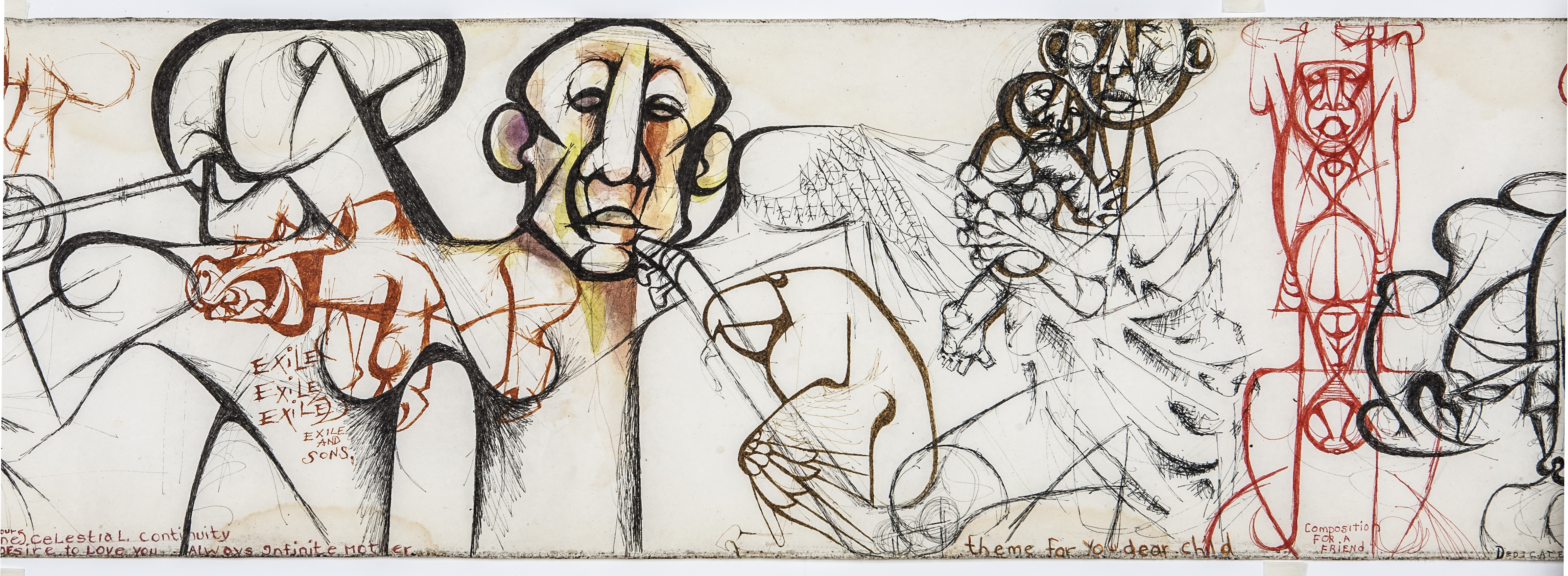
“Dumile Feni: African Guernica”
NATIONAL MUSEUM REINA SOFÍA ART CENTER. MNCARS
C/ Santa Isabel, 52
Madrid
From March 25 to September 22, 2026