
Aix-en-Provence,
It is easy for those who come to Aix-en-Provence to soak up the atmospheres that surrounded Cézanne visit their workshop in Lauves, only something away from the city center, their paintings in the Musée Granet and, perhaps, the mountain of Santa Victoria, which on so many occasions contemplated the painter under the rain and under the sun. Within the framework of the Saison Cézanne 2025, the city wants to remember the ties of other enclaves with the production of this artist, including the Jas de Bouffan and the Bibémus quarries.
The first was, in the background, a field of experimentation for this author, who first painted on the walls of his living room before portraying his nearby, representing the farm and the peasants he met there. This property, which is westing the urban core of Aix, consisted of a country house, a farm, a greenhouse, a park and a pond and was the place where Cézanne glimpsed its potential with the brushes. His name has an explanation: in the Provencal dialect it was called Jas to the country houses where the wealthy people of the cities in times of heat or epidemics took care; Louis-Auguste Cézanne, the father of the artist, a hatter who ascended socially when he became a banker, acquired it in 1859, and over time he would name the neighborhood as a whole.
Until next October, Musée Granet hosts the exhibition “Cézanne in the Jas de Bouffan”, which deepens its connections with this place and counts, as great attraction, with numerous self -portraits in which a young Cézanne is represented as a young artist. The center itself is closely linked to its beginnings: from 1857 to 1862, it enrolled in the free drawing school located in the former Palace of Malta, which also housed the art collection of the Aix museum, turned into the Granet Museum in 1949. It was in the rooms of its ground floor where it learned the foundations of the painting and the drawing from classes of natural models, drawing of antiques and the realization of antiquities and the realization of antiquities.
However, as we pointed out, Cézanne’s first workshop was the Great Hall of Jas de Bouffan. Although his family did not settle here until 1870, the painter endorsed that stay a decade before, when he was only 21 years old, to display his oils on the plaster walls, experimenting with different styles and themes. Carried out at the beginning two decorative programs, which were typical of the Provencal Campo Casas (The four stations In the bedroom and a series of monumental landscapes in the East and West walls), but by 1865 he turned to the adventure and painted new themes about his previous creations.
Finally, this mansion ended up selling and the fate of the works was not placid. Its new owner, Louis Granel, partially covered the walls with wallpaper, leaving only some visible paintings and something later, in 1907, Léonce Bénédite, director then of the Luxembourg Museum, who at that time exposed to living artists, valued them negatively. The panels were removed, trimmed and transposed to canvas to be sold by bulk and the subsequent owners of the farm between 1912 and 1960, hence their meeting for the first time for this sample (in the absence of some fragments, which is expected to be located) has a historical character: they have been arranged in a large reconstructed room, evoking that of the Jas de Bouffan.
Cézanne later referred to his stage here as Couillarde: His works, also his portraits of family and friends, were dark and tormented; Faces, strikingly overwhelming. I was not afraid, being so young, painting with a spatula, leaving thick and dense strokes on the canvas. He more frequently painted his father and his uncle Dominique than his mother and sisters, and among his friends some would become first-order intellectual figures: we will see Baptiste Baille, Antoine-Fortuné Marion, Antony Valabrègue, Gustave Boyer, Achille Pateire and Émile Zola; The novelist lived a season in Aix because of his father’s work. Marion was appointed director of the Marseille Natural History Museum, Valabrègue would be a renowned art poet and art critic and Baille enjoyed a brilliant scientific career.
Until the beginning of the 1870s, their compositions retained the spirit of that painting Couillardederived from his observation of Gustave Coubet and Honoré Daumier and also from the Franco -Prussian war environment; Provence was then Cézanne refuge, which was increasingly isolated in nature. After the contest, things changed: during numerous rooms in the Parisian region next to Camille Pissarro, he learned to work with the outdoor light, in the impressionist style, although his greatest source of inspiration remained his region. In Provence he began to consolidate an increasingly personal style: he structured his compositions with increasingly warm and intense colors, using regular, solid, fluid and dense strokes at the same time.
Over time, those landscapes, made of pencil, oil or watercolor, would occupy a prominent place in their trajectory. Even then, the Jas de Bouffan – who today has been absorbed by the city, but in those years it was a field – was a real outdoor study for Cézanne: its park became a usual reason, appearing in sixty works. It will be easy to recognize it: he expressed the long avenue of Castaños to the south that flows into the Casa de Campo, typically proven and ocher; The pond, to the west, bordered by statues of a dolphin and lions, which allowed the artist to play with the light reflected in the water; or the farm, to the east, probably the place where he met the peasants who chose as models. More to the east, I would contemplate the Sainte-Victoire mountain, today hidden by modern buildings (the same occurs from the Lauves hill). We can assume that, in the heart of the park, the artist was protected from the world.
But I would still learn more in this place. Louis-Auguste Cézanne ordered to build his son’s first real study in the attic of the Jas de Bouffan in the early 1880s; It was there that the artist dedicated himself to investigating lifting nature and moved away from the traditional representations of this genre. As approaching the nineties, he arranged tablecloths, ceramics, jugs, fruit and sugar in a seemingly unstable balance: the dimensions were altered, the escape points were unexpected, and Aix’s reinvented the impact of light on the objects. The subject and form are revealed before our eyes in compositions born of a long meditation and in a very characteristic harmony; These principles, we know, later became the main references of Cubism. Some objects frequently represented in Cézanne’s still lifes are still visible in the study of Lauves, the last one in which it developed.
In Bouffan the poet and art critic Joachim Gasquet, friend of the painter, contemplated for the first time a very different piece, a bathtub originally from the many who arrived later: Once I saw a splendid replica, almost finished, at the top of the staircase of the Jas de Bouffan. He stayed there for three months, then Cézanne turned her against the wall and disappeared. He did not want anyone to talk about her, even when he shone in the middle of the sun and had to pass by her to enter her study in the attic. What happened to her? The theme that obsessed was a woman bathing under some trees in a meadow.
On this subject he drew at least thirty small sketches, including two or three very fine and detailed canvases; Multitude of drawings, watercolors and outlines of sketches that never left the drawer of their comfortable in their bedroom or the table of their study.
If Henri Gasquet and his son Joachim arrived at the Jas de Bouffan, Hortense Fiquet remained far away from him. Henri was one of Cézanne’s earliest friends, whom he presented to his aforementioned son Joachim. A friendship was forged between the painter and this young poet of Aix, a fervent regionalist, who in 1921 would publish a book with his mutual conversations. Father and son were portrayed there. As for Hortense Fiquet, he met the artist in 1869 and learned his instructions to “pose like an apple”, extremely still. This patient model is the main female figure of his work, but his relationship remained in secret for Louis-Auguste for a long time, since Cézanne feared his father and the loss of his pension. After finally marrying in 1886, Hortense finally visited the Jas de Bouffan with his son (over time, however, the painter, absorbed in his work, delved into his roots in Provence, while Hortense remained in Paris with little Paul).
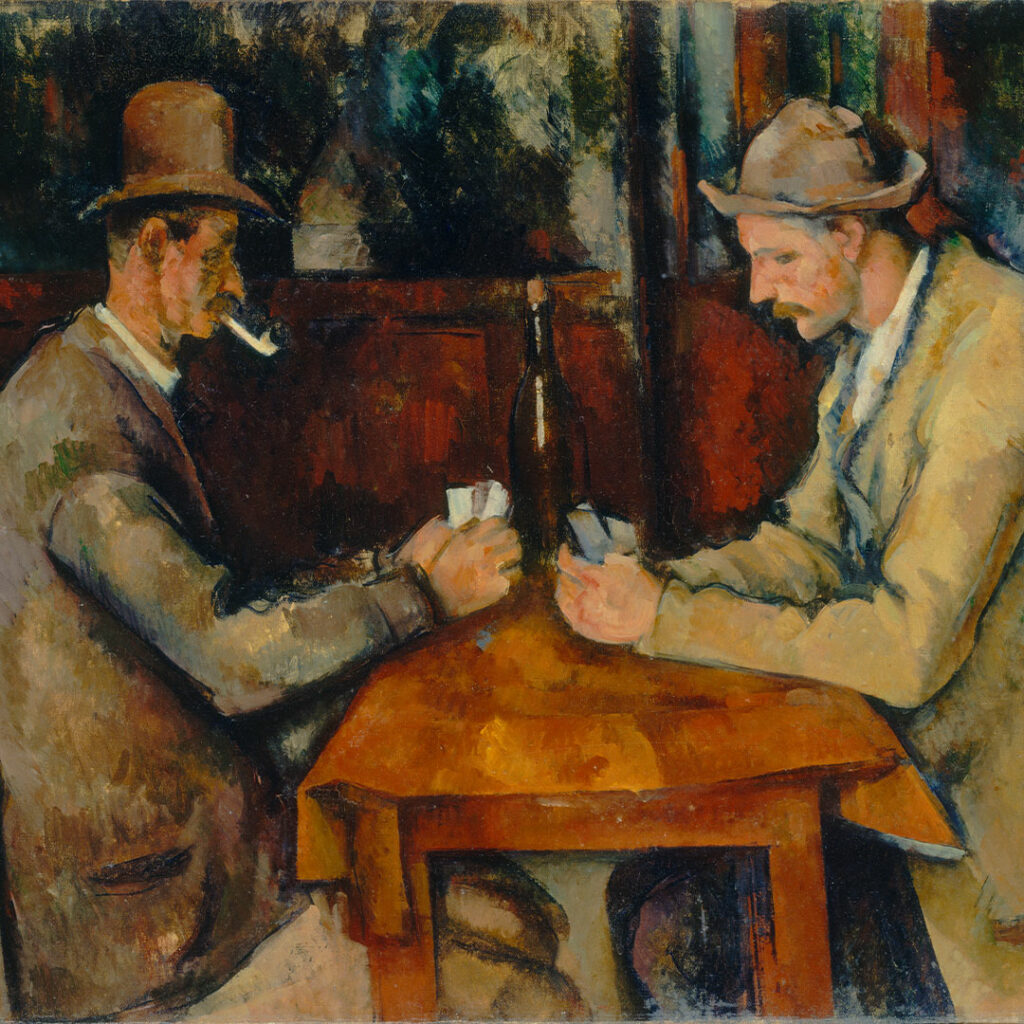
He preferred the peasants of his land before the Parisian urbanites, and was not interested in his psychology, but the geometrization of their faces and bodies in planes, masses and volumes. Sometimes meditative, as captured at a time of rest, or posing in front of the author, those generic figures become monumental and distance themselves from their daily reality. Between realism and idealism, Cézanne’s pictorial intensity shows them in all their severity and humanity.
Until the last years of his life, Cézanne de Jas de Bouffan did not distance himself; His latest model would be the gardener Vallier. A few days before his death, he still drew a view of the Jas de Bouffan Park at the end of a letter he sent to his paint merchant. It was October 19, 1906.
The mansion will gradually reopen, after its restoration, from this summer, to allow us to know what remains of that first domestic and creative intimacy of the father of the avant -garde of the twentieth century. All information can be consulted at https://cezanne2025.com/
“Cézanne Au Jas de Bouffan”
Musée Granet
Place Saint Jean de Malte
Aix-en-Provence
From June 28 to October 12, 2025


