Paris. All that for that? We remember the controversy triggered a few years ago by the decision to replace the stained glass windows of Viollet-le-Duc, 19th century architect of the great restoration of Notre-Dame de Paris cathedral, with those of a contemporary artist. A petition from heritage defenders had been launched and an appeal filed with the administrative courts. Faced with the work ultimately created by Claire Tabouret, exhibited at the Grand Palais, and perfectly consensual, we come to think that this so-called umpteenth quarrel between the Ancients and the Moderns was quite useless.
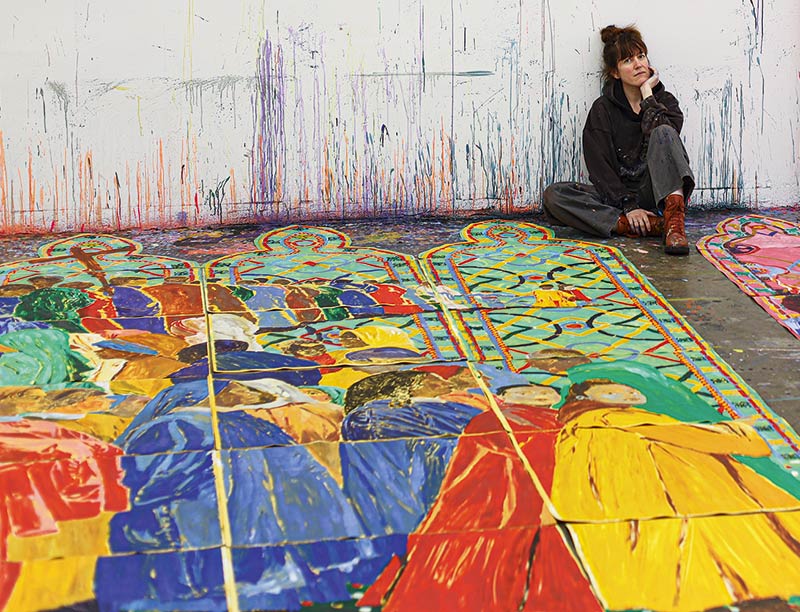
Not that the “cardboards” – these life-size models reaching almost 7 meters in height and intended to be transformed into stained glass windows – are not impressive. Made in monotype, the artist’s favorite technique, they are enriched with stencils for the rosettes and decorative motifs. Installed here in a long room, the panels are presented according to the exact configuration of the twin bays of the Parisian cathedral.
Claire Tabouret, detail of the model of the bay for the Saint-Paul-Chen chapel, ink on paper, 73 x 81 cm.
© Claire Dorn
© Adagp Paris 2026
Chosen by a selection committee led by Bernard Blistène, former director of the National Museum of Modern Art-Centre Pompidou, and author here of the text presenting the work, Claire Tabouret is omnipresent in the French and international artistic landscape. An artist appreciated by the collector François Pinault, represented by Perrotin – two powerful vectors of notoriety – she is indisputably a good artist. We know his adolescent girls depicted isolated or in groups, anonymous, locked up or lost in their silence, as if cut off in a universe to which no one is admitted.
The monumental figures, such as the apostles or the Virgin, who participate in the representation of the verses dedicated to Pentecost, a theme imposed by the archbishopric of Paris, seem contaminated by this same refusal of expressiveness. Despite their shimmering colors, the works do not exude the breath promised by the artist. The absence of formal invention evokes an amplified version of the religious painting of Maurice Denis. No doubt impressed by the scale of the task, the artist favored beauty to the detriment of the sublime. However, says Claire Tabouret, “it would be a catastrophe to freeze a monument in its history”. Without being frozen, the work remains warm.