Madrid,
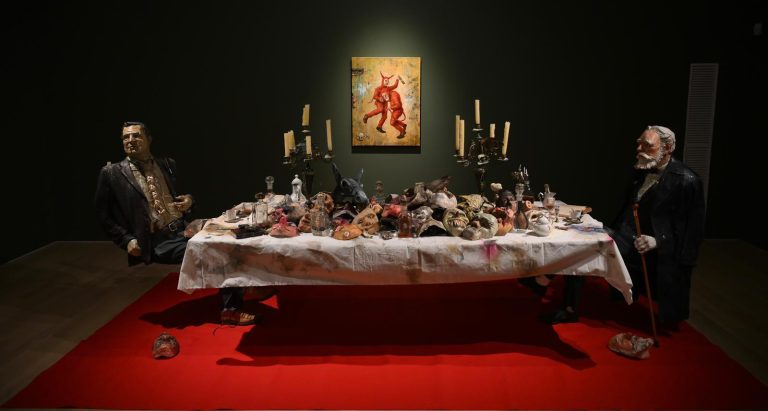
Almost a decade after the ABC Museum presented an exhibition that introduced us to the imagination of Ana Juan, the Valencian artist offers a new institutional exhibition in the capital, larger and curated by Inmaculada Corcho, the director of that institution. It is hosted by CentroCentro and is titled “Wunderkammer”, in German. chamber of wonderssince their iconography is linked to the collections that they treasured: imaginary beings into which, on this occasion, life is breathed, as they jump from drawing to sculpture or animation.
Trained at the Faculty of Fine Arts of San Carlos, this author moved to Madrid in the eighties, where she would begin to collaborate with publications such as Madriz, The Moon, The Country either The World; Since then, more than forty years ago, Ana Juan has not stopped illustrating book covers, posters and advertising campaigns. It has also carried out nearly twenty covers for The New Yorker -highlighting Solidarityin tribute to the victims of the attack Charlie Hebdo-, and left his stamp on multiple children’s books and albums.
On the fifth floor of CentroCentro, a hundred of her compositions await us, most dated in the last year, which reflect the peculiarities of the creative processes and the way of understanding the world of an artist who has been striving to bring order to her daily reality.
These works make up, together and as Juan has explained, a visual fable in which our eye will not be able to trust the apparently obvious: it constructs metaphors in which it is not easy to discern what is true and what is false. Confusing were also, perhaps more than anything else, those wunderkammer: cabinets of collectors interested in very diverse branches of knowledge, in what is created by nature and what is manufactured by human hands. In some cases with an encyclopedic vocation, these funds, to a large extent, tell us about the universal knowledge achieved at the time in which they were created, but also, and paradoxically no less, about the most intimate concerns and inclinations of their owners. Also of course, of their power and influences when acquiring all those pieces, from works of art to minerals.
In the case of Rudolf II of Prague, who owned one of the most interesting, his maxim seemed to be “the stranger, the better.” Few accessed his chamber, because he was not interested in showing off (he was a closet collector, rather than a showcase collector), but those who did access assured that it aroused both admiration and unease. Like all important discoveries.
In Cibeles, the Valencian has displayed her personal iconographic cabinet of curiosities: images born from her own concerns, her desires and passions (her favorite themes have been humans: life and death, love and war, truth and lies, the drifts of power…), but also, of course, from her imagination. The Internet, as expected, is another of its sources: Nowadays, the extraordinary navigates the networks and we are the authors of the collections. We create our own vision of the world with information that we store in our cabinets located in intangible clouds and that leads us to create parallel worlds.
Nowadays, the extraordinary navigates the networks and we are the authors of the collections. We create our own vision of the world with information that we store in our cabinets located in intangible clouds.
It was also foreseeable that this sample would not have a linearly established route; The pieces relate and transform each other. Although they are autonomous, their readings are enhanced in their contemplation together. Yes, it is structured in sections, in six: Chaoswhich refers to the disorder that arises from not being able to distinguish truth from lies; The trace of chaoswhich views the body as an archive that records the traces of what has been experienced; Stories; in which each work gives rise to one or many stories, capable of being continued by the public; whole and parta reflection on life, the individual and the collective, the effects of our actions, transformation and death; Draw the worldwhich alludes to his first impulse to trace his concerns, the basis of drawings, paintings, sculptures and designs; and finally, The drawinga vindication of what was its inaugural language.
We will verify in this “Wunderkammer” that this drawing, together with life itself – with its attractions and disturbances – are the basis of all his creations, in any discipline.

Ana Juan. “Wunderkammer”
CENTERCENTER
Cibeles Palace, 1
Madrid
From January 28 to May 3, 2026