
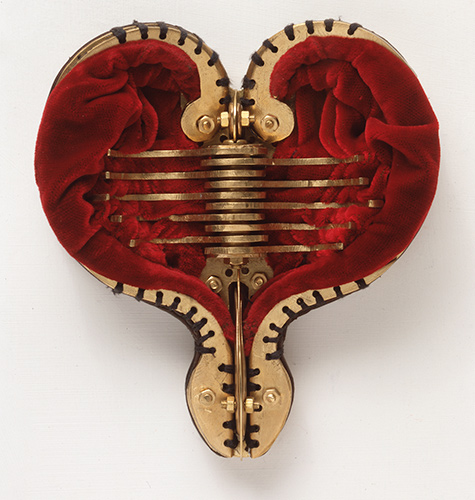
Paris. Under the title “Body Norms”, the Palais de Tokyo presents a cycle of eight exhibitions on the theme of the body and “validism”. Cathy de Monchaux (born in 1960 in London) treats the female body and its transformations precisely as an aesthetic subject, including in its sexual and biological aspects. Many of his sculptures represent more or less stylized female genitalia, made using leather and metal: unsurprisingly, “she was assimilated into the BDSM world (bondage, discipline/domination, sado-masochism) by art critics in her early days”explains Hugo Vitrani, curator of the exhibition. These sculptures of varying size adorn the walls and corners of the rooms, alongside works in velvet and metal frames, including a heart with multiple connotations (object from a cabinet of curiosities, automaton, ex-voto, etc.) [voir ill.].
A large unicorn sculpture, one of the artist’s first works in 1984, provides the keys to his universe, “the bone framework [y] symbolizes[ant] the oppression and confinement that the artist felt »specifies Hugo Vitrani. Most of the works speak of the life of Cathy de Monchaux, from her horse riding accident to the sexual assaults she suffered, including her disabilities (dyslexia, autism) and motherhood: the body thus remains the fixed point of her life.
Cathy de Monchaux, view of the exhibition “Studio, wounds and battles, desire is the reiteration of hope” at the Palais de Tokyo, 2026.
© Aurélien Mole
© Adagp Paris 2026
Linked to the London scene of the 1990s
Several works are exhibited for the first time, because after a promising start to her career at the end of the 1990s, in parallel with the Young British Artists, Cathy de Monchaux disappeared from the artistic scene: she explained in interviews that she saw her career stop as soon as she had a child, even though pregnancy and motherhood inspired her to create new, sometimes disturbing creations (boxes with small sexual objects made of fabric and nails). Art critics and institutions have turned away from his work “probably too avant-garde and feminist for the time”according to the commissioner. The artist was able to continue producing thanks to the support of private collectors, and for twenty years has been creating sculpted paintings inspired by the world of tales as well as the battle scenes of the Renaissance painter Paolo Uccello. These fantastical landscapes feature pregnant women lost in a magical forest, unicorns and delicate creatures made of copper wire covered in plaster. These “cruel fairy tales” alternate with armies of horsemen, always using the same technique: the feminine and the masculine dialogue from one painting to another, with sophisticated shadow play that the lighting highlights. All of the works are made by hand by the artist, who masters both the cutting of metal and the handling of leather, a material that she works in accumulation of tight folds, covered with white talc like almost all of her works.
The last room presents part of the archives of Cathy de Monchaux, her numerous notebooks and preparatory drawings and her autobiographical texts, shown for the first time. We see extremely precise work with materials. The exhibition therefore allows the (re)discovery of an abundant work where the body reveals its plasticity and its pain.
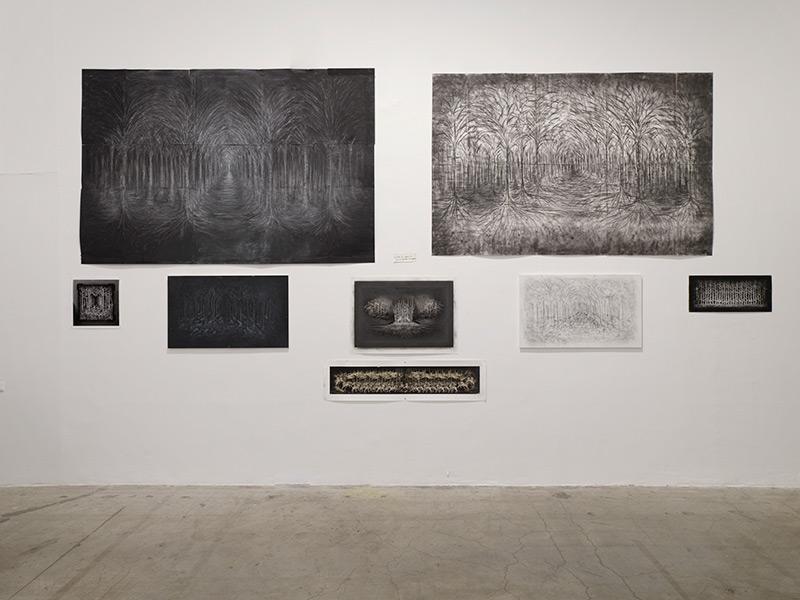
Cathy de Monchaux, view of the exhibition “Studio, wounds and battles, desire is the reiteration of hope” at the Palais de Tokyo, 2026.
© Aurélien Mole
© Adagp Paris 2026


