In 2023, the same year in which the Barcelona MACBA offered her an exhibition, the French-Moroccan artist Bouchra Khalili presented, with a prize, at the Sharjah Biennial The Circle Projecta project that collects thematically and formally key aspects of his career: the attention to subjects made invisible in countries to which they emigrated and the reference, in the montages of the pieces, to the circles or assemblies in which, in the Moroccan tradition, oral stories are told in public spaces.
In reality, Khalili had been working on that proposal since 2012 and would continue to be immersed in it until 2024; Now it is being deployed at La Casa Encendida in Madrid, where it will also be screened. The Tempest Society on September 10. Both productions share a theme: the artist has investigated, facing the scarcity of testimonies, the activity of the Arab workers’ movements for equal rights in France in the seventies, groups to which she feels very linked because they coincided with the generation and aspirations of her parents -Khalili was born in 1975 in Casablanca-.
Given the lack of documentation, she herself, as she explained today, has created her own archive around those groups; He has done it against his will, because it is not this classifying work that interests him, but rather the investigation, fundamentally based on video, into the ways of representing absence. Even in the paths it takes to make itself present.
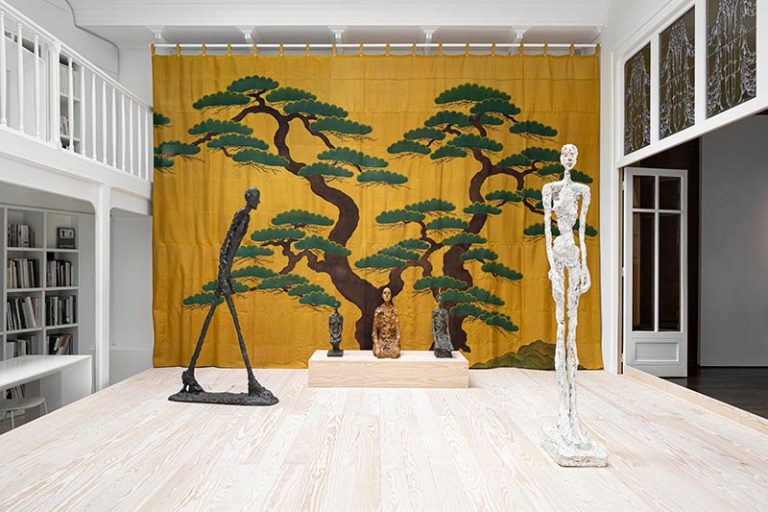
The Circle Project. Bouchra Khalili. The House On, 2026
Five decades ago and in France, this population from North Africa was considered, in the words of this author, as easy labordespite the fact that they soon launched anti-racist campaigns and founded, in Paris and Marseille, theater companies that also designed forms of protest against the wave of xenophobia that shook this country, especially the south, in 1973, following the murder of a bus driver by a young Algerian with mental problems. The escalation, which caused several deaths and injuries, even led the Algerian president at the time, Houari Boumédiène, to suspend the emigration of workers from that country to what was his metropolis.
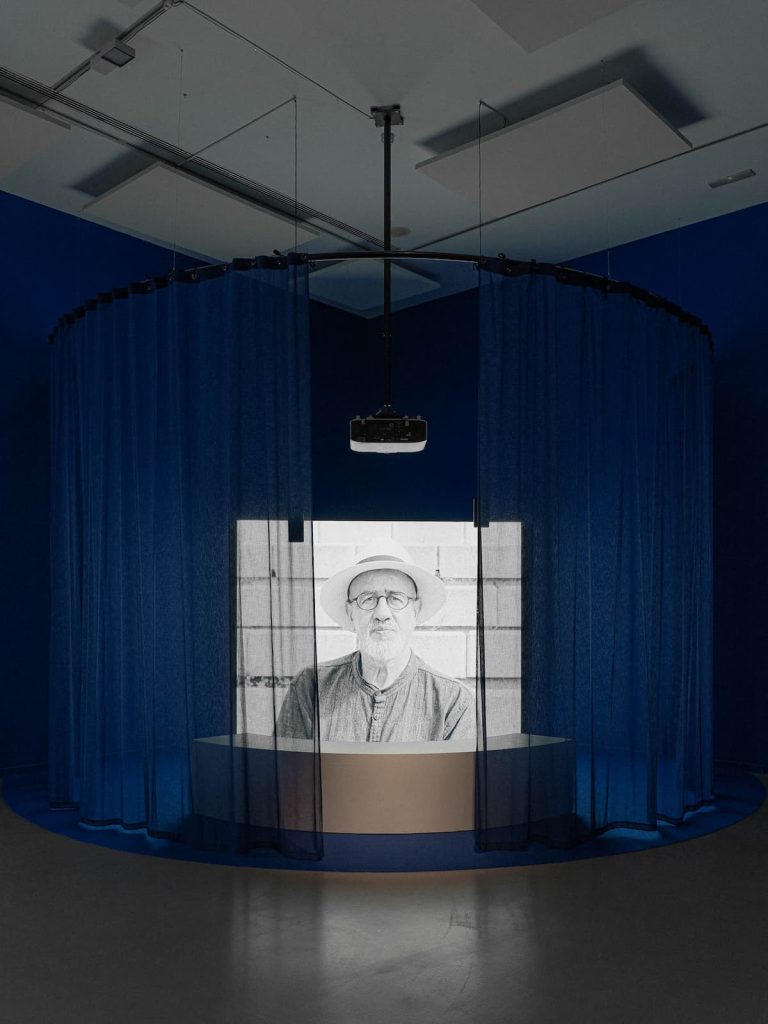
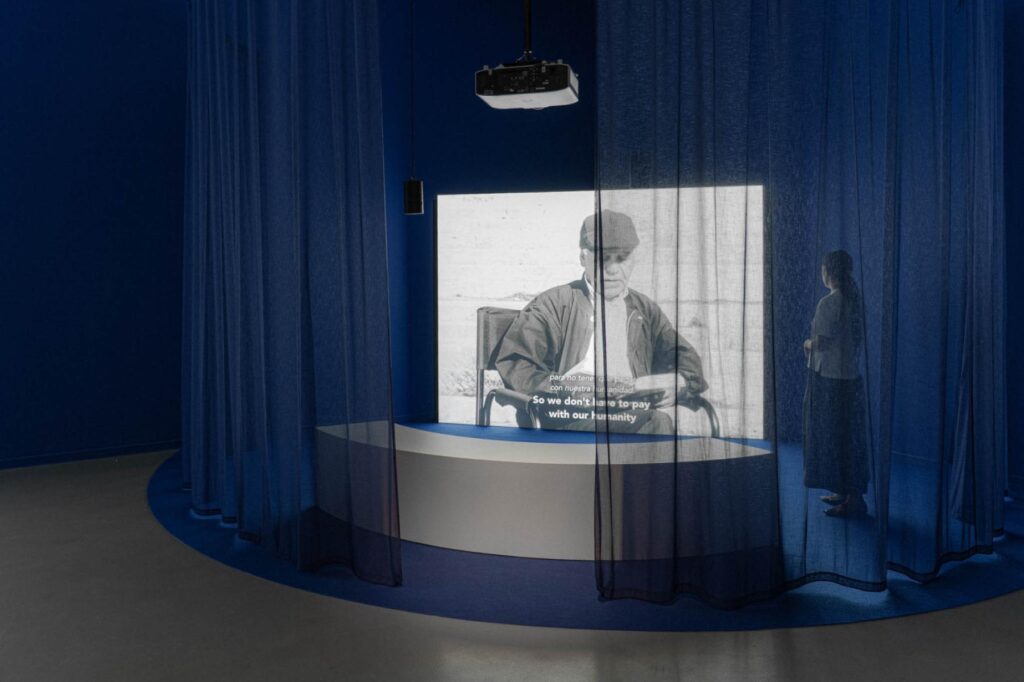
The performances and theatrical practices of these groups, like the exhibition devices that Khalili chooses for his videographic installations, refer, as we advance, to the development of orality in Morocco and other areas of North Africa: a narrator attracts his audience by seating them in a circle around him; Without said circle, a form that public assemblies also take, there is no story. In La Casa Encendida, visitors are invited to form a community of spectators that replicates those of those events.
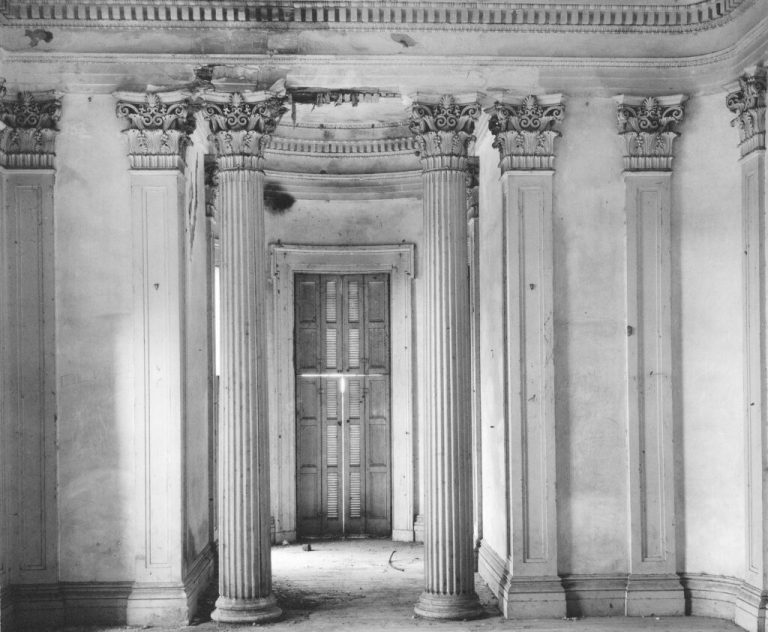
The Circle Project. Bouchra Khalili. The House On, 2026
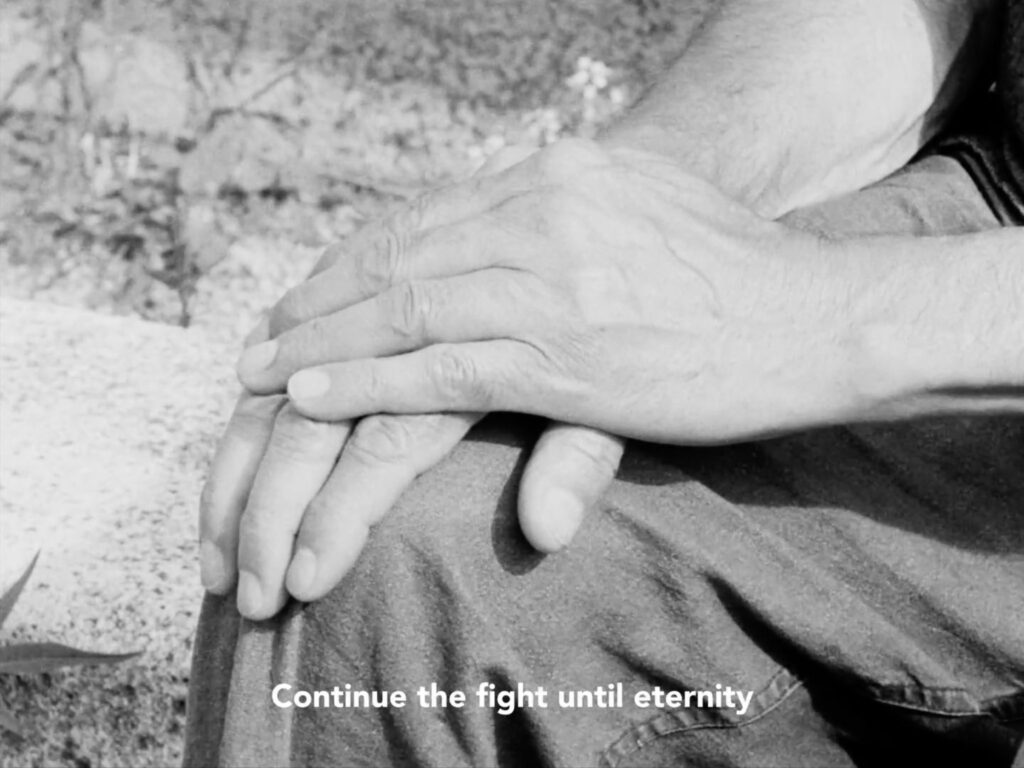
This exhibition is divided into three parts. The first corresponds to a short film, titled The Storytellerscomposed of five 16-millimeter black and white films that compile fragments of the activities of those theater and fighting groups – which were named Al Assifa and Al Halaka -, replicated by some of their former members in an empty theater in Marseille, since at the time no one filmed them. These are sketches and poems that allude to racism, access to housing and difficult living conditions and, given the absence of an audience in the place, the one from La Casa Encendida will be the natural spectator, invisible to the performers.
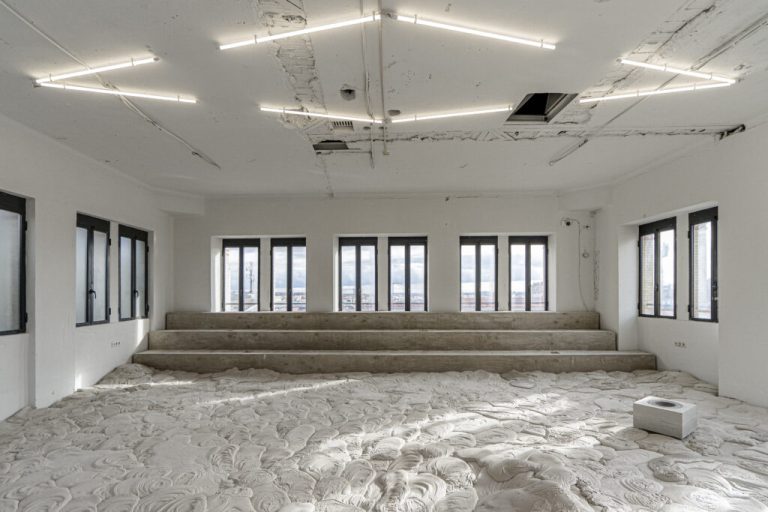
Secondly, Khalili shows the mural in La Casa Timeline for a constellationwhich provides context through documents, interviews and chronologies about the journey of these movements in the first half of the seventies, their alliances and their capacity for action, information that has just been collected in a publication of the same name, published in London in February.
Its articulation can be related to that of the wall newspapers used precisely by Arab workers, written in their original language and in French.
The Circle Project. Bouchra Khalili. The House On, 2026
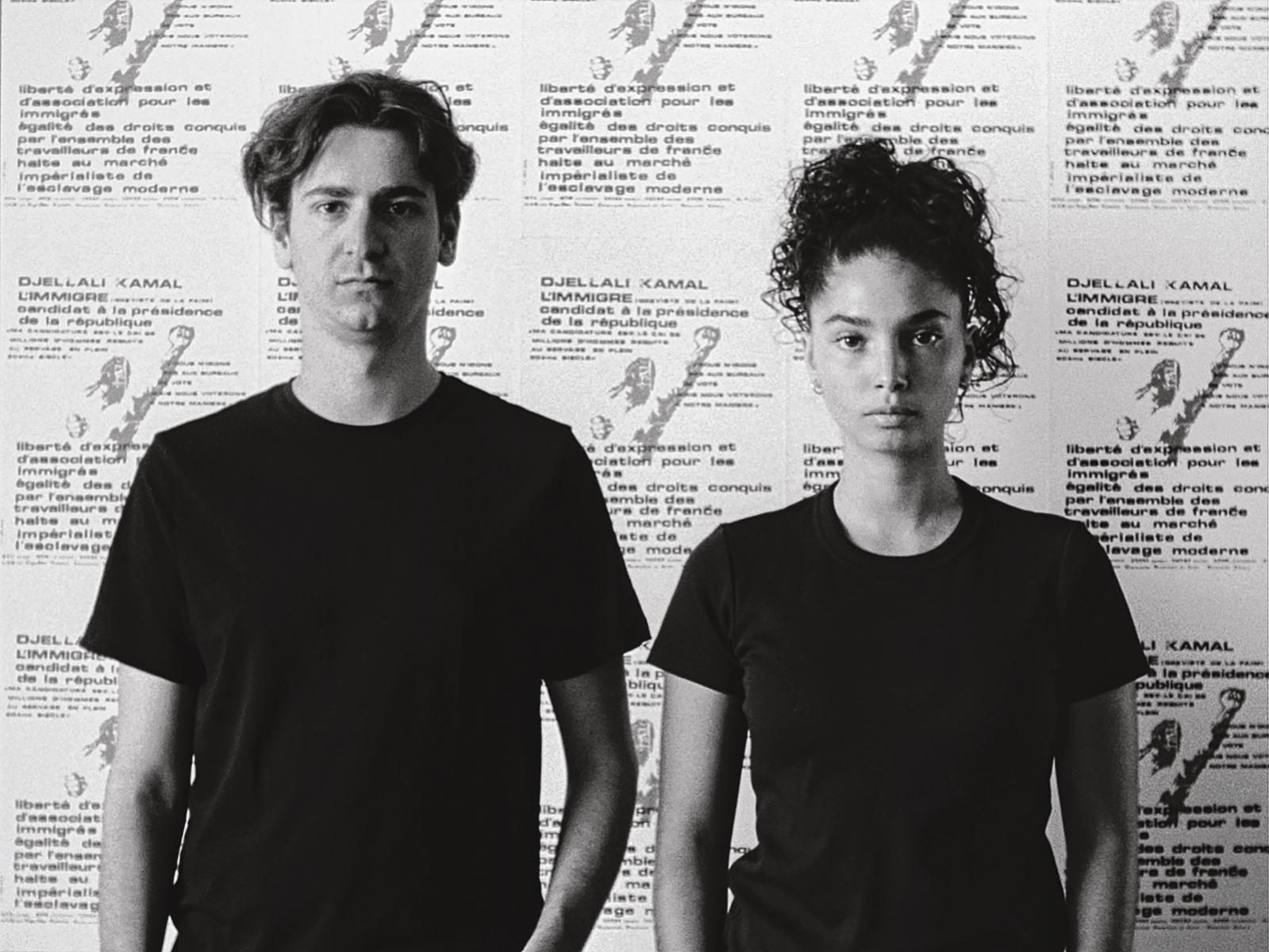
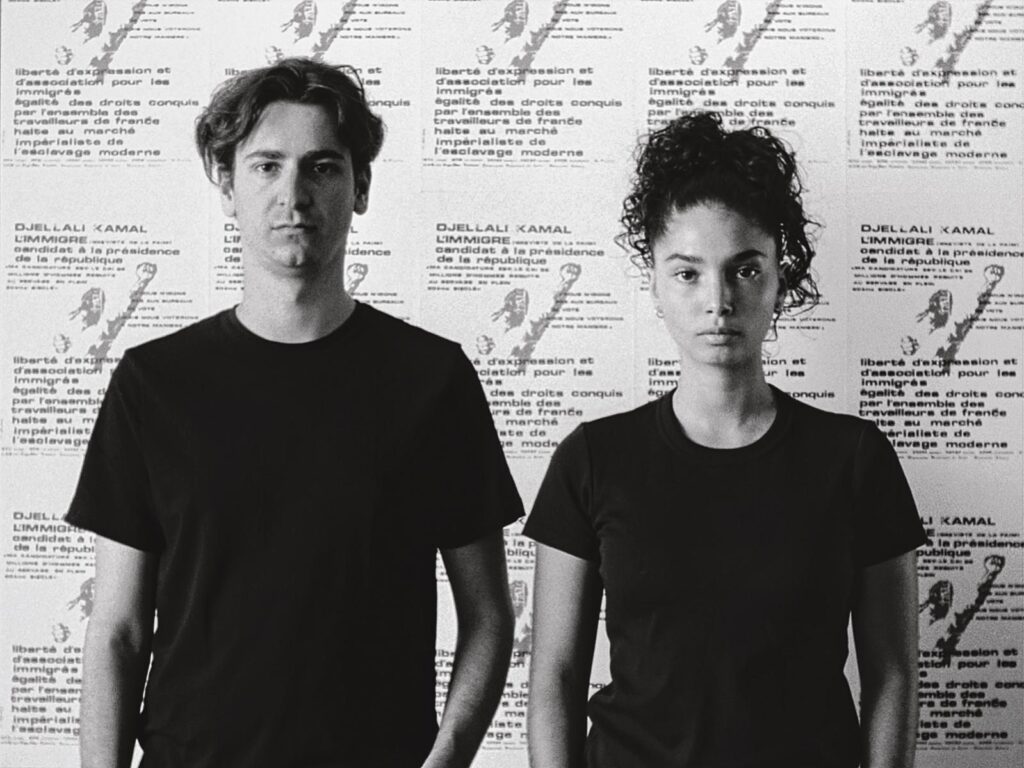
Finally, we will see The Circleanother hour-long video in which two young French people of Maghreb origin, and residents precisely in Marseille, Mía and Lucas, search for the traces of those struggles of their elders and compile files, music, images and theatrical fragments together with members of Al Assifa and Al Halaka.
In this intergenerational dialogue, the figure of Djellali Kamal -that was his pseudonym-, a member of Al Assifa and an illegal immigrant who, in 1974, while on hunger strike demanding his regularization, ran in the French presidential elections. It was, at its core, an exercise in public performance that sought to challenge migrants excluded from voting and invite them to imagine the possibility of transnational citizenship.
Khalili makes him visible from his invisibility, turning his spectrum into a signifier. All his projects are, at their core, self-reflexive: they imply a meditation on the mechanisms of transmission of the history of the defeated and on the capacity of the film medium to produce presence through absence; memory where, as in this case, there was no file.
Their works are also very transparent in terms of their production process: they are based on the montage of recovered photographs and videos, on the concatenation of an archeology of fragmented media that is not hidden from the observer.
The Circle Project. Bouchra Khalili. The House On, 2026
«The Circle Project. Bouchra Khalili
THE HOUSE ON
Valencia Round, 2
Valencia
From September 10 to November 29, 2026