Barcelona (Spain). The exhibition of Barcelona on Francesc of Assís Galí I Fabra (1880-1965) starts from an observation: the Catalan remained in the memories above all as the influential teacher from the whole of the Catalan Noucentist generation. But his work as an artist is much less known. The route therefore proposes to reverse this trend. And to well solemn the exhibition, visitors go under a dome decorated with shimmering figures, signed Francesc of A. Gali, before reaching the gallery on the second floor of the grandiose National Museum of Art in Catalonia.
This initial gesture does not however foreshadow the continuation thought by the Barcelona commissioner, Albert Mercadé, more anxious to present his life than his work, breaking the promise of “Reveal the trace of the one who did not want to leave it”. His biography recalled at the beginning, says that the painter’s uncle was none other than Pompeu Fabra (1868-1948), theorist of the modern Catalan language. On contact, FranceSC frequents intellectuals of the time. At 15, he joined the Llotja, the Barcelona School of Fine Arts, where he studied at the same time as Pablo Picasso.
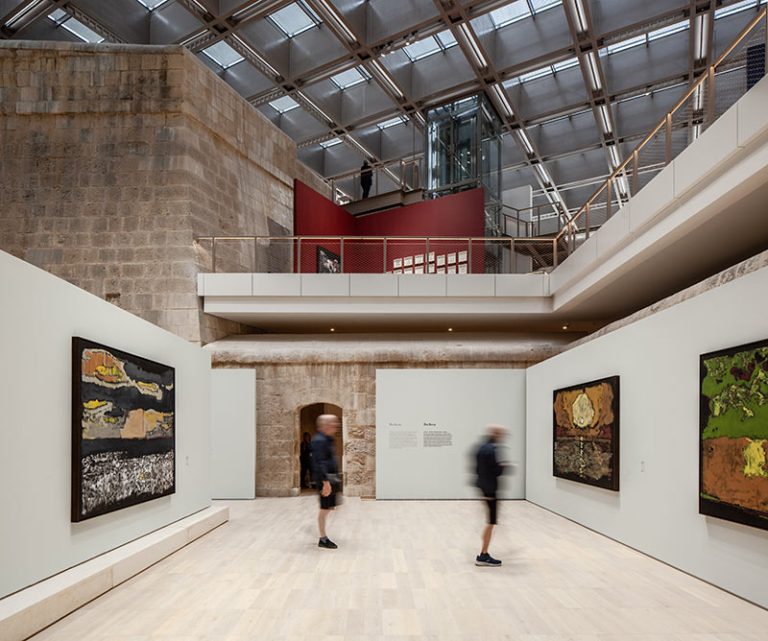
Many photographic archives of the Catalan intelligentsia also attest to its proximity to the big names of the time. It’s a bit of a shame, because it gives the impression that the value of Gali comes down to those around him. At 22, the Catalan bourgeois fully kisses his teaching career and opened his own school, considered the first academy of newism. The hanging also reflects this spirit well, evoking a workshop with its wooden structures on which certain parts are hung.
The Gali school is not common. He teaches a certain spontaneity there: thus, for example hands in the back, the students must palpate an object and then draw it without seeing it. It is partly thanks to these games that Joan Miró, whose young artist’s exercises are exhibited, develops his interest in sculpture. Catalan also takes its students in contact with nature, with their own eyes. Back at school, apprentices have “mental landscapes”, trying to remember the shape and color of the mountains admired a few hours earlier.
Poster of the International Exhibition of Barcelona of 1929 illustrated by Francesc d’Assís Galí (1880-1965).
© Mnac
Resistant and exile
Further on, Gali’s work finally unfolds. Symbolists and then surrealist posters testify to his avant-garde spirit. At the center of the exhibitioner, the visitor is invited to test his methods via interactive devices.
Gali was also resistant and forced to exile in 1939. Director of Fine Arts of the Republic, he then participated in the safeguard of the Prado collections, which he managed to transfer to London where he later lived ten years. Curiously, this essential period is entrusted to the Musée Memorial de l’Exil (MUME), on the Franco-Spanish border, in a twin exhibition which precisely explores its life as an exile and resistant. Without this part of his career, it becomes difficult to really grasp the character of the master who remains, ultimatelyalso poorly known.