Paris. Meticulously reproduced scaly polypores or a downy-haired civet alongside a delicate Josephinia imperatricis signed Pierre Joseph Redouté (1759-1840), nicknamed “the Raphaël of flowers”. “We are here at the crossroads of scientific drawing and the prestige of fine arts”notes Louise Fauduet, co-curator of the exhibition “Artists at the Museum, 400 years of art and science” and curator of libraries at the National Museum of Natural History (MNHN), in front of these illustrations from the institution’s famous vellum collection. Since the 17th century, several generations of artists have contributed to enriching this exceptional collection, which today lists nearly 7,000 plates and several dozen originals of which are presented here in rotation. “On the occasion of the exhibition, we relaunched this production interrupted at the end of the 20the century, by reconnecting with the same principles that guided its creation: asking the Museum’s researchers to identify species representative of current scientific news, and supporting the designers to guarantee the scientific accuracy of the illustrations”, she continues. The public can thus discover three new vellums: a paleontological reconstruction, a new species of plant and a marine microorganism, each testifying to the vitality of scientific illustration.
This is the whole point of this exhibition: to show that this practice, far from belonging to the past, has continued to reinvent itself according to scientific advances. It has not been replaced by photography, to which it brings a complementary perspective. It is not immutable either, but transformed by new practices ranging from the use of colors to microscopy. The route thus encompasses four centuries of creation, between works commissioned by the Museum and artists’ views on its collections. But the subject remains accessible by being available in various small highlights: artists embarked on scientific expeditions of the Museum, portraits of illustrators or even contemporary artists committed to the protection of biodiversity.
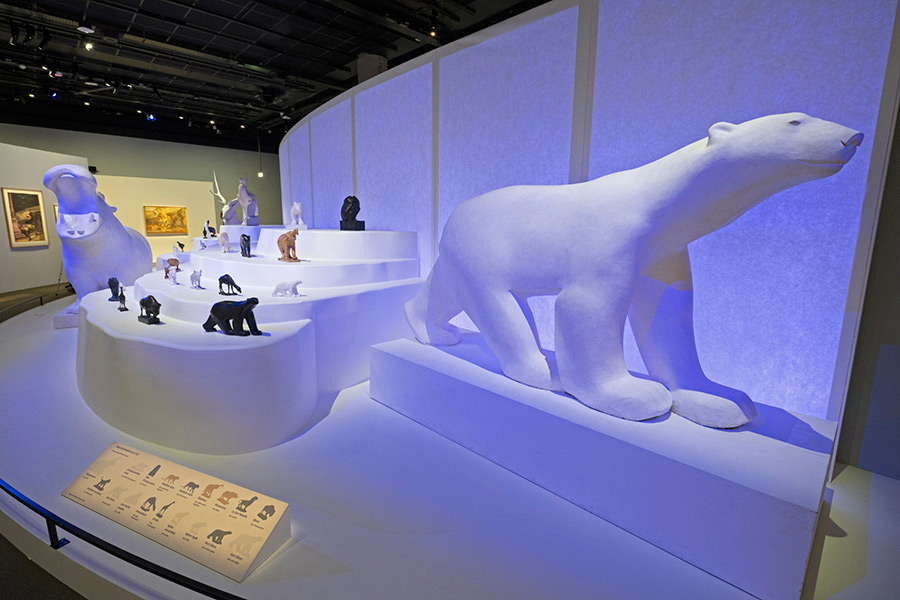
View of the exhibition “Artists at the Museum, 400 years of art and science” at the National Museum of Natural History.
© J.-C. Domenech / MNHN
Faced with the diversity of works released from reserves, it is clear that scientific drawing is never neutral. Each designer brings his own style, sensitivity and perspective. But “certain artists also come to draw inspiration from the Museum’s collections, scientific research, and the place as such to draw something completely different from it,” adds Louise Fauduet. Eugène Delacroix, Bernard Buffet, Sarah Moon and Alberto Giacometti are among the many artists who one day roamed the spaces of the Museum without pursuing a scientific mission. As the highlight of the exhibition, the impressive caravan of François Pompon (1855-1933) displays an entire bestiary with smooth and refined shapes, sculpted from sketches taken from life in front of the Menagerie enclosures. A parade which is reminiscent of that of the Grand Gallery of Evolution, located on the upper floor, demonstrating how much the Museum’s collections have nourished and continue to nourish the imagination.
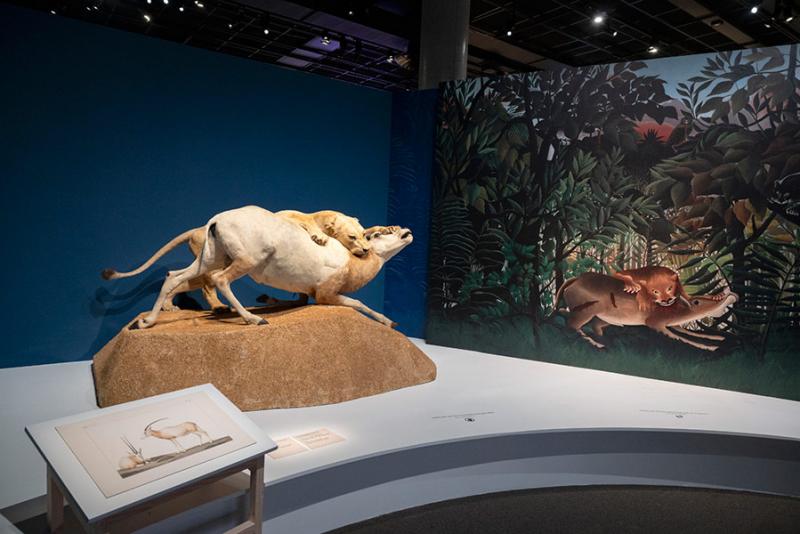
View of the exhibition “Artists at the Museum, 400 years of art and science” at the National Museum of Natural History.
© J.-C. Domenech / MNHN