New York. The first room, a sort of preface to the double retrospective, sets the tone: it is dedicated exclusively to Lee Krasner (1908-1984), a choice misunderstood by some visitors already searching, out loud, for the iconic Jackson Pollock (1912-1956). This choice, however, subtly affirms what the subtitle of the exhibition – Past Continuoustitle of a work by Krasner – only whispers: the desire to direct the gaze towards one of the major figures of abstract expressionism. Emblem of this first room, and visual chosen for the communication of the exhibition, Bald Eagle (1955) radiates onto the opening wall. This work is a collage made by the artist by cutting out his unsold canvases and drawings by Pollock. Example of interdependence between artists for some, opportunistic reuse of materials for others: the discussion will never cease, and the presence of Pollock seems destined to unfold as a ghostly filigree in Krasner’s work.
An educational scenography
The route is then chronological. The scenography knows how to be modest for the years of learning, with sections of walls which simply mirror the training works of the two artists. It then becomes educational for the years when, in a common experimentation with abstraction, each spouse establishes the characteristics of their work. A first device is put in place by the scenographers, interesting on paper but difficult to read during the visit: in the exhibition room, hollow walls fit together to materialize the difference in size of their respective workshops in their East Hampton house, the barn for Pollock and a modest bedroom for Krasner. In the same room, the works of the two painters are compared on several occasions. The viewer can compare the plastic approaches of the two artists during the same periods. Besides the question of knowing which of the two is a precursor (they both are), this system makes it possible to discern their singularities.
Abstraction, in Pollock, takes on eruptive, jubilant accents. The line follows cathartic paths which seem to ignore any organization, but are in reality developed by the artist in a plastic planning. Krasner, for her part, offers an inspired, harmonious, rhythmic construction which we suppose to be the fruit of a mechanics of gesture, but also of the mind. Characteristics to which the gender biases of their time could have been applied, but which the Met intends to thwart.
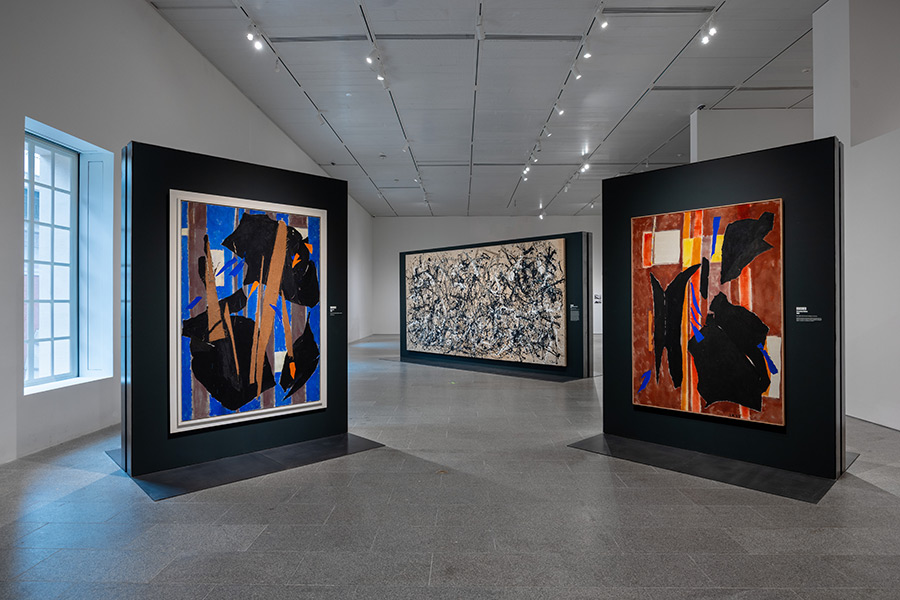
View of the exhibition “Krasner and Pollock: Past Continuous” at the Metropolitan Museum of Art.
© The Met
© Adagp Paris 2026
In the 1950s, according to historian Griselda Pollock: “To be an artist was to be Jackson Pollock and to be a woman was to be Marilyn Monroe”. Recognized professionally even before Pollock, Krasner nevertheless became, over time, less visible than him. She was aware of the favoritism enjoyed by men, recounting the words of her teacher Hans Hofmann about one of her paintings: “It’s so successful that you wouldn’t guess it was the work of a woman.» (Cindy Nemser, Art Talk1975). Despite everything, the artist refused a feminist reading of her career, wanting to escape the “cliché”. The exhibition takes its side and, like it, invites us to study its work without locking it into an overly marked genre reading.
At the center of the exhibition: the most emblematic works of the two artists, starting with Pollock’s monumental canvases, painted in 1950. The power of his drippings is dazzling, and for a time eclipses reflections on Krasner’s work. A certain irony sets in when remembering the open letter addressed in 1950 to the president of the Met, signed by eighteen painters including Pollock, and published in the New York Times. They all demonstrated their refusal to participate in the “American Painting Today – 1950” exhibition, denouncing the museum’s contempt for “modern painting”. In 1957, a year after Pollock’s death, the museum finally included in its collections Autumn Rhythm (1950). Almost seventy years after this acquisition, the dripping is one of the major works of this first major exhibition granted by the institution to the painter.
After the drippings Krasner’s exhibition at the Stable Gallery in 1955 is mentioned. Surprise: the revelation also comes from contact with the eight works exhibited there. Less vivid or dramatic in appearance than Pollock’s physical works, they captivate with their harmony. Oil, paper, collage, all are adorned with a science of verticality and colors. The materials, the composition, the subtle curves are paths towards abstraction which are distinguished from those of Pollock by their harmonic desire. Less revolutionary than drippingsthese nevertheless freeze visitors to the exhibition.
Krasner, far beyond Pollock
Numerous rooms follow, almost exclusively dedicated to Krasner and his work after the death of Pollock (1956). The artist now works in Pollock’s barn, where she amplifies her formats and does not renounce any influence: everyone guesses Picasso, the cubist intention, the reference to the cave, the outlined color undoubtedly borrowed from Die Brücke and especially Matisse, so often cited, whom Krasner introduced to Pollock. Lee Krasner’s artistic erudition is evident in his work. With the seventy-four pieces on display (forty-eight for Pollock), the visitor becomes aware of the incontestable strength of this figure of abstract expressionism: a work always at a tiny distance from a silhouette or a landscape, which is strongly distinguished from what Krasner called the “pure painting” by Pollock.
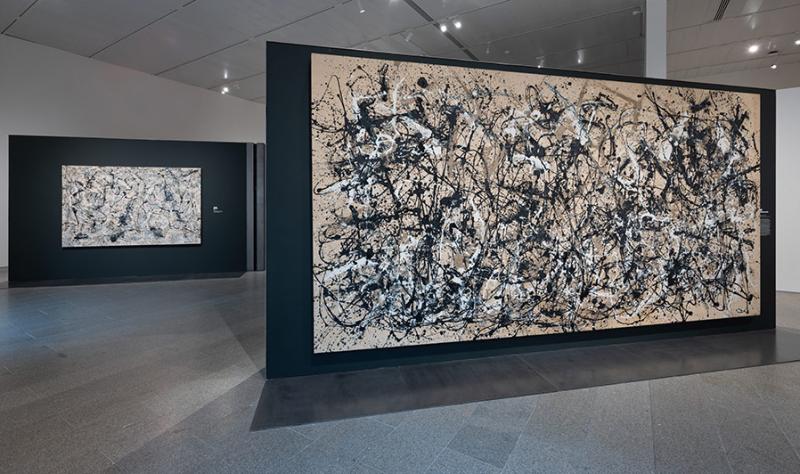
View of the exhibition “Krasner and Pollock: Past Continuous” at the Metropolitan Museum of Art.
© The Met
© Adagp Paris 2026