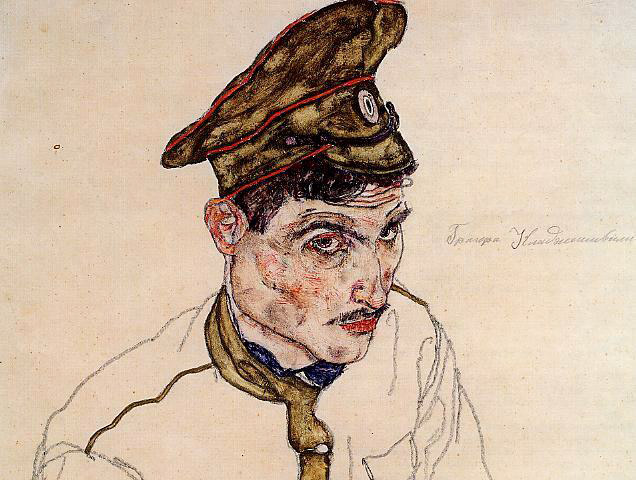
The Supreme Court of New York State has decided, Art Institute in Chicago must finally return its drawing Russian prisoner of warproduced in 1916 by the Austrian expressionist Egon Schiele, estimated at 1.25 million dollars (around € 1.17 million).
District office investigators have, according to the New York Timessaid that this work, which had belonged to the artist and collector of Austrian Jewish art Fritz Grünbaum, who died at the Dachau concentration camp in 1941, had been stolen by the Nazis during the Second World War.
In 2024, a request was filed by the New York prosecutor claiming the restitution of the drawing to the heirs of Fritz Grünbaum. The museum had then presented a detailed file before the Supreme Court to prove that it held the watercolor legally. The work had been bought in 1966 from the BC Holland gallery in Chicago. The museum also challenged the legitimacy of New York investigators to claim a work outside their jurisdiction for sixty years. The establishment said that Mathilde Lukacs, the sister-in-law of Fritz Grünbaum, had legally inherited the work before giving it to the Swiss art dealer Eberhard Kornfeld in 1956.
Egon Schiele (1890-1918), Russian prisoner of war1916, watercolor on graphite, 43 x 30 cm.
The museum also invoked civil procedures initiated by the Grünbaum heirs, some dating back more than ten years, one which, according to the New York Timesbelieved that the heirs had come forward too late and deemed credible the story of Eberhard Kornfeld.
But New York judge Althea Drysdale agreed with the heirs, arguing that Fritz Grünbaum would have been forced to hand over to the Nazi authorities in 1938. She notably refuted the story of Mr. Kornfeld, who died in 2023, stressing that several invoices presented as proofs of transactions with Mathilde Lukacs were falsified, even some spelling, wrong with his name. “It is highly unlikely that Mathilde Lukacs never obtained the title of ownership of Russian prisoner of war »»said the judge, indicating that the museum should have conducted a more in -depth investigation into the origin of the work.
In addition, according to the prosecutor, the drawing would have transited in 1938 by the warehouse of the Viennese company Schenker & Co., affiliated with the Nazis, before being sold to finance the war effort.
Following the request for restitution, the Art Institute of Chicago indicated to the New York Times be “Disappointed by the return decision, we examine the court’s decision and study all the options available to appeal. These options include the request for a stay when the work is given the investigators. »»
Raymond Dowd, the lawyer for the Grünbaum heirs, welcomed this decision: “This judge has sent a clear warning to all people in the world who hide works of art looted by the Nazis: you better not approaching them with New York. Never. »»he said.