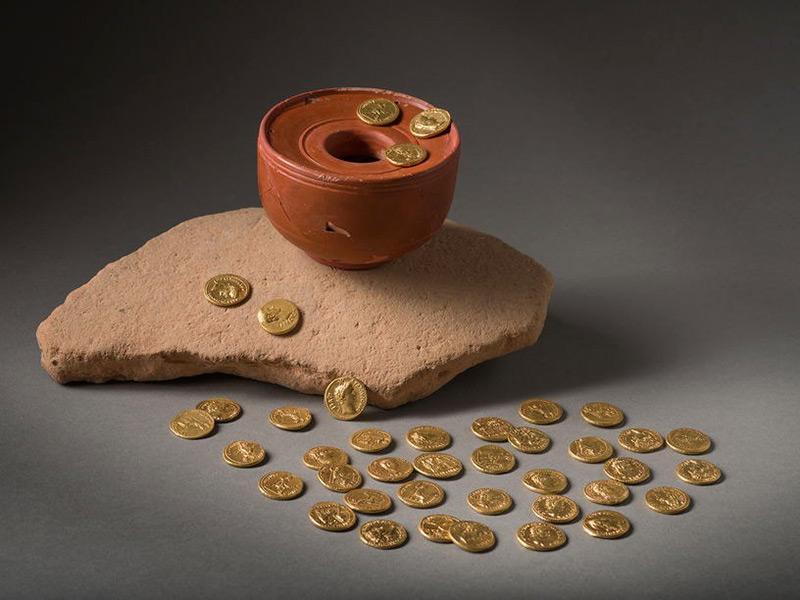
The scene would be almost romantic if it were not dramatic for the victim: on the night of June 30 to July 1, burglars disappeared in the darkness, a pottery filled with around forty Gallo-Roman gold coins under their arms. In their flight, they dropped an aureus, found on the road. Perpetrated in less than 15 minutes, the amount of the theft is estimated at around 120,000 euros. A sum hardly representative of the heritage value of the treasure, “invaluable” according to the Archaeological Center of Montans (Tarn).
At 4:30 a.m., the alarm sounded after the perpetrators entered the museum by breaking a window, before breaking down the door to the treasure room, then breaking the anti-intrusion grille and the secure display case which protected the object of their desire: gold coins from the year 50, struck with the effigy of four Roman emperors, discovered in Montans in the 1990s.
The sequence of steps suggests an operation prepared in advance. Despite the rapid arrival of law enforcement, the thieves could not be caught. A complaint was filed and an investigation was opened by the gendarmerie. To control the risks of the treasure leaving French territory, the inventory items were sent for border control. However, there is a great risk that the parts will be melted.
Although we do not yet know anything about the identity of the criminals or their experience, the theft appears to have taken place without much difficulty. As was the case at the Maison des Lumières Museum in Langres (Haute-Marne), last October, during the theft of hundreds of silver and gold pieces from the 17th and 18th centuries. And at the Desert Museum of Mialet (Gard), which lost gold Protestant crosses. Or at the Adrien-Dubouché Museum in Limoges (Nouvelle-Aquitaine), where more than 6 million euros worth of porcelain were stolen in September. And of course, at the Louvre, during the burglary of the Crown jewels, which outraged some and amused others, and led to the departure of its director Laurence des Cars four months after the events.
The Montans Archaeological Center, which does not have a video surveillance system, planned to equip itself soon. The mayor of the town Jonathan Vidal admits “should we have done this sooner?” In hindsight, it’s easy to say yes, we should have”.