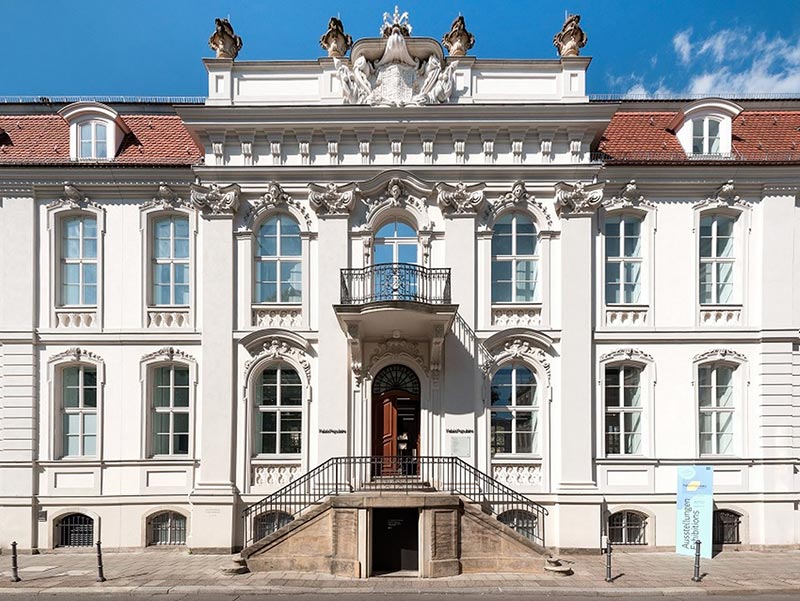
Next November, Deutsche Bank will celebrate its farewell at the PalaisPopulaire, its main exhibition venue in Berlin for eight years. The Frankfurt-based bank’s collections will permanently move from the former palace of the Prussian royal family at the end of 2026.
Germany’s leading credit organization in terms of total assets, Deutsche Bank has decided not to renew the lease that linked it to billionaire Mathias Döpfner, owner of the imposing building on the boulevard Under the Lindenone of the main axes of the city. If bank spokesperson Klaus Winker presented the decision as a way of “reorient your cultural commitment to Berlin”he also cited financial reasons. The newspaper Tagesspiegel suggests that this public announcement could act as a “signal” sent to Mathias Döpfner, also CEO of Germany’s largest media group Axel Springer.
Whatever the reasons, the non-renewal of the rental lease for the former Princesses’ Palace (Prinzessinnenpalais) is an opportunity for an update of Deutsche Bank’s curatorial policy. The company announced that it wanted to focus more on young artists, continuing a line started some time ago. With the creation of the “Artist of the Year” prize in 2010, and its extension to several winners in 2021, it already clearly indicated its desire to highlight emerging artists. The exhibition by the Slovak artist Lucia Tallová (born in 1985), rewarded in 2026 by a jury notably composed of Sam Bardaouil and Till Fellrath, directors of the Hamburger Bahnhof, will accompany the closure of the PalaisPopulaire.
The bank now plans to create a new program to support young artists on the Berlin scene. Another axis of its future programming, Deutsche Bank intends to strengthen its partnerships, once again taking a familiar direction: the conferences organized at the Hamburger Bahnhof museum with loans from its collections will be maintained, as will the education program in collaboration with the Berlin Philharmonic.
Built in the 18th century, the Princess Palace was rebuilt in the 1960s after being damaged at the end of the Second World War. It was at this time that theOperncaféan emblematic place of East Berlin, then of the reunified city, which closed at the beginning of the 2010s. Although the historic building saw museum uses at the end of the monarchy and during the Third Reich, its transformation into PalaisPopulaire by the Berlin architectural firm Kuehn Malvezzi, from 2017 to 2018, made it possible to restructure the interior surfaces by adapting them more to a use stable museographic.
The Deutsche Bank collection has been occupying Avenue Unter den Linden for almost thirty years: from 1997 to 2013, it was visible at the Deutsch Guggenheim, a short-lived institution founded as part of a partnership with the New York museum. After the end of her collaboration, she created her own KunstHalle in the same building. The inauguration of the PalaisPopulaire marks a more institutional shift in its cultural strategy, because it invests in a place which has a greater anchorage and influence in the capital. However, with a usable surface area of 750 m2, the building offered limited space for a collection of more than 50,000 works.
The PalaisPopulaire will have presented big names from the Deutsche Bank collection: Sigmar Polke, Gerhard Richter and Andy Warhol were among the 300 works presented during its inaugural exhibition in 2018. Other more experimental and immersive exhibitions have also been organized there, notably in 2023 with the futuristic installations of the Chinese artist LuYang, winner of the “Artist of the Year” prize.
More recently, in 2025, an exhibition brought together works from Deutsche Bank with museum loans, bringing together canonical figures of modern and contemporary art – Max Beckmann, Felix Gonzalez-Torres, Christo – and names less known to the general public, such as the Indian artist Shilpa Gupta (born in 1976) or the Turkish visual artist Ayşe Erkmen (born in 1949).