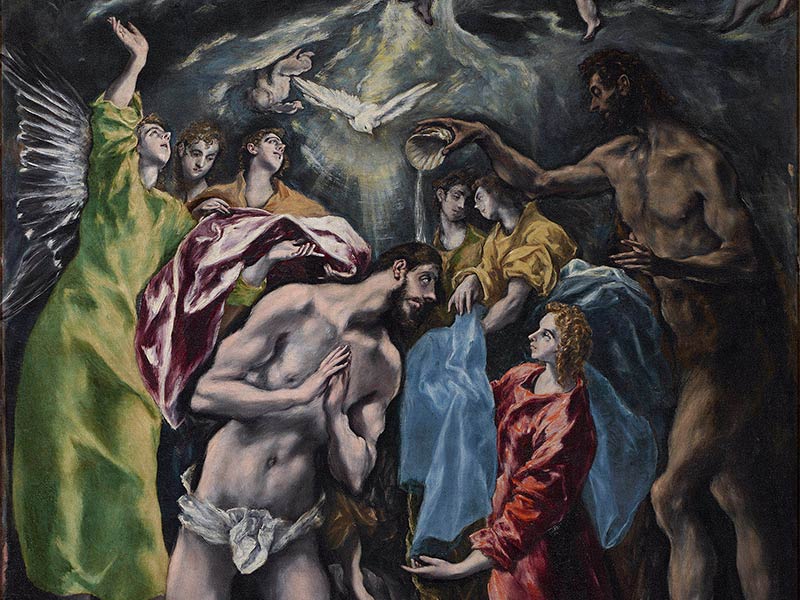
A scientific study relaunches the attribution of Baptism of Christ (330 x 210 cm) by El Greco, commissioned for the Tavera Hospital in Toledo (Spain), the execution of which was partly attributed to his workshop. Despite an uneven production, the stylistic imprint of the Cretan master, particularly in his way of distorting bodies, elongating figures, melting landscapes into a mystical mist, always shines through behind the superficial layers.
The painting has a complex history. In November 1608, Pedro Salazar de Mendoza, administrator of the Tavera Hospital in Toledo, entrusted El Greco, then aged 67, with the decoration of the chapel dedicated to Saint John the Baptist. The contract provided for a main altar and two side altarpieces for 7,000 ducats, a considerable sum, considering the scale of the project. The inventories after death (1614, for El Greco then, in 1621, for his son Jorge Manuel) described the “great baptism for the hospital” as sketched, not completed.
The legal disputes between the workshop and the hospital in 1622 revealed a blocked construction site with more than 8,600 ducats already paid, but unfinished paintings. In 1624, the Baptism was nevertheless hung on a side altarpiece, alongside an unidentified Pentecost. From then on the idea of a composite work emerged. The master would have provided the invention and left his son and the workshop to take care of the finishing, especially in the main figures in the foreground considered less inspired. The Fundación Casa Ducal de Medinaceli, current owner, summarizes the consensus by describing a “magnificent personal invention” of Greco, however supplemented “in its superficial parts” by Jorge Manuel.
El Greco (1541-1614): The Baptism of Christc.1608-1614, oil on canvas, 330 x 211 cm, Museo Fundación Lerma, Hospital de Tavera | Christ on the crossc. 1600–1610, 193 x 116 cm, Cleveland Museum of Art.
© Museo Fundación Lerma, Hospital de Tavera
Courtesy Cleveland Museum of Art
The upper areas, with God the Father, the dove of the Spirit and certain angels, maintain a typically Greek spiritual elevation, while the evangelical groups on the ground betray a more routine style. The angel in the foreground, who intervenes between Christ and John the Baptist, is an iconographic interpretation specific to the master.
A study recently published in the American journal Science Advances however, upsets the consensus. Researchers from Case Western Reserve University (United States), armed with a deep search tool called PATCH, mapped the micro-topography of the Baptism using optical profilometry. This 3D technique records the ridges and valleys left by the brush on a millimeter scale.
Calibrated on a Christ on the cross (around 1600-1610) from the Cleveland Museum of Art unanimously autographed by El Greco, PATCH detected in the Baptism four “communities” of pictorial gestures. But the resemblance rating remains low overall, suggesting technical consistency compatible with a single hand. The hypothesis of a finish provided by the workshop is weakened.
The authors discuss El Greco’s declining health in his final years, including documented ischemic attacks and visible tremors in self-portraits. The variations in style would no longer indicate different hands, but the phases of an aging body, alternating vigor and failure. What was considered an intervention by Jorge Manuel could reflect a diminished artist, but still in charge. PATCH is not infallible, however. Restorations, state of conservation or overly skilled imitators can distort the data. The algorithm complements expertise without supplanting it.