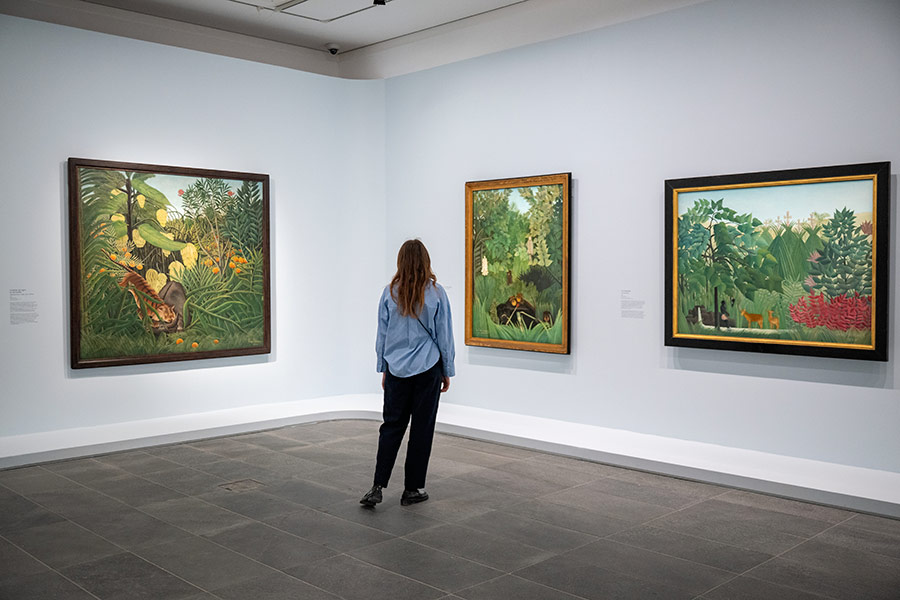
Paris. Since “Henri Rousseau: the Douanier”, which commemorated the centenary of his birth in 1944-1945 at the Museum of Modern Art of the City of Paris, several exhibitions have been devoted in Paris to the painter Henri Rousseau (1844-1910). In 1984-1985, “Le Douanier Rousseau”, at the National Galleries of the Grand Palais, presented 65 works; “Jungles in Paris, the paintings of Henri Rousseau”, at the same place in 2006, had 54; “The Customs Officer Rousseau. Archaic innocence”, at the Musée d’Orsay in 2016, went down to 43. This year, the hemorrhage has stopped since “Henri Rousseau, the ambition of painting”, at the Musée de l’Orangerie, goes back to 50 works. This improvement has an explanation: for the first time, the Barnes Foundation (Philadelphia) lent 9 paintings, or half of its collection, the first in the world of works by the artist. The new rules of this foundation having opened up such a possibility, a Franco-Anglo-American team worked on an exhibition organized jointly by the Barnes Foundation and the Orangerie. If we don’t see The Dream (1910), a legendary canvas from which the Museum of Modern Art (MoMA) in New York no longer separates, this is the first time that the “manifest paintings” (according to the name given to this space) that are exhibited together, in a room reserved for them, are The sleeping gypsy (1897) from MoMA, Bad surprise (1899-1901) of the Barnes Foundation and The Snake Charmer (1907) from the Musée d’Orsay.
“Henri Rousseau and the ambition of painting” at the Orangerie Museum.
© Laetitia Striffling
In addition to the eleven paintings from the Musée de l’Orangerie, one of the works belongs to a private collection, eight come from French museums (Orsay, Picasso Museum, Museum of naive art and singular arts of Laval [Mayenne]National Museum of Modern Art), thirty-two from Swiss institutions, one from Prague and one from the Courtauld Gallery, in London. It was Christopher Green, professor emeritus of the Courtauld Institute, and Nancy Ireson of the Barnes Foundation who proposed this partnership to the Orangerie (the exhibition was presented in Philadelphia before Paris), and they are co-curators with Juliette Degennes, curator at the Orangerie. From Prague comes the important opening painting of the route, the self-portrait Myself, portrait-landscape (1890) entered the collections of the Czech National Gallery in 1923. But the Barnes Foundation was unable to bring him to the United States: he was too fragile to travel so far. We must therefore fear that future exhibitions will be cut from this work. For the same reason, The Muse inspiring the poet (1909) was unable to leave the Kunstmuseum in Basel. The other version of the painting is in Moscow, the public will not see this double portrait of Apollinaire and Marie Laurencin in France for some time.
The material conditions in which the painter worked, poor all his life, may be at the origin of the fragility of his canvases. But other questions arise about them: did Rousseau prepare them himself? Was he using a pantograph? About Father Junier’s Carriage (1908), Michel Hoog, in the catalog of the 1984-1985 exhibition, pointed out that the art historian Dora Vallier had no doubts about it. What are the repentances that frequently appear in the paintings hiding? From 2021 to 2024, the Barnes Foundation conducted a material study of his works and, in Paris, the Center for Research and Restoration of Museums of France (C2RMF) examined his works as well as the three belonging to the Musée d’Orsay. An article in the catalog presents the conclusions of this research while, in the last room of the exhibition where documents are gathered, a video is devoted to this subject.
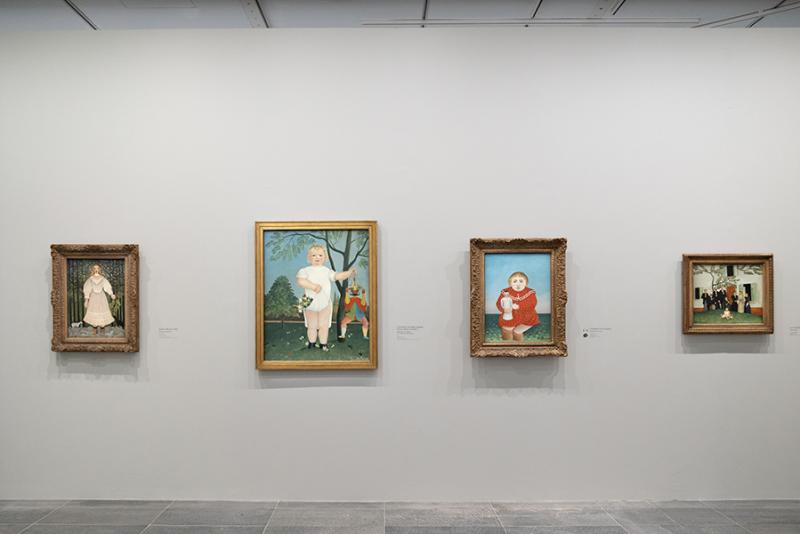
“Henri Rousseau and the ambition of painting” at the Orangerie Museum.
© Laetitia Striffling
A devourer of images
In several respects, the exhibition therefore draws its exceptional character from its co-organization with the Barnes Foundation. It can thus present important works such as The Past and the Present, or Philosophical Thought (1899), The Family (around 1892-1900), Scouts attacked by a tiger (1904), but also The Rabbit’s Meal (1908), which is probably the painting that Sonia and Robert Delaunay had purchased at the same time as The Carriage…the rabbit being in this case a pet of the Junier family.
Despite the interest of the last room which documents the painter’s dealers and collectors, and particularly the artists (who, like Picasso or Kandinsky can also be mentioned in certain cartels), it is missing, for visitors who have not seen the exhibition at the Musée d’Orsay in 2016, a section devoted to the influence on Rousseau of the art of his time, as well as to his own influence on the art of the 20th century. Another element would also have deserved to be developed, even if space is limited to the Orangery: what inspired the painter in his iconography. Absent from the rooms as from the catalog, a presentation, even brief, of examples of publications, prints or postcards which nourished his imagination and which the work of Yann Le Pichon revealed, would show the public the singularity of this devourer of images who transmuted this material into gold.