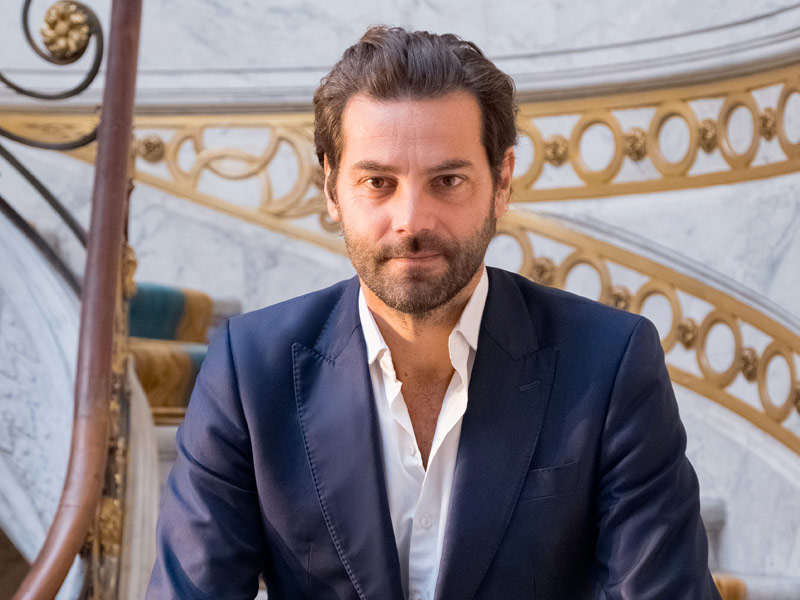
Paris. Arriving in November 2024, before his appointment was announced in January 2025, Aurélien Bosc took over from Bruno Monnier at the head of Culturespaces in a context of change of shareholders. At 47 years old, the new president has an unusual background in the heritage sector: a graduate of a business school, consultant at the consulting firm Ernst & Young, briefly with Carrefour, he managed the Pathé cinema network for fourteen years. This trajectory sheds light on the line defended by the company.
Culturespaces’ historic activity in heritage sites remains profitable, but to date it no longer offers any real prospects for expansion. The group now only operates two heritage sites, the Jacquemart-André Museum in Paris and the Hôtel de Caumont – Art Center in Aix-en-Provence (Bouches-du-Rhône). At the Jacquemart-André Museum, the model remains based on ambitious exhibitions, like the one devoted to Georges de La Tour (which ended on February 22), the cost of which reached 1 million euros. Aurélien Bosc specifies: “We do not wish to host traveling exhibitions organized by other cultural actors. We prefer to design and produce our own exhibitions on exceptional and attractive themes. » But this qualitative requirement comes up against physical constraints. “350,000 visitors in five months is the maximum attendance that we can achieve given the size and architectural constraints of the museum. » The relative disappearance of the management of heritage sites is due to the economic thresholds required by this activity. “It is quite difficult to find heritage sites of critical size – beyond 200,000 annual visitors – on which we could position ourselves and implement our know-how,” underlines Aurélien Bosc. However, he adds, “We remain deeply attached to the heritage segment, it is the DNA of our group. The profitability and stability of our network of immersive sites make it possible to maintain this level of ambition and this scientific requirement in our museums.”
10 digital art centers
This immersive activity, in fact, now represents the majority (80%) of the company’s activities. The parallel with cinematographic exploitation which he knows well is assumed. He summarizes the model in a formula: “We combine a production studio and a large distribution network. It is a unique device in our industry and it is our strength. » The network now includes ten digital art centers: three in France, four in Europe and the United States, and three in Asia. The call for tenders for the renewal of the public service delegation in Baux-de-Provence for Carrière des Lumières (which ends in March 2027) should be completed by the summer. The sites are owned directly by the company, with the exception of Asia, where development occurs through franchises. This structure allows “to engage in quality productions and improve our technological systems, by investing 5 to 6 million euros per year in immersive shows, because we have the capacity to produce between 4 to 5 million entries through our own network.”
Although it relies heavily on digital technology, cultural immersive is not as affected by artificial intelligence (AI) as we think: “It is not a “game changer” at the pure creation level, but it is a fantastic tool for improving the various production and post-production processes. » Upstream, the essential thing remains access to identifiable and desirable content on a global scale. The company has the capacity to produce from renowned universes, such as those of Van Gogh, Leonardo da Vinci, Picasso, but also characters like the Little Prince: “It is easier to go see a rights holder and convince them to make their “IP” available (its content, editor’s note) when we have a complete value chain, going from the production studio to the distribution tool: our cultural legitimacy associated with our network of emblematic sites often makes the difference when it comes to negotiating rights both in France and internationally. »
120 people in production
Faced with the proliferation of players entering the immersive market – Chargeurs Museum Studio, Aura or Museum Manufactory – Aurélien Bosc defends his specific positioning. The group intends to continue opening new immersive centers and at the same time strengthen its studio, which employs around thirty people. It has also just changed creative direction, with the arrival of Jean-Baptiste Hardoin, author of the immersive show presented under the Invalides dome. “We are not a creative studio, we are producers. Our job is to call on the best talents around our creative directors, capitalizing on an exclusive and international creative ecosystem. Nearly 120 people worked on the new “Renaissance” show currently offered at the Atelier des Lumières in Paris. he insists. The president of Culturespaces continues to defend a market based on cultural outings: “I believe in the strength of the collective, in the emotion shared around major events. I am convinced that a cultural outing must be fundamentally different from what one can experience at home. »
This roadmap is part of a logic of asset growth. The new shareholders favor the reinvestment of “comfortable” results rather than the payment of dividends. The resources released are reallocated to content production and network expansion, with a classic perspective of increasing the value of the asset before sale. For 2025, the announced turnover stands at 90 million euros.