Egypt. The Grand Egyptian Museum (GME), which has finally opened, offers a panorama of ancient Egypt unprecedented in its scale and diversity. Its museography unfolds in vast volumes with very high ceilings, connected by openings and walkways articulating sections organized in ascending and descending levels. The route offers a fluid visit and an overall reading, from prehistory to the Ptolemaic dynasties and Roman domination, integrating the lesser-known intermediate periods between the Old, Middle and New Kingdoms.
The monumental as an assertion of authority
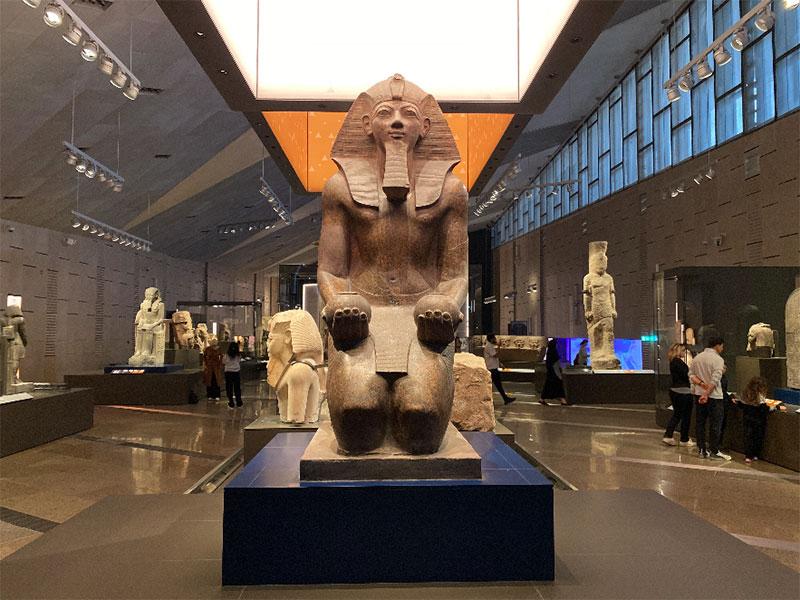
Highly reported by the media, the monumental sculpture of Ramses II which welcomes visitors in the hall (see ill.) has a strong symbolic significance: it evokes one of the greatest builders of ancient Egypt and echoes the ambition of the new museum. In this same space, on the right is a series of ten almost identical statues of Senusret I, from his funerary complex at Licht, while on the left are two elegant statues of a royal couple from the Ptolemaic era.
Statue of Ramses II in the Grand Egyptian Museum in Cairo.
Courtesy Grand Egyptian Museum
The visit continues with the grand staircase, punctuated with monumental sculptures arranged on successive landings. There is notably a colossal statue of Queen Hatshepsut, endowed with a male body in order to assert her pharaonic authority, as well as a representation of Ramesses II accompanied by a goddess, probably Anath, a Canaanite and Syro-Palestinian divinity associated with war and who became protector of the sovereign. The staircase finally opens up to a spectacular view of the Pyramids of Giza. This belvedere recalls the configuration of the Acropolis Museum in Athens, inaugurated in 2009 facing the Parthenon. In both cases, the architectural articulation goes beyond the spectacular effect: it affirms the connection between the museum and the ancient site, supports restitution policies and reminds, for the GME, that the center of gravity of Egyptology has resolutely refocused in Egypt.
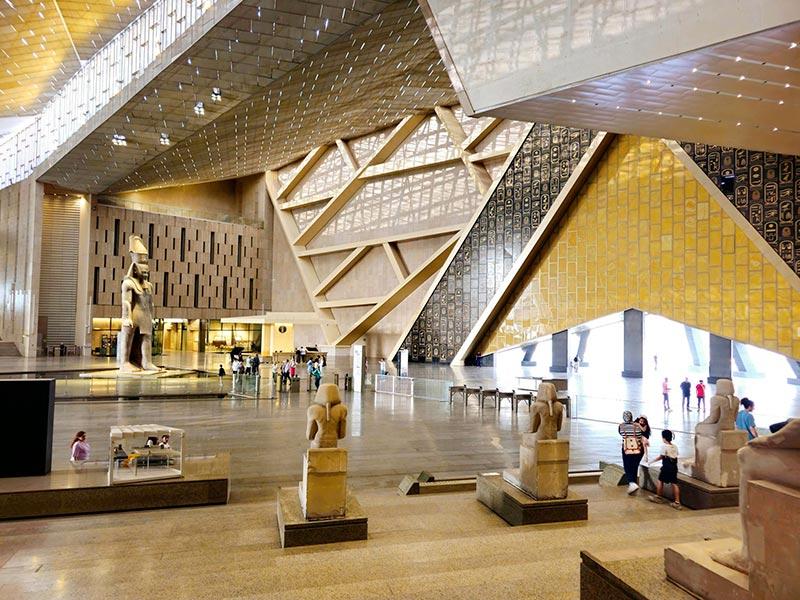
The Great Hall with the colossal statue of Ramses II in the background.
© GEM
The stroll then continues in the main galleries, which, beyond the numerous majestic figures of pharaohs, bring together a remarkable collection of statues of scribes, including that of Nefer, as well as funerary beds, like the granite one dedicated to Osiris, accompanied by Isis represented in the form of a bird. Painted frescoes, ceremonial objects, jewelry, kohl pots and papyrus complete this ensemble. Structured chronologically around three themes, society, royalty and beliefs, the journey restores the diversity of ancient Egypt by highlighting social and spiritual developments, as well as ruptures and external influences. A space in the basement is finally dedicated to submerged objects discovered in Alexandria and in Abouqir Bay.
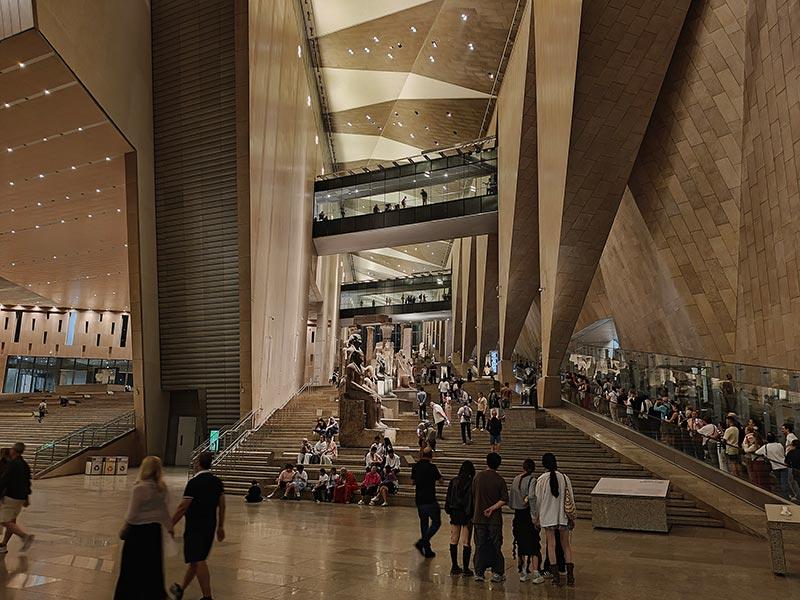
Visitors in the grand staircase of the Grand Egyptian Museum in Cairo.
Connected to the main galleries by footbridges, the galleries dedicated to Tutankhamun constitute the highlight of the visit. They bring together some 5,000 objects discovered in his tomb, the best preserved from Egyptian Antiquity. The longitudinal route allows a progressive deployment, from the famous mask and the sarcophagus to the four nested funerary chapels, arranged like Russian dolls. Presented in a deliberately dark space, punctuated by precise lighting, this time capsule of more than 3,350 years benefits from an aesthetic scenography without being distorting, giving substance to the pharaoh’s wish for immortality. Remaining in the Valley of the Kings, only the mummy is not exposed there. However, digital devices stage it using touch screens and archive images, and offer a reconstruction of Tutankhamun’s face. Notably, all of the cartels are translated into Japanese, unlike the rest of the museum, a sign of Japan’s decisive role in the completion of the GME thanks to a thirty-year preferential rate loan.
A museum cut off from its environment
Placed under the authority of the Ministry of Tourism and Antiquities, the Grand Egyptian Museum is distinguished by an autonomous management method, distinct from that of other museum institutions. It operates under a public-private partnership ensured by Legacy, a subsidiary of the Egyptian Hassan Allam group, also involved in its construction. This organizational hiatus is reflected in the visiting experience: the fluidity of the interior route, enhanced by a wide choice of restaurants and shopping malls, contrasts sharply with the access conditions. The museum appears like an island cut off from the surrounding neighborhoods, without suitable public transport. Even the hotels located directly opposite are separated by an eight-lane artery, without a footbridge or tunnel.
Grand Egyptian Museum.
© GEM
Beyond infrastructure issues, there is the question of articulation with the Cairo museum ecosystem. Many visitors are unaware that the Egyptian Museum in Cairo, Tahrir Square, remains open, and the contrast in attendance is particularly striking. Although it has lost certain major pieces to the GME, it retains an exceptional collection, but suffers from degraded presentation conditions, revealing a chronic lack of funding.
Located around twenty kilometers from the GME, the National Museum of Egyptian Civilization (MNCE), inaugurated with great fanfare in 2021 following the parade of royal mummies, also appears relatively isolated. Although it offers a broader account of the history of the country, from prehistory to modern times, the presentation of the mummies within it may surprise and reinforces its anchoring in Pharaonic Antiquity, at odds with the GME.
Conversely, the Solar Boat Museum, previously located at the foot of the Cheops pyramid, was dismantled in order to be integrated into the GME, in a specially dedicated related building. Ultimately, the Coptic Museum and the Museum of Islamic Art would also benefit from being part of a more understandable and more synergistic urban museum journey.