Spain. As temperatures regularly exceed 40°C in several regions of Spain, air-conditioned museums become places to seek refuge. In Madrid, Barcelona or Valencia, cultural institutions open their air-conditioned spaces to residents, offer activities during the hottest hours and participate in municipal networks of climate shelters. An evolution which leads them to rethink their role in the city, beyond their traditional missions of conservation and exhibition.
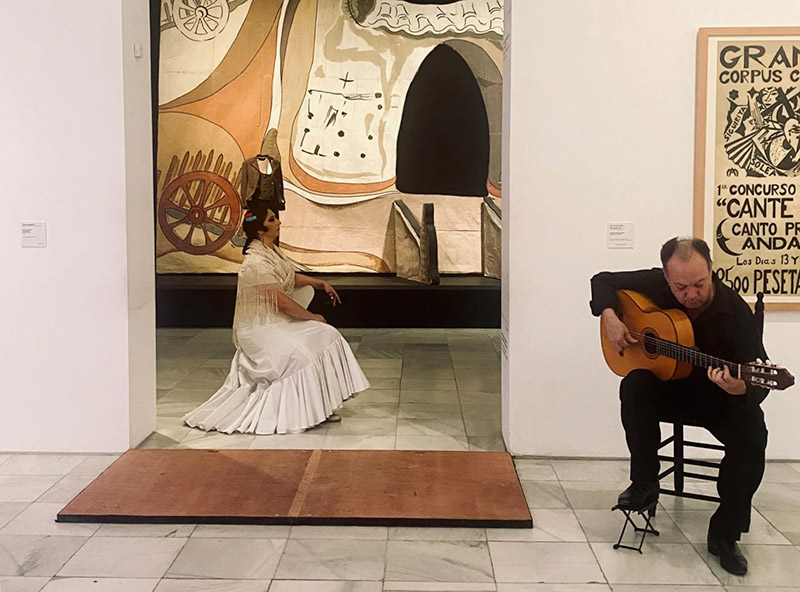
In Madrid, the capital has made freshness a cultural argument. For its third edition, the operation “Refugee in Culture” (“Take refuge in culture”) offered more than sixty free activities in July and August, in the middle of the afternoon. Flamenco, Golden Age theater and cinema have taken over the capital’s cultural institutions. The Prado, the Reina Sofía, the Thyssen-Bornemisza and the National Archaeological Museum participated in the operation, the latter hosting dance performances in its hall. The Reina Sofía Museum has also opened its garden and part of the Sabatini cloister free of charge.
Barcelona has five hundred climate refuges
In Barcelona, welcoming residents during heat episodes is part of a broader municipal policy. The city has more than five hundred climate refuges this year, almost a hundred more than in 2025. Museums, libraries and cultural centers are part of this network, whose reception conditions were specified in a protocol published in June by the Office of Barcelonathe provincial administration. A shelter must allow free entry, seating and protection from the heat without obligation to consume or participate in an activity. An air-conditioned building where passers-by are tolerated is not enough. The Study and Documentation Center of the Museum of Contemporary Art of Barcelona (MACBA), accessible free of charge from the street, meets this definition. It welcomed 1,558 people between June and August, compared to 1,091 a year earlier, an increase of 43%. Visitors find seats, an Internet connection and a cool space, without having to justify their presence.
This reception function also raises architectural questions. The museum’s glass atrium, designed by Richard Meier and facing south, receives continuous solar input, making it one of the most difficult spaces to temper. MACBA is preparing the replacement of approximately 500 m2 of glazing and wishes to create through ventilation to evacuate hot air. The museum also plans to treat the atrium separately from the galleries to limit cooling needs without affecting the exhibition rooms.
On the Montjuïc hill, the Museu Nacional d’Art de Catalunya (MNAC) also plays the refuge card. With almost all of his activities taking place indoors, he has not had to change his programming. In Valencia, the expansion of the network of climate shelters has made it possible to go from eighteen to forty reception places, with the objective of guaranteeing at least one per district. Among the latest establishments to join, the Valencian Institute of Modern Art (IVAM) opened its rest spaces free of charge in July. The museum has also thought of families with “At the museum, you don’t feel the ponant”, a program of visits and workshops intended in particular for young children, in reference to this warm wind coming from the west.
But not all establishments give the same meaning to the notion of refuge. In Toledo, the Sephardic Museum was inspired to offer free activities during the summer, from yoga to kintsugi, without opening its doors permanently or generalizing free access. In Seville, the Museum of Fine Arts is exploring another path. Installed in a former convent, it already benefits from patios and fountains which help to temper the ambient air.
The Spanish experience thus shows how museums can become local facilities in the face of heat episodes. A function which requires thinking about free access, timetables, signage and the needs of the most vulnerable groups.
At the Alcazaba of Almería, we close during the hottest hours
Heat wave. In summer, the Alcazaba of Almería takes a break during the hottest hours. From Tuesday to Saturday, the fortress opens from 9 a.m. to 2 p.m., closes for five hours, then reopens from 7 p.m. to 10 p.m.; on Sundays and public holidays, it remains open from 9 a.m. to 3 p.m. This rhythm is part of a strategy of Junta (regional government) of Andalusia, applied since 2022 to its “ cultural groups », whose archaeological sites, exposed to the open air, cannot be cooled: it is therefore better to move visitors. The programming follows the same logic, with morning and evening visits. “These times are expressly set to avoid the hours of greatest heat”specifies the direction of the monument. Protocols related to the alerts of the Spanish State Meteorological Agency, ranging from simple recommendations to the closure of the most exposed areas, are in preparation.
The Alcazaba of Almería.