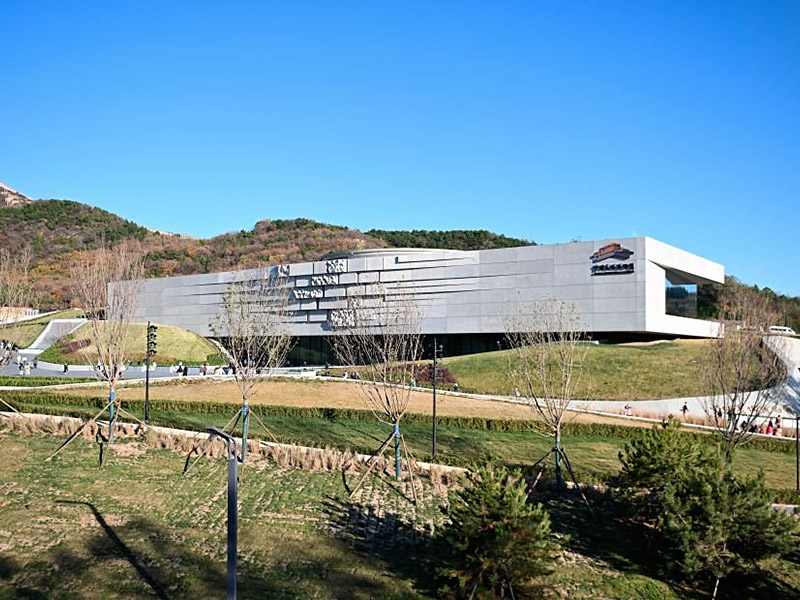
Closed since April 2022, the Great Wall of China Museum reopened to the public on Saturday October 24, 2026, after a major renovation. Located at the foot of the Badaling section, northwest of Beijing, the establishment, inaugurated in 1994, has been completely redeveloped. The project, which began in December 2023, made it possible to expand its spaces, renew its museum itinerary and better integrate the building into the landscape. This operation is part of the policy of conservation and promotion of the Great Wall, classified as a UNESCO world heritage site since 1987.
The architecture of the museum was designed to blend into the surrounding landscape. If the surface area of the building has been quadrupled, to now reach 16,000 m2, its height has on the contrary been reduced, from 16 to 9 meters. A way of reducing the visual impact of the building below the wall. Located in the most visited section of the monument, the museum was designed to integrate with the mountain, with diagonals that follow its crest lines, and to echo the wall, whose bricks are found on the facade.
The Badaling section of the Great Wall of China.
The museum houses a collection of around 700 archaeological objects, 10 of which are classified with the highest grade of protection by the State. It documents the history of the construction of the Wall from various perspectives, from its original military role to its political, economic and even spiritual importance. Built for the first time between 700 and 476 BCE, and until the Ming dynasty, from 1368 to 1644, it alone covers several periods of Chinese history. Handwritten strips from the Han dynasty (206 BC to 220), a silk painting representing Fuxi and Nüwa dating from the Tang dynasty (618-907), or a 1.7 m long cannon created during the Ming dynasty, representative of the technical advances of the time, reflect centuries of culture and circulation.
A space was dedicated to the protection of the Great Wall, presented as a national and patriotic issue. Taking advantage of the attractiveness of the monument, the inhabitants of the village of Shixia, near Badaling, have developed a homestay accommodation business, as well as agritourism activities.
The protection of the Great Wall is part of a public policy deployed at the national level and at the level of the municipality of Beijing. In 2006, the Chinese government adopted regulations aimed at governing the conservation of the monument and its use. More recently, the city of Beijing adopted a Conservation and Development Plan for the Great Wall Cultural Belt covering the period 2018-2035, and since June 2024, municipal authorities have allocated 100 million yuan per year (or approximately 12 million euros) to the restoration of the Great Wall.
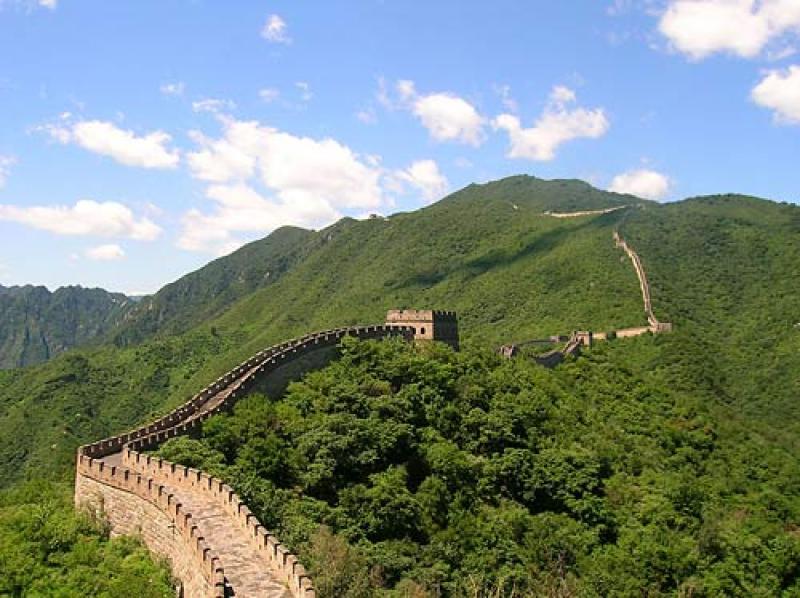
The Great Wall of China.