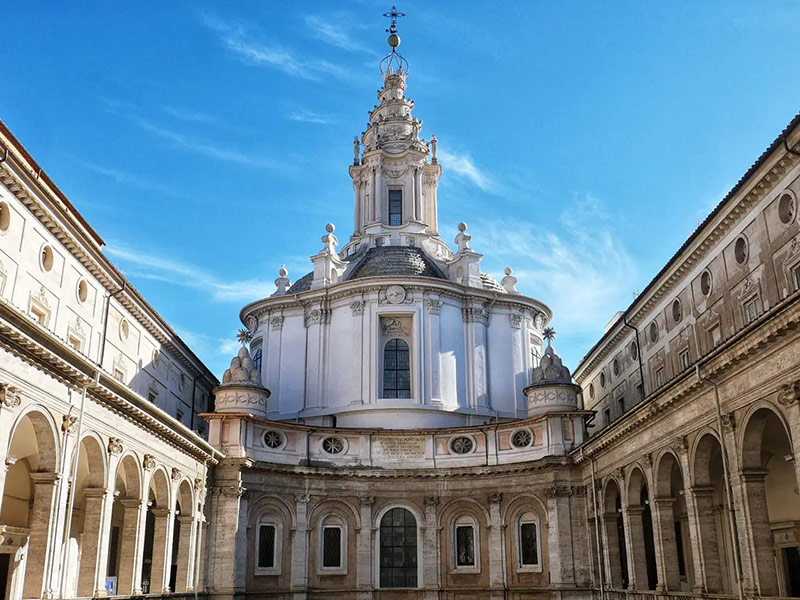
Located at the back of the courtyard of the Palazzo della Sapienza, between the Pantheon and Piazza Navona, the church of Sant’Ivo alla Sapienza reopened to the public on October 27, 2026, after almost ten years of closure. Designed by Francesco Borromini (1599-1667), this 17th century baroque building was the subject of a long restoration campaign, initiated after the earthquake which struck central Italy on October 30, 2016.
In December 2016, work began on the Sapienza palace complex, but work on the Sant’Ivo church did not begin until a few years later. In 2021, the first phase of work is launched, and a larger restoration begins from September 2024. In reality, the earthquake only aggravated damage linked to a lack of structural maintenance. Coatings already showed partial detachments and swelling in several places, and cracks already present on the dome opened following the tremors.
The Sant’Ivo building belongs to the State, but the church is placed under the responsibility of the diocese of Rome. This dual supervision required the signing of an agreement, in 2025, between the Italian Ministry of Culture and the Diocese of Rome to allow the opening of the building to the public. Sant’Ivo has also been included in the Jubilee walking route of the Catholic Church. Before 2016, the church was not accessible on a regular basis, but only during masses.
As part of the “Aperti per voi” (“Open for you”) project, supported by the Touring Club Italiano, an Italian non-profit association promoting tourism and the promotion of heritage, the church will now be open Monday to Friday from 9:30 a.m. to 1:30 p.m. Entrance management is ensured by the association’s volunteers, who work to make accessible cultural places that are closed or only very rarely open to the public.
Financed to the tune of 2.3 million euros by European funds from the PNRR, the Italian EU recovery plan, and within the framework of the cultural program “Caput Mundi”, the restoration campaign of the church was carried out by the Special Superintendence for Archaeology, Fine Arts and Landscape of Rome, an organ of the Ministry of Culture.
Built between 1642 and 1660, the Sant’Ivo church is a masterpiece of Roman Baroque. Famous for its complex geometry, it is designed according to a six-pointed star plan, alternating concave and convex segments. In a very unusual way, the dome extends the shapes of the plan, allowing the visitor to clearly perceive its originality. The lantern which overlooks the column in a stepped spiral crowned with flames, a sphere and a cross, marks the church with a spectacular distinctive sign. Decorative elements have been integrated, echoing the three popes under whose pontificates the building was constructed. Bees, emblems of the Barberini family, for Urban VIII, a dove for Innocent X and stars for Alexander VII.