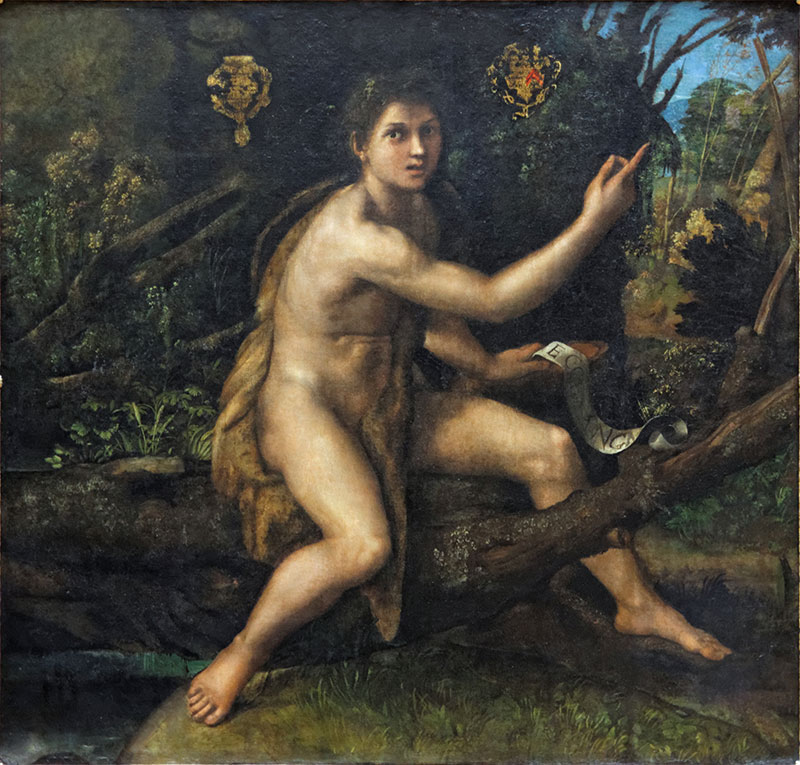
Longpont, 1821. Charles de Maillé de La Tour-Landry, 2nd Duke of Maillé, obtained, for the church of Longpont in Aisne, three paintings from the Royal Museum, including one Saint John in the desert attributed to the Italian school. In return, the Duke must ensure their conservation and must return them upon simple request made by the Minister of the King’s Household. When the Duke died in 1837, his heirs sold various goods found in his estate, including the painting of Saint John in the desert (see ill.). The latter was acquired by a certain Mr. Cousin, a painting dealer, for 59 francs. Very quickly, he realizes that a coarse layer of varnish hides a painting by a great master. After restoration, the painting is attributed to the Italian artist Raphael (1483-1520)!
Faced with this discovery, Maillé’s heirs quickly forbade Mr. Cousin from relinquishing the painting. The latter responds and summons them to have his legitimate ownership recognized over this painting which he, after all, purchased in good faith at a public sale. But this was without counting on the intendant of the Civil List who summoned Maillé’s heirs to obtain the restitution of the painting. At the heart of this conflict, the following question must be resolved: can the furniture of the crown be claimed, because it is inalienable and imprescriptible?
After joining the two cases, the Seine court ordered, on August 25, 1837, Mr. Cousin to return the painting to the Civil List within a certain period under penalty of having to compensate the Civil List in hard cash. Cousin appeals. On April 24, 1838, the royal court of Paris (ancestor of our current court of appeal) considered that the Civil List had only granted temporary use of the painting to the Duke of Maillé. Also “ Cousin must be required to return said painting (but) the heirs of Maillé must compensate Cousin who bought it in good faith, not only for the price and costs of its acquisition, but also for the care he took and the expenses he incurred for the restoration of the said painting.. Cousin perseveres and appeals to the Court of Cassation.
On August 10, 1841, the Court of Cassation forcefully affirmed that “it is a fundamental maxim in France that the goods which make up the endowment of the crown are inalienable and imprescriptible by their nature”. Also “this maxim, constitutive of the old monarchy, was reconsecrated again by the senatus-consulte of January 30, 1819, by the law of November 8, 1814, and by that of March 2, 1832, which decreed the civil lists of the Emperor Napoleon, Louis XVIII and the reigning king”. It follows from these texts that “diamonds (sic), pearls, precious stones, statues, paintings, engraved stones and other monuments of the arts, which are found in the king’s palaces, are part of the endowment of the crown” implying that they are inalienable and imprescriptible. From then on “the painting representing “Saint-Jean in the desert” belonged to the Museum and that the Civil List had only granted temporary use of it to the Duke of Maillé; that this painting, from then on, has not ceased to be part of the endowment of the crown, which consequently has never lost the right to claim it.” Mr. Cousin is therefore ordered to return the work while the heirs of the Duke of Maillé must compensate Mr. Cousin to the tune of 1,000 francs!
The inalienability of public goods
With this “Cousin” judgment, the Court of Cassation recalls that the rule of article 2276 of the Civil Code (former article 2279) according to which “in the case of furniture, possession constitutes title” does not apply to the case where it concerns property declared inalienable by law, as part of the endowment of the crown. A pioneer of its kind, the Court of Cassation paves the way for claims to crown property and, more broadly, public domain property. It is true that the latter as we know it today is a recent notion that must be distinguished from older domains. As early as the Edict of Moulins in 1566, the principle of inalienability was enshrined for property belonging to the domain of the crown and the French Revolution changed this domain into a domain of the Nation. With the evolution of jurisprudence and the law since the 19th century, it is now well accepted that cultural property dependent on the public domain of the State is inalienable and imprescriptible in accordance with article L. 3111-1 of the General Code of Property of Public Persons. This amounts to saying that the principle of imprescriptibility reinforces the rule of inalienability and allows the public person to perpetually claim public property which would be found in the assets of an individual.
This solution is logical: the State has the right – and the duty – to claim objects that have disappeared from its monuments, libraries or museums since the 19th century when indisputable proof that they belong to the public domain is provided. This explains why Mr. Charron was unable to sell in 1844 a receipt from Molière that he held in his autograph collection since it had been illegally removed from the Royal Library and was inalienable. Closer to home, the judges granted the restitution of a fragment of the Vendôme column, a gemillon from the Chartres Museum, and a Boizot vase from the Cité de la Ceramique which had ended up in private hands having been stolen from the public domain.
Today, this painting known under the title of Saint John the Baptist in the desert pointing to the Cross of the Passion is exhibited at the Louvre Museum as the “school of Raphael”.