
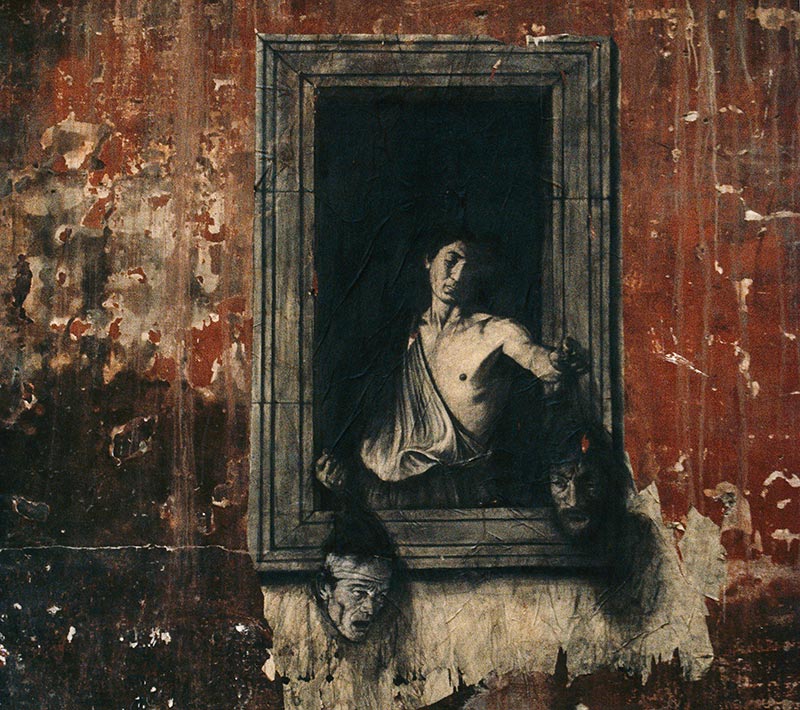
His various Neapolitan stays proved essential in the artist’s career and his drawings plastered in the streets are among the best known of his work in the world. Their exhibition at L’Inguimbertine, a former Hôtel-Dieu founded by the bishop Dom Malachie d’Inguimbert in the 18th century, brings together a large part of these drawings. “These are not drawings exhibited in the city, it is the street itself worked by the plastic proposal of my drawings. My images, nourished by painting, history, mythology mixed with the biblical and the presence of death in the city, reactivate them,” explains the artist. This results in the presentation, for each life-size drawing, of sketches and photographs of the collage in the street, starting with the first – a drawing inspired by David and Goliath by Caravaggio bringing together the severed heads of Caravaggio and Pasolini. This unique walk through the streets of Naples begins, beforehand, in the dazzling rooms of the library-museum with a selection of works from its prestigious collections linked to Italy, the southern city, the paintings of Caravaggio, the eruption of Vesuvius in 1631, the ravages of the plague of 1656 and the revolts. “Among the 18,000 works bequeathed in 1757 by Dom Malachi to his fellow Carpentras citizens, we note the numerical importance of books relating to Naples, an observation that explains the common destiny shared by the Kingdom of Naples and Provence around the House of Anjou,” underlines Jean-Yves Baudouy, director of the museum. We also discover a portrait of Masaniello, a humble fisherman at the origin of the popular revolt of July 7, 1647 against the decision of the Viceroy of Naples to tax food products, and model in 1995 for an Ernest Pignon-Ernest design.

Similar Posts

Woman, with postgraduate studies and hardly any salary reviews: a profile of cultural employees
Madrid, Artepreneur, a human resources consultancy for the artistic sector that operates in Spain and Latin America and was founded…
Elliott Erwitt, the man who looked at everyone watching
Madrid, He never considered himself an artist nor did he intend for his work to be driven by a consolidated,…

The modern and the contemporary: San Telmo Museoa reviews a century of Basque art
Saint Sebastian, Usually, the collections on display at the San Telmo Museoa in San Sebastián do not date beyond the…

José Guerrero, from the document to abstraction
Madrid, José Guerrero trained as a technical architect, but after passing through the Art School of Granada and after obtaining…

Henri-Edmond Cross, ferryman of modernity
Be that as it may, for this child from the North born in Douai, this landscape bathed in Mediterranean light…

American People: Faces for documentary photo
Malaga, The photographic funds of José Luis Soler Vila, who created the Fundació Per Amor to L’Art and the Pumpas…