“The rocks which rise into citadels, into cones, into pyramids, into pinnacles, which advance into abrupt promontories, which project points and enclose the coves and coves by the hundreds, which appear in the crystal clear waters are red as fire. It looks like the entire coast is lit by a vast fire. » Is it still a landscape that the geographer Pierre Foncin (1841-1916) described in 1910, or already a painting? It must be recognized that in the Estérel, a small stretch of rocky coast between Provence and the Côte d’Azur, the volcanic rocks, formed between -299 and -252 million years ago, continue to glow, as always fiery. These flamboyant rocks became, between the end of the 19th and the beginning of the 20th century, a place of inspiration for post-impressionist artists. After the first voyages of Claude Monet and Pierre-Auguste Renoir, the Mediterranean shore then established itself for painters as one of the great laboratories of pictorial modernity. Paul Cézanne regularly stayed at l’Estaque, before André Derain, Georges Braque, Othon Friesz and Raoul Dufy followed in his footsteps. Henri Matisse and Derain painted in Collioure. Why have we forgotten that many artists came to set up their easels on the reefs of the Estérel massif? “However, at the Salon d’Automne of 1905, which marked the public recognition of Fauvism, no less than seven paintings signed Albert Marquet, Charles Camoin or Louis Valtat represented the Estérel”remarks Marine Roux, in charge of the collections at the Draguignan Museum of Fine Arts and curator of the exhibition “Les roches rouge”, dedicated to the landscapes of Estérel. Despite the arrival of the train in 1863, this coast which extends from Saint-Raphaël to Cannes has long retained the reputation of a dangerous place, populated by bandits. Painters and tourists alike hardly dare to venture there, or rarely. It was not until the inauguration, in 1903, of the Corniche d’Or coastal road, under the leadership of the Touring Club de France, that artists fully discovered the spectacular views of this volcanic massif. Armand Guillaumin, Louis Valtat, Henri-Edmond Cross, Albert Marquet and Jacques Majorelle then seize these landscapes and inscribe them in their work. The Draguignan Museum of Fine Arts invites you to rediscover this place of inspiration and experimentation through the paintings of the “numerous and distinguished colony of artists” who came to set up their easels there at the turn of the century, as tourist guides of the time describe.
Clémentine Ballot (1879-1964), The Dramont through the pines1913, oil on canvas, 60 x 73 cm, private collection.
© Jean-Louis Losi
The exhibition finds its origin in the acquisition, in 2025, of Red rocks by Louis Valtat (around 1904). Through more than sixty pictorial and graphic works, accompanied by numerous archival documents, it invites visitors to immerse themselves in the tourist and artistic context of the turn of the century, in a stroll restoring the sensation of walking in the massif. An invitation, too, to follow in the footsteps of the painters to discover first-hand the landscapes of Estérel, located less than 50 kilometers from the museum… with the exhibition catalog as a travel guide.
At the meeting of friends
“More and more amazing!” When is your visit? », wrote Albert Marquet (1875-1947) to his friend Henri Manguin (1874-1949) in 1905. That summer, he stayed with Charles Camoin (1879-1965) at the Grand Hôtel d’Agay. This establishment built around 1881, one of the first mentioned by tourist guides, is a preferred starting point for excursions in the region. Marquet represents here the harbor of Agay in a curvilinear, bold and modern panoramic perspective. The same year, he exhibited landscapes of the Estérel at the Salon d’Automne which marked the birth of Fauvism.
At the Estérel school
Few women have painted the Estérel. Clémentine Ballot (1879-1964) discovered the red rocks in 1913, on the advice of Armand Guillaumin (1841-1927), whom she met the previous year in the Creuse valley, and with whom she formed a solid friendship. The subtle range of blues and turquoises crashing against the rocks results from the artist’s sensitivity to light and atmospheric effects. “I paint from intuition and have no imagination,” confided this artist, now forgotten, but recognized in her time.
A grandiose and dangerous massif
At the end of the 19th century, “passing the Estérel step” was a proverbial expression: not only is it said that this inhospitable massif is guarded by the mythical fairy Estérel, but above all brigands find refuge there. This post-romantic representation of the Estérel cliffs by the landscaper Adolphe Fioupou (1824-1899) bears witness to this sublime vision of a nature that is both grandiose and threatening, in the face of human fragility: fishermen prepare a meal, while the point of a rock seems to threaten their boat.
Portrait of rocks
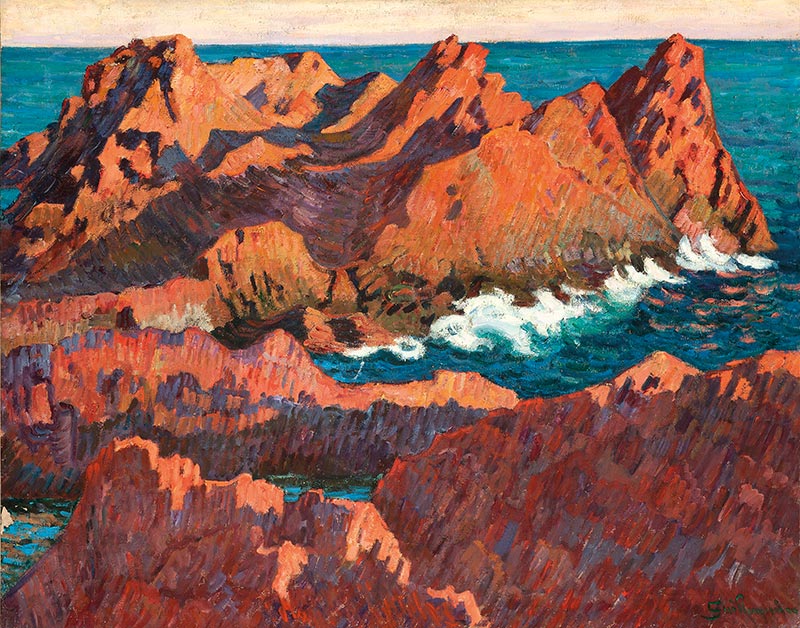
No question of being a simple decorative element! From the end of the 19th century, red rocks became subjects in their own right, which painters attempted to capture in their singularity, within a tight framing. The island of Besse is among the most represented rocks – as here in this “portrait” of Armand Guillaumin (1841-1927). The high horizon line, punctuated by the red ridges, and the rocky foreground, which the white foam and the shadowy areas cut out, give the composition a strong graphic tension.
On the spot
Sketched in pencil and painted in watercolor, this lively drawing where the quarrel between drawing and color seems to be brilliantly replayed has nothing to envy of oil paintings. Henri-Edmond Cross (1856-1910) considers it an artistic language in its own right. To make his landscape of the Trayas rocks vibrate, the painter, who settled in the Var in 1891, accentuates the contrasts, juxtaposing commas of complementary colors in a neo-impressionist touch.
Before Fauvism
When Georges d’Espagnat (1870-1950) created these rocks in 1901, Fauvism had not yet emerged. However, through the use of vibrant colors applied in finely nuanced flat areas, this landscape already sketches the beginnings. That year, the painter stayed in Estérel with his friend Louis Valtat (1869-1952). Both exhibited in the same Parisian galleries, gravitated around the Nabis circle and frequently visited Pierre-Auguste Renoir (1841-1919) in Cagnes-sur-Mer, where they had met the previous year.
A decorative dimension
When he discovered the south of France in 1896, Louis Valtat (1869-1952), who only knew the skies of his native Normandy, fell in love with its light. From then on, he stayed regularly in Estérel where he built a house, constantly painting his red rocks on the motif. This painting, recently acquired by the Draguignan Museum of Fine Arts, demonstrates the decorative nature of his art. The rocks, like the vegetation and the sky, are executed with the same vigorous, swirling touch. This gives the work an abundant appearance, evoking tapestry.
Bather
In the works representing the Estérel, which fascinates artists with its colors and its wild nature, constructions and human figures are rare. When a character appears, it is often to evoke a golden age, a Mediterranean where man lives in harmony with nature. The Estérel then becomes a background for painting a female figure evoking the naiads of Antiquity. Here, however, the red fringed napkin anchors the scene in the present.