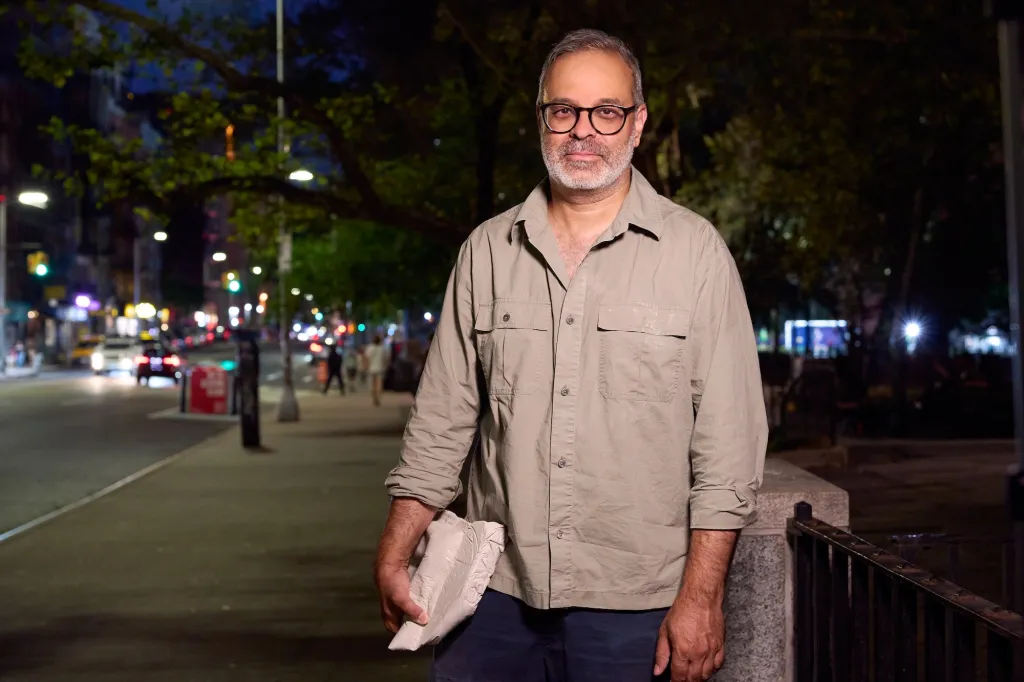
One hot August afternoon on New York’s Lower East Side, artist Asad Raza led this reporter through his new, unconventional public art show. Without him, you and I certainly would never have noticed it, but then it’s not really for us.
“I’ve made a lot of works for people, trying to create experiences of different kinds that, a lot of the time, dealt with living elements of the environment around them,” said Raza, whose projects have included exhibiting live trees in a museum, rerouting river water through an art venue, and turning trash into fertile soil.
With his newest project, Raza turned his attention to one of the countless creatures New Yorkers share their turf with: Rattus norvegicusthe brown rat that thrives in the millions beneath our feet. The week before he gave me a tour, the artist and a few helpers drove around the city in a minivan, placing small sculptures in public parks and other unremarkable places popular with rodents, such as fenced-off construction sites, the yards outside public housing, and trash collection spots. The sculptures were created with advice from animal behaviorist Michael Parsons, who is fascinated with urban rats. The sculptures and documentation will go on view in “Thigmotaxis (the rat show),” opening September 19 at the new downtown nonprofit arts venue Times. Rats’ tendency to hug walls as they move, a way of reducing exposure to predators, is an example of thigmotaxis (defined as “an organism’s movement in response to physical contact with surfaces or objects”). The show will also include a wall-mounted sculpture for humans to touch, so they can also experience thigmotaxis.
“At the beginning, I thought the sculptures would be much more like architecture,” Raza said. “But Parsons told me, ‘No, they like really chaotic spaces.’ He said, ‘Think shattered fragments of rubble.’ Shattered fragments of rubble is a totally different vibe.”
Indeed, one could easily mistake the small gray sculptures for broken bits of construction material or cinder-block fragments. (Low-tech although they may appear, they were designed with the aid of MIT architects Zaynab Eltaib, Mara Jovanovic, and Jaffer Kolb.) Some have indentations meant to gather rainwater, and some have multiple points of entry and egress, all of which the rats apparently appreciate.
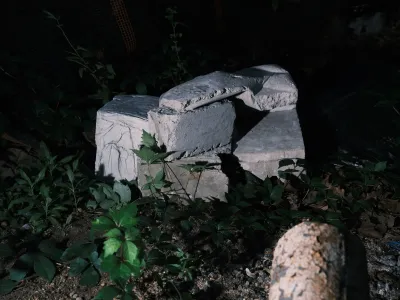
Asad Raza’s sculptures for rats, on view in a New York park, during the making of his exhibition “Thigmotaxis (the rat show),” at Times, New York.
Devyn Galindo, courtesy of Asad Raza and Times, New York
Parsons told Raza that rats’ vision isn’t great and that they mostly rely on smell and touch. “So I thought, those are the two senses we should try to work with,” he said. I have included substances that absorb scent, like burlap, and texture some of the walls and floors.
Along with the sculptures, Raza and his team—artists Devyn Galindo, Kunning Huang, and Jared Packard—placed cameras to capture the intended audience’s nighttime reactions. He worried the rats wouldn’t be interested, but when he saw them, they showed real curiosity, much to the team’s enthusiasm. “When we first started seeing videos of the rats actually interacting with them,” he said, “we were just high-fiving in the van.”
He thought they might have to lure the animals by putting food among the sculptures, but that actually didn’t yield results: “They’re like, ‘Wait a second. I smell a rat.’” Ba-dum.
In Raza’s Hands, Water and Earth Provide Revelations
As you might guess, you wouldn’t want to make the mistake of asking Raza, who lives in Berlin, what medium he works in. On his website, he says his practice “conceives of art as a metabolic, active encounter within and beyond the exhibition setting.” (That’s after a preamble in which the Pakistani-American artist points out that there are many Asad Razas in the world, like a self-deprecating Wikipedia disambiguation section.)
For the inaugural Medina Triennial, currently on view in upstate New York, Raza routed water from the Erie Canal through an exhibition space; he did the same in Frankfurt, diverting the Main River through a museum, allowing visitors to wade in the liquid and filter it to make it drinkable. As I have explained in Art in America, the project was partly intended to reunite people with bodies of water from which, in modern cities, they are often separated.
When recently asked to name an artwork that was a “revelation,” poet Claudia Rankine cited Raza’s Absorption (2019), which combines waste products and other ingredients to create fertile soil, which the artist then gives away. “I like to think Raza’s work venerates change and growth,” she wrote, “because after everything, after all we have put our belief and trust in collapses, that’s what’s left.”
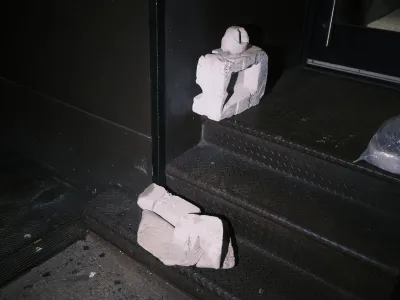
Asad Raza’s sculptures for rats, on view in New York, during the making of his exhibition “Thigmotaxis (the rat show),” at Times, New York.
Devyn Galindo, courtesy of Asad Raza and Times, New York
In 2015, I wrote for Artnet News about “The Home Show,” which Raza curated in his SoHo apartment. Turning the tables, that show acted on him more than it did on anyone else: for it, he asked 36 people, including artists, friends, and family members, to intervene in his life in some way. Before that, Raza had mostly been a producer, helping Tino Sehgal perform his 2010 Guggenheim Museum show and Philippe Parreno his 2015 Park Avenue Armory installation, but he was coming into his own as an artist. Two years later, he would hit a new high with an installation at the Whitney Biennial involving a copse of trees titled root yesequence. mother tongue (2017). Attendants were tasked with caring for the trees, interacting with visitors, and giving performances, as well as contributing knickknacks that would serve as totems from their past.
The Pied Piper of the Lower East Side
Raza talked about the diversity of his projects as we traversed the sites for the rat sculptures. “Every time,” he said, “it has to make you a little bit frightened of what you’re doing, and make you feel a bit like this might be a stupid idea that’s incredibly humiliating in some weird way.”
These days, of course, it’s not completely off-the-wall for an artist to make work involving other species, whether enlisting animals to help create their work, commenting on humankind’s interventions in nature, or acknowledging the validity of non-human experiences of the world. Agnieszka Kurant has exhibited termite-made sculptures. Eduardo Kac bioengineered a glowing rabbit. Duke Riley choreographed an aerial ballet with pigeons. Sometimes animal rights advocates get involved, as when New York’s Guggenheim Museum showed Huang Yong Ping’s sculptural installation involving various species fighting to the death, and Peng Yu and Sun Yuan’s video in which frustrated dogs, placed facing each other on treadmills, trying to do battle.
Rats and mice are common subjects in biomedical research because they share physiological and genetic similarities with humans. (Another commonality, this one etymological: they live in burrows, while New Yorkers live in boroughs.) For all they’ve done for us, it hasn’t earned them much love; rats remain associated with filth and disease. Parsons has said that the lab rat compares to the street rat as a chihuahua compares to a wolf, and he maintains that despite their ubiquity, very little is actually known about them.
And Parsons isn’t the only one fascinated with these animals. Another consultant on the project was Kenny “The Rat Daddy” Bollwerk, who leads tours of New York for the norvegicus-curious.
Rats show up plenty in art. Banksy loves them, saying in his book Wall and Piece that they (obviously like the street artist himself) “exist without permission,” that “if you are dirty, insignificant and unloved, then rats are the ultimate role model.” Katharina Fritsch’s giant sculpture Rat-King (1993) refers to the strange phenomenon of a group of rodents getting bound together through an accidental intertwining of their tails. A rat is a central character in Bruce Nauman’s 1988 video installation Learned Helplessness in Rats (Rock and Roll Drummer)in which it is exposed to an inept percussionist’s banging as it tries to navigate a maze, as if to mock the notion of scientific research.
“That seems sadistic,” Raza said on hearing about Nauman’s piece. His project has left him with much more fellow-feeling for the creatures. “I got to understand: they’re part of this city too,” he said. “They’re co-denizens.”
And they are legion. Urban legend says that rats outnumber the city’s humans by as many as five to one, but a 2023 study put the number at more like three million, or about one for every three bipeds. These humble creatures can tread water for three days, leap four feet, and squeeze through holes as small as a quarter.
Impressive though they may be, the city has been hard at work trying to reduce their numbers. Then-major Eric Adams put in place Kathleen Corradi as an official “rat czar” in 2023; she promised that New Yorkers would see “a lot of me and a lot less rats.” When she danced on the gig in 2025, the Guardian tartly headlined the story “Rodents prevail in rat race.”
No More Rat Czar, But Fewer Rats All the Same
The current mayor, Zohran Mamdani, has revealed no plans to anoint a successor to Corradi, but the second part of his prediction has come true: the city has been hard at work getting more of its businesses and residential buildings to set out their trash for collection at specified times and in sealed containers, depriving rodents of the open-air buffets they have long enjoyed as trash bags wait on sidewalks to be hauled away. As a result, reported rat sightings have failed for 18 months straight. So Raza is cultivating an increasingly smaller audience of animals.
As we ambled along Hester Street between sites, Raza said that with this project, he wanted to ask what it means to experience an artwork, which for him is an ambivalent or ambiguous experience. Race quoted Immanuel Kant’s Critique of Aesthetic Judgment as an inspiration: The philosopher discusses art as having “purposiveness without purpose,” leading Raza to ask, “How can we produce something that for them feels strangely like it’s intended for them but doesn’t have any purpose? I don’t want it to just be pieces that rats love, like a water slide for rats. They have to be slightly enigmatic for the rats too.”
“In a weird way,” he said, “this is the show.” What will be on view in the gallery, he noted, will be more along the lines of documentation.
Many New Yorkers profess a love-hate relationship with their city, but getting to know a bit more about the town’s most reviled residents, perhaps seeing it through their eyes, has only increased the artist’s affection for it.
“It’s making me fall in love with New York again,” he said, “the way I did when I first came here when I was like 19 years old from Buffalo, and I was like, this city is so magical and so cool.”
On a nondescript street under the Manhattan Bridge, near graffiti-marred walls, as smells of trash and rat urine perfumed the air and subway trains thundered deafeningly overhead, Raza looked around with evident satisfaction. “I just love this area.”
Asad Raza, “Thigmotaxis (the rat show)” will be on view at Times, 151 Lafayette St. 4th floor, New York, September 19–December 12, 2026.