
Nantes (Loire-Atlantique). Justine Emard (born 1987) is a visual artist whose work – photography, video, installation – lies at the intersection of art, neuroscience and technology. Her career, which allowed her to exhibit in different institutions in Europe and Asia, led her to be appointed artistic director of the exhibition of the France pavilion at the Osaka-Kansai World Expo (Japan) 2025. Last April, she also participated in the first edition of “Noûs”, an “Art & AI” festival organized at the Bibliothèque nationale de France.
The brain, dreams…, the subjects that interest Justine Emard are a priori fascinating. To explore them, she often starts from tangible data, by collaborating with scientists. This is the case in the installation Somnolux which opens the route to the Unique Place. Large polycarbonate panels erected vertically form a symbolic portal, their ribbed walls randomly reflecting colored waves. This device is based, according to the information document, on the analysis of Justine Emard’s brain activity, interpreted by a program which generates a luminous atmosphere linked to the different sleep cycles.
The exhibition, whose scenography places the public in near darkness, to better suggest the space of dreams and the shift “in the head of the artist” – does not follow a narrative strictly speaking. It proceeds in sequences, structured in particular around three video installations. The first, Somnorama 1in collaboration with the National Center for Space Studies, uses the encephalogram readings of an astronaut operating in weightlessness 400 kilometers from Earth. His mental landscape translates into a digital image within which it is possible to move, like in a video game, using a controller. Justine Emard learned to speak the language of the machine. More than its effectiveness, it is the hallucinations and errors of the system that it exploits. So in Chim[AI]rathe visitor can guide the chimera of his choice to take it trotting through game levels which modify the visual layers by simplifying them and thus lighten the graphics card, a metaphor for a more habitable world…
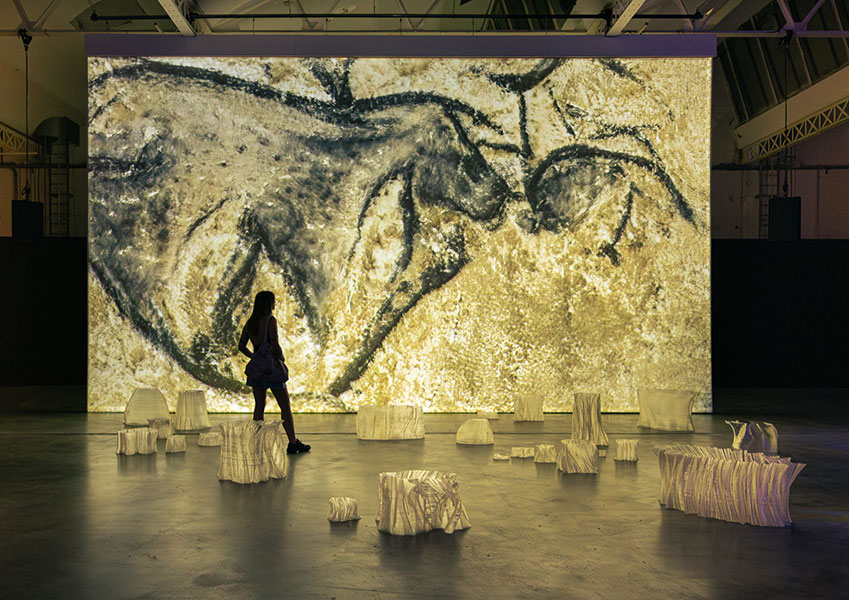
Hyperphantasia (2022, [voir ill.]) was presented at the Grand Palais Immersive in 2024. This video installation scrolls through variants of the cave paintings of the Chauvet cave, as if the latter, hacked by artificial intelligence (AI), no longer offered any familiarity. Having reached this point, the visitor experiences a certain confusion. As if to emerge from this nightmare, an alarm goes off every hour – echoing the Song of the Sirensan immersive device which establishes a parallel between the dangerous seduction of mythological creatures and the ambivalence of AI whose pitfalls the artist wants to point out to us.
Justine Emard’s ambition is to make complex technologies more accessible to the public. But we can wonder why we should place works of digital art in a separate category and if the good use of technology in art is not measured more by its capacity not to impose itself in the foreground.


