France, 1857. Historical, pharaonic, megalomaniac…, the adjectives were used to describe the work announced at the end of January 2025 by the President of the Republic intended to renovate the Louvre and offer it a “New Renaissance”. Many commentators have drawn a parallel between this project, the cost of which exceeds a billion euros, and that of the Grand Louvre, another gigantic project launched by the Élysée forty years ago. On the other hand, few have made the connection with an even more titanic undertaking: the “Napoleon III”, carried by the last emperor of France. On August 15, 1857, the public discovered a Louvre transfigured by Napoleon III. An inauguration date which owes nothing to chance: the Assumption coincides with the Feast of the Empire and Saint-Napoleon’s Day. Quite a symbol for a project intimately marked with the imperial seal.
A centuries-old project
What was then called the “New Louvre” was in reality the realization of a three-century-old dream. Because, since the Renaissance, sovereigns have never stopped wanting to unite the Louvre and the Tuileries into a vast palatial ensemble. Henri IV undertook to connect the buildings by two wings and to empty the central space in order to install offices and beautiful gardens. Only one wing was built under his reign: the famous Grande Galerie which runs along the Seine. A majestic setting immediately dedicated to the arts, where the sovereign exhibits the royal collections and houses the artists of the Crown. His successors will try to continue his work but will encounter major architectural and urban planning difficulties, because the palaces following the curved path of the Seine are slightly out of alignment. In addition, emptying a neighborhood of its occupants takes time: at that time, expropriation laws did not exist, which required negotiating with each owner.
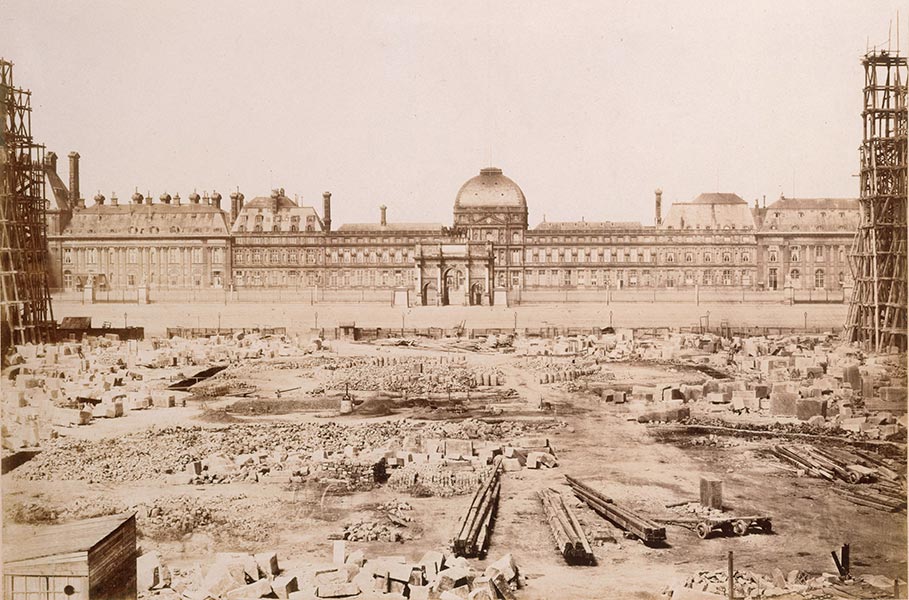
Édouard Baldus (attributed to), Panorama of the works of the Louvre Palace towards the Clock Pavilionlate 1854.
© Paris Museums / Musée Carnavalet
Strangely, while he left this site fallow, Louis XIV ordered other developments as colossal as they were superfluous, relating to the colonnade! This is the most contested point of Emmanuel Macron’s project. For the main entrance to the palace, the Sun King aims for an imposing facade, but none of his subjects’ proposals find favor in his eyes. Colbert then gave him a revolutionary idea: launch an international architectural competition. It was the immense Cavalier Bernini, crowned with the success of the papal basilica of Saint Peter in Rome, who was chosen. The master of Italian Baroque came to Paris to refine the plans but, in a twist of events, his style was ultimately deemed too exuberant and construction was stopped in its tracks even though the first stone had already been laid! It was ultimately the project of Claude Perrault (1613-1688), with a much more classic aesthetic, which was chosen.
Imperial Completion
Paradoxically, it was not until the advent of Napoleon I that the completion of the Louvre, dear to the Bourbons, was restarted. The Emperor, who had just laid out the Rue de Rivoli, decided that the new wing would follow this newly opened artery. Barely begun, the work was buried with the fall of the Empire. But the project will bounce back thanks to another political event. In 1851, Louis Napoléon Bonaparte seized power and made a point of finishing his uncle’s work in order to symbolically establish his authority. Bringing his personal touch, he asked the architect Louis Visconti (1791-1853) to create administrations, a library, ministries, a hall of states to bring together the corporate bodies, stables and barracks within this imperial city. At the same time, he ensured that more space was given to the museum so that its collections, copiously enriched under the Second Empire, could be displayed in the sumptuous pavilions that we still know today.
Napoleon III, who resided in the Tuileries, closely supervised the work and was involved in the architectural choices. It allocated considerable resources – more than 25 million francs at the time – but above all authorized unprecedented working conditions: the site ran at full capacity, day and night, for five years. Up to three thousand workers and hundreds of sculptors are busy on this extraordinary construction site which is progressing at full speed despite the sudden disappearance of its project manager. After the death of Visconti, it was Hector Martin Lefuel (1810-1880) who took up the torch by bringing a different coloring since he gave the whole more monumentality and accentuated the decorum, significantly weighing down the silhouette and the workmanship. The buildings are thus raised and provided with numerous grand staircases, while the decoration of the facades is considerably enriched with monumental and ornamental sculptures. Antoine Louis Barye, Jean-Baptiste Carpeaux, François Rude and Auguste Préault, to name only the most famous sculptors, bring to life a people of stone exalting the history of France. Posted on the entablature bordering the Cour Napoléon, 86 characters more than three meters high recount the great times of science, literature and the arts since the 6th century. This stone population is complemented in the niches by statues of illustrious soldiers and on the pediments by allegories to the glory of France and the imperial family.
The press of the time widely reported on this project of the century. Although freedom of expression is clearly not in the spirit of the times, commentators are already allowing themselves criticism. “It’s big and rich – even too rich sometimes,” thus estimates Claude Vignon in Le Figaro. “ This excess of sculptures and embroidery, on the pavilions only, detracts from the elegance and gives heaviness. » The journalist also laughs at the conservatism of those who reject this contemporary architectural gesture. “Massacre and desecration!” they cry. Why did we not surround the Louvre de Lescot with a gate to protect it from the approach of the profane (…) Was it therefore necessary that we build main buildings of modern architecture, which are like the signature and trademark of the 19th century?e century ? » In short, nothing new under the sun.